Streaming Potential Revisited
After last week’s post detailing the problems I’ve been having with my streaming potential setup, Jirachai was kind enough to come by the U of R last friday to look at my device. We banged our heads into the wall for a good two hours, but the drifting potentials and apparent insensitivity of the streaming potential to applied pressure had us stumped. On Monday I brought my device to RIT so that we could use his measurement setup and membranes to see if the same thing was happening. At first, we ran into the same problems – although there was a fluid connection between the two electrodes (we knew this because we could measure a resistance and there was flow across the membrane when we applied pressure) the voltage difference between the electrodes was erratic and insensitive to applied pressure. After troubleshooting for another hour and getting nowhere, the setup suddenly began working. At the time, I assumed it was a wetting issue and that the device could only be expected to work after the chip had been immersed for an hour or more.
I’d forgotten to bring 5-slot Sepcons, but Jirachai was kind enough to let me use one of his circular 2-slot chips (which fit beautifully into the device). I wrote down one pressure run:
| Pressure | Streaming potential |
| 0 psi | 0.070 mV |
| 0.5 psi | 0.063 mV |
| 1 psi | 0.048 mV |
| 1.5 psi | 0.035 mV |
| 2 psi | 0.016 mV |
| 2.5 psi | 0.011 mV |
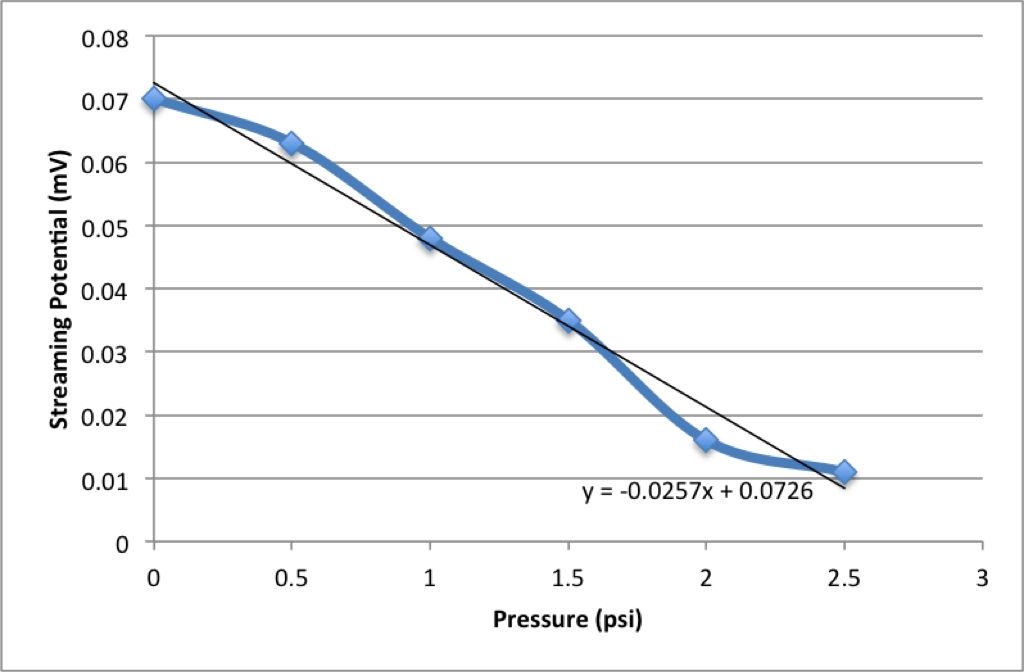
The data isn’t great – we expect a more linear relationship. Also, when I tried repeating the collection of data by resetting the pressure to zero and working back up, the streaming potential had shifted closer to zero volts. So we are still getting a drifting potential. That said, at least we’re seeing a streaming potential.
I talked to Jim on Monday, and he agreed that it was a wetting problem, and suggested that I flush the membrane with methanol before applying the salt solution. Because of the complexity of using a wash (and also to make it easier to load my device) I added some valves and syringes to the setup so that it can be more easily loaded. I also switched to using circular rubber gaskets, because their weight makes loading the chips easier:

I also added a function generator and a very narrow tube to the drain of the device so that I could monitor EO pumping:
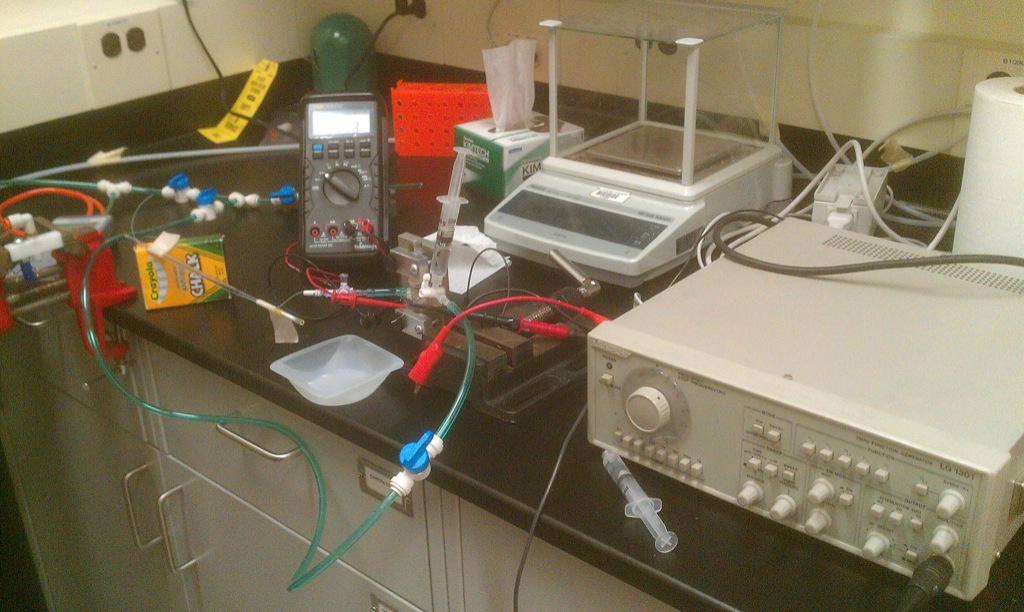
I decided to do one run without a methanol wash just so that I could confirm that it was indeed a wetting problem. I loaded up the chamber with a pnc-Si 5-slot chip and 100 mM KCl solution and saw a zeta potential. Similar to before, I was getting drifting potentials, and the resolution of the voltmeter (a TEK DMM252 multimeter, the same one that Jess used) was not quite precise enough to measure streaming potential. But I repeatedly pressurized the system to 2.5 psi (any higher would risk breaking the chip) then depressurized the system. Consistently, the streaming potential would drop by about 0.2 mV when pressurized, then rise by 0.1 mV when depressurized. The voltmeter we use has a resolution of 0.1 mV, and we’d need another decimal of precision to measure these streaming potentials. Jirachai uses an Agilent 34401a with 6.5 digits of precision (home.agilent.com,  675).
675).
I’m not sure why the potentials are drifting so wildly. Zydney and Jess both saw the absolute value of the streaming potential change over multiple runs, but the slope of the pressure vs. streaming potential relationship was constant. Zydney blamed the electrodes gradually breaking down in solution, and I’m tempted to blame the electrodes in my setup as well. Jirachai told me that he ‘seasons’ his painted electrodes by immersing them in KCl and applying a square function of +/- 1 volt across them, which could explain why sometimes my setup only worked after an hour of being immersed.
Finally, I tried to generate an electroosmotic flow by applying +/- 1 V. This did not work. Jirachai uses a custom circuit (pictured in one of Jess’s posts) to apply a constant current, so this may be the problem.
PLANS:
1. Get a better voltmeter
2. Repeat the experiment with a methanol wash
3. Repeat the experiment with bleach-coated electrodes and electrochemically plated electrodes
NRG discussion: Soaking electrodes in Clorox to chlorinate it. Might be better than the ink.
If you are not sure whether the problem is membrane wetting or the electrodes, is there a reason that you cannot just run without the membrane to simplify? With no membrane, if the voltage is not rock solid, you can play with the electrodes until they are working well, then re-introduce the membrane….