Aliens, Voodoo, or Magic? How does DNA Extraction via Silica Adsorption Actually Work?
The first DNA extraction was done over 150 years ago in 18691. Since then, the process has been refined and expanded to include multiple physical and or chemical methods. For the waste water epidemiology project (described here), we will be focusing on DNA extraction via silica adsorption without the use of chaotropic agents. The mechanism with which this occurs is not completely understood, but there are a few ideas of how binding could occur. One such idea will be described and its application to our experiments will be expanded upon below.
Adsorption Mechanism
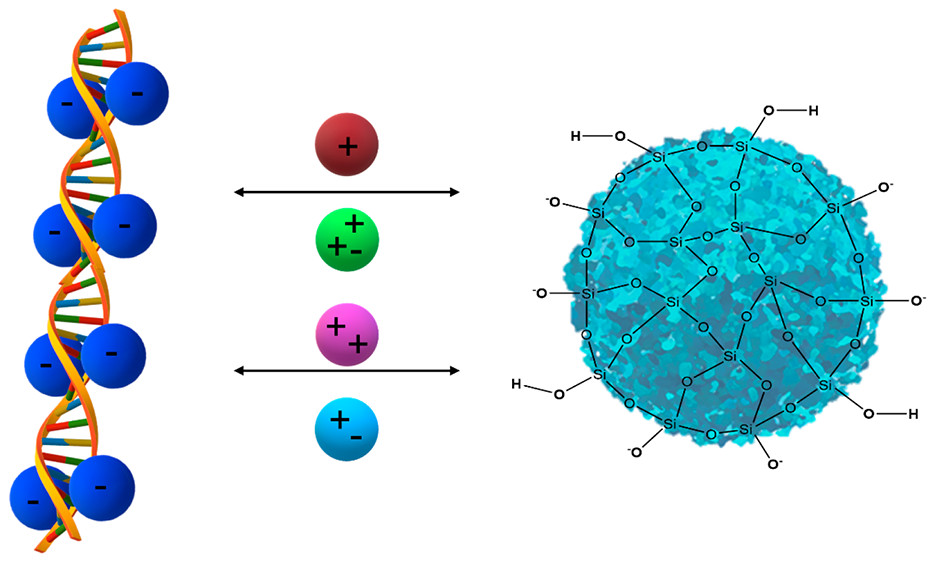
DNA cannot bind to silica on its own due to electrostatic repulsion. Both DNA and silica are negatively charged and repel each other, therefore a binding agent must be present in order for the two to bind. An explanation of the binding of DNA and silica given by a recent publication in Langmuir states the requirement of a binding agent which is positively charged, has a high adsorption affinity for silica and forms complexes with DNA2. In the presence of DNA, the positively charged binding agent forms a complex with DNA. After formation, the complex has the ability to bind to negatively charged oxygen sites on the silica via its newly formed, positively charged binding agent component. Altogether, the theory is that DNA binds to silica via intermolecular forces which are facilitated by a positively charged binding agent. This is illustrated in Figure 1 below.
Experiment Parallels
In our protocol, cells are lysed by the addition of a concentrated NaCl solution, TE buffer is added to stabilize genomic material, and 70% ethanol is added to minimize DNA solubility. After mixing, silica beads are added to the solution which bind DNA complexes formed by the dissolved NaCl. More specifically, DNA molecules which have formed complexes with sodium ions (Na+) are able to bind to the surface of silicon at their negatively charged oxygen sites (O–). The bound DNA is cleaned using various washing buffers containing lower concentrations of NaCl, ethanol, TRIS buffer, and water. The DNA-Na+-silica complex disassembles and the DNA is released after rinsing with just water due its lack of charged ions.
Conclusion
While the method with which DNA binds to silica is not well understood, the one presented here seems plausible and is supported by simulated and experimental data. While we move forward and our working knowledge changes as we gather more data, this will provide a foundation from which we can work from.
Resources
- Gupta N. (2019). DNA Extraction and Polymerase Chain Reaction. Journal of cytology, 36(2), 116–117. https://doi.org/10.4103/JOC.JOC_110_18
NLM - Bag, Rauwolf, S., Schwaminger, S. P., Wenzel, W., & Berensmeier, S. (2021). DNA Binding to the Silica: Cooperative Adsorption in Action. Langmuir, 37(19), 5902–5908. https://doi.org/10.1021/acs.langmuir.1c00381