Daily In-Situ Permeability using mouse CMECs
Introduction
In the Glading Lab we study Cerebral Cavernous Malformations (CCMs). In CCMs, brain capillaries develop enlarged lumens and a disrupted blood-brain barrier. The presence of a mutation in KRIT1 causes loss of KRIT1 protein function in the endothelial cells. KRIT 1 plays a role in the integrity of endothelial junctions, therefore the lack of KRIT1 leads to a leaky endothelial barrier.
The μSiM devices with the NPN membranes have been used to study mouse cerebral microvascular endothelial cells (mouse CMECs) isolated from KRIT1 knock-out (KO) and KRIT1 wildtype (WT) mice.
The aim of the permeability studies is to demonstrate that the leaky endothelial barriers from the KRIT1-KO cells can be modeled in vitro in the device and compared to cells from animals with WT-KRIT1.
Methods
Due to the varying growth rates of KRIT-KO cells compared to KRIT-WT cells, KO cells were seeded at half the density (15,000 cells/device or 40,500 cells/cm²) of the WT cells (30,000/device or 81,000 cells/cm²).
The CMECs were seeded on the devices, trench down, 3 days after isolation from the mice. The in situ permeability assay was conducted daily on the Dragonfly Confocal beginning on Day 2 after seeding the cells on the devices using lucifer yellow dye.
After the assay, the top and bottom wells were rinsed 3X with 100uL of media to remove any residual lucifer yellow dye. It was confirmed that there was no fluorescence signal detected before the assay was repeated the following day.
Results
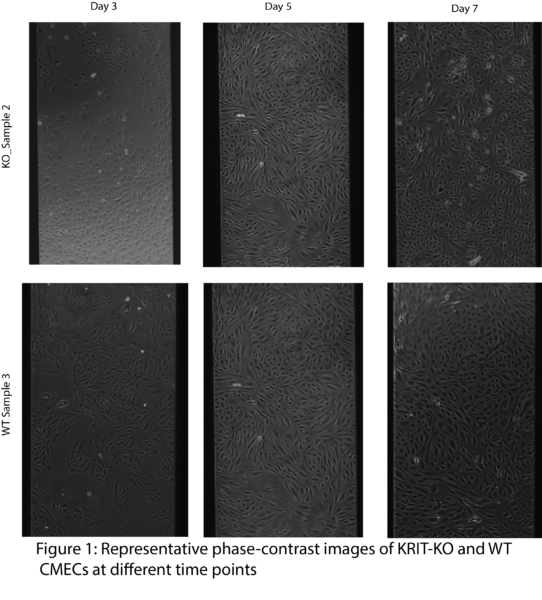
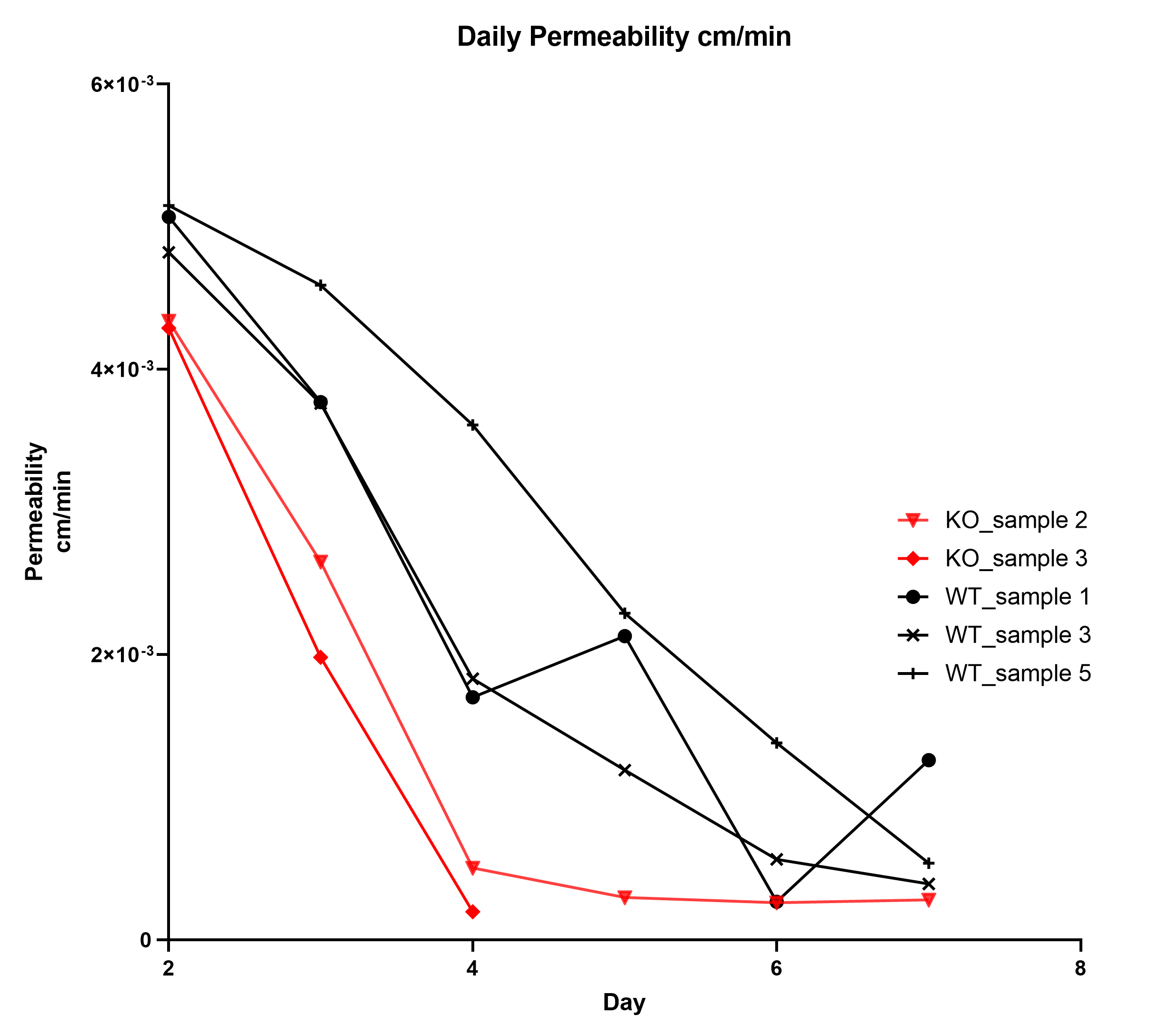


Permeability measurements were able to be collected daily without disturbances to the cell monolayer. This allows us to determine the experimental control conditions in which the CMECs have developed mature junctions or a stabilized barrier/permeability value.
Future Directions
- Determine the cell density from phase images at the different time points and assess if this is correlated to the permeability
- Stain the devices for junctional proteins to determine the maturity of the cell barrier in the monolayers
- Add flow to the devices to determine the effect on permeability
