The effect of pump rate and channel height on Urea clearance (COMSOL modeling)
Comsol modeling was done to find the ideal channel height and volumetric flow rate. What is clear from the simulation is that ever increasing flow rates in the model lead to increased clearance and decreasing channel heights give some benefit but not on the order previously expected. In addition, (Depner 2005) shows that increasing the flow rate improves the clearance only up to a point, with this ‘point’ being dependent on the device. There is a formula for the maximum clearance for counter flow systems but not for our in-beaker set up. Testing at higher flow rates with the stronger membranes will let us explore this. We will also need to understand the minimum and maximum flow rates for the device. The minimum rate will be determined from the clearance K and the maximum treatment time, remember KT/V > 1.2 for 75% URR.
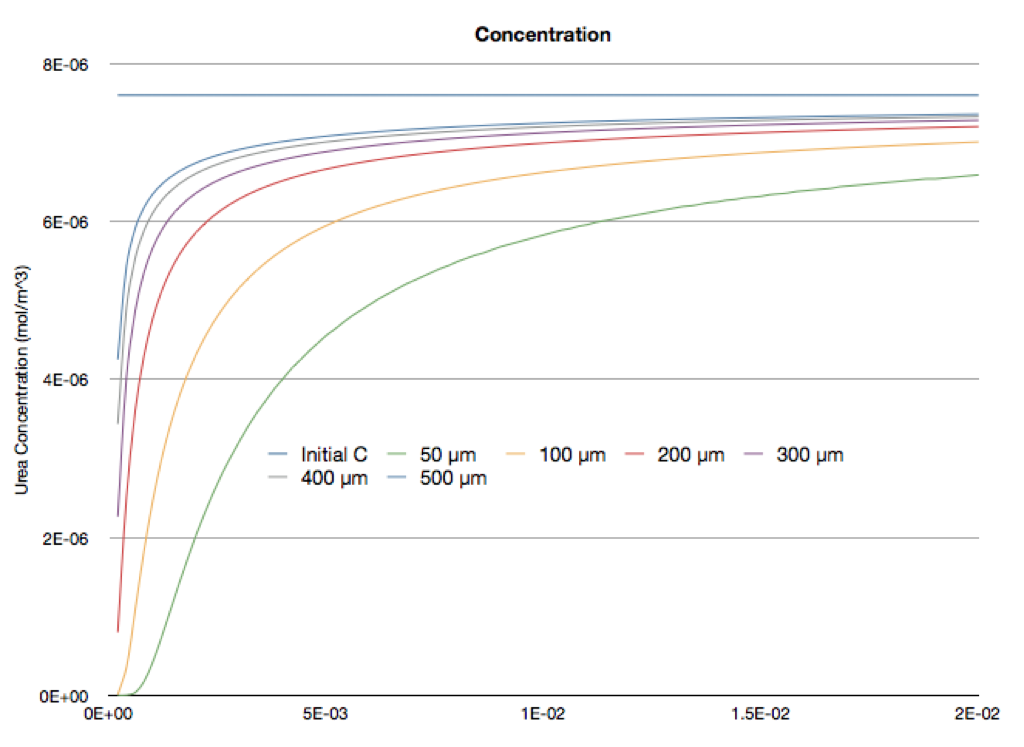
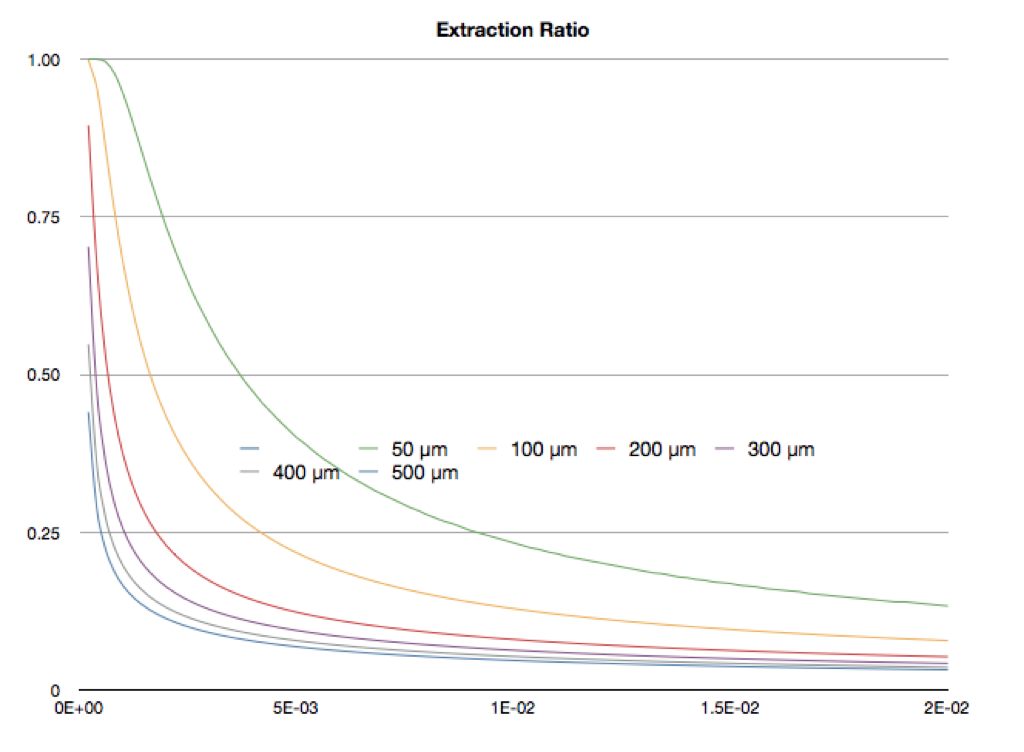
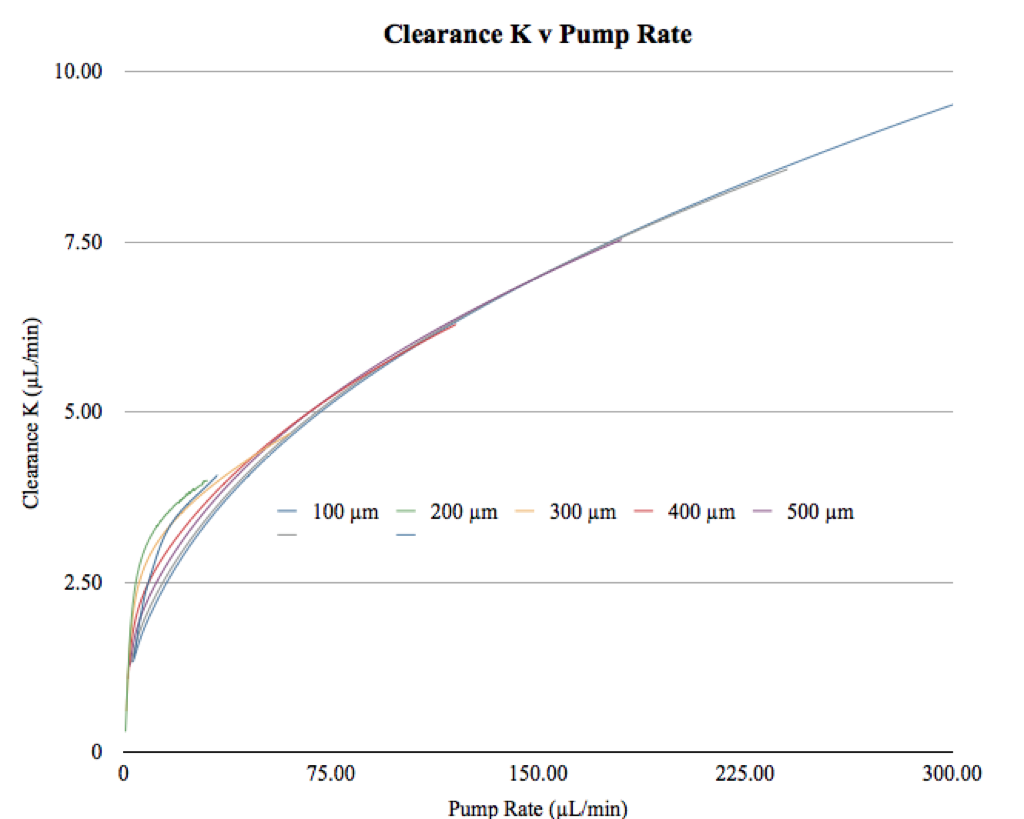
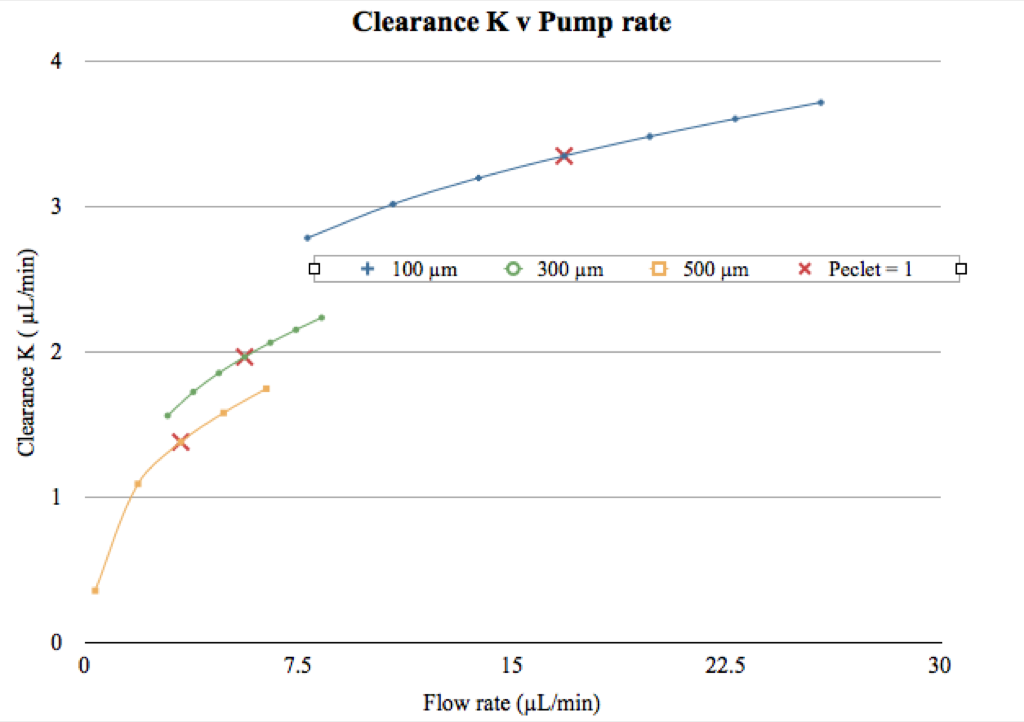
E.G. For the 100-µm channels (500 µm x 10 cm) at ~35 µL/min blood flow rate we get 4 µL/min of clearance. K = 4 µL/min per, V = 5 L, so to get KT/V = 1.2 requires T = 1.2V/K = 1.2*5/4×10-6 = 1.5×10⁶ min for a single channel. For 20 channels per chip, 80 µL/min, and 100 chips per device, 8000 µL/min. that gives us 750 min of dialysis, 12.5 hours. We still need to do better. It is still not certain that we can pump at that rate, 35 µL/min, through the channels, which would be a total rate of 70 mL/min for a total KTot of 8 mL/min.
References:
Depner, T. A. (2005) ‘Hemodialysis adequacy: Basic essentials and practical points for the nephrologist in training’, Hemodialysis International, 9(3), 241-254.
What is to prevent us from pumping at 35 ul/min through a channel? What pressure is required?
I think we need to plan on lengthening the membranes, adding channels, and flowing faster. I would like to get this down to 20 chips and 5-6 hours.
Also if the device can operate at blood pressure 2-3 PSI, we can avoid adding a pump.