Pore morphology is RTP time dependent
During the last production run, we experimented with varying the RTP annealing time (1 min vs. 5 min) at three different RTP temperatures (1050 C, 1100 C, 1150 C) in a 30 nm thick membrane. Below are the TEM micrographs with corresponding histograms and average pore diameter/porosity plot.
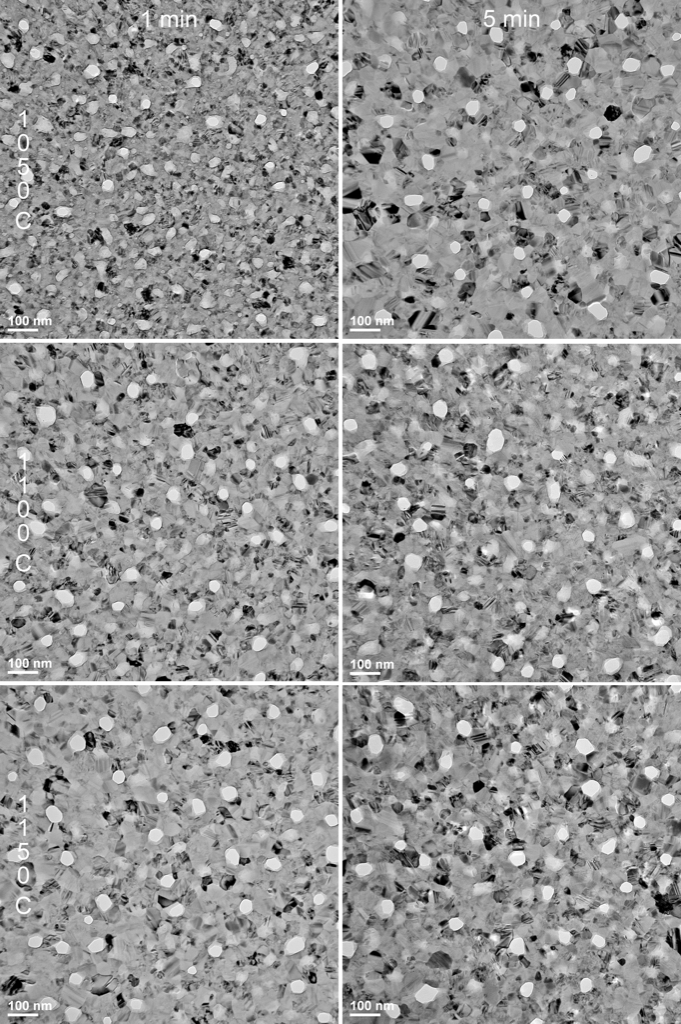
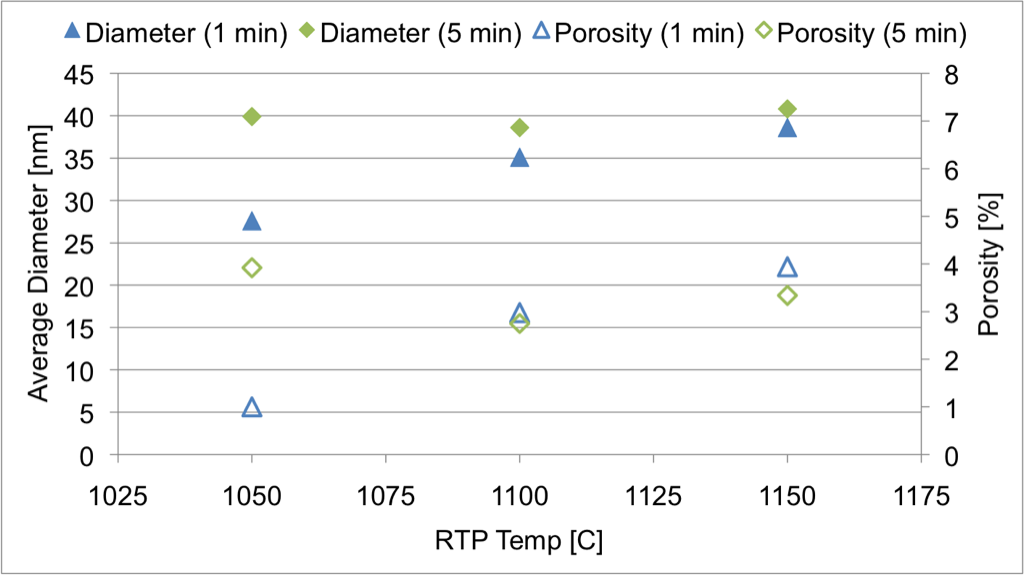
Of note is the 1050 C anneal for 1 min and 5 min. We can significantly increase the pore size by annealing longer at 1050 C. The physical basis for this is that at 1050 C, annealing for 1 min does not fully crystallize the film so there is still a certain amount of amorphous material. By increasing the thermal budget (product of anneal temp and time) we completely convert the amorphous material to nano-crystalline. You can see that the background texture is much different comparing the 1050 C 1 min/5 min film. The 5 min membrane has larger crystals and many more stacking faults/twins (linear features) indicative of a fully crystallized material. The difference is less drastic at 1100 C and 1150 C because the thermal budget is sufficiently high such that we completely crystallize the film at 1 min.
The next experiment I would like to run is to anneal at 1050 C at finer time points e.g. 1 min, 2 min, 3 min, etc…
Remind me what SOP has been. 1 min? 5 min?
Does this mean that we have a simple kinetic process that is a function of only the ‘thermal budget?’ So the same material can be made with short times and high temp or long times and low temp because they reach the same point on a imagined crystalization vs. thermal budget curve?
Our baseline process has been to anneal for 1 min. Yes, the idea is that within a certain temperature range we can play around with the thermal budget to tweak the pores. The curves are bounded on the low temp side by the threshold for nucleation of crystals and on the high side by complete crystallization. Of course other factors like the ramp rate will affect morphology, too.