ALD on pnc-Si
Today I made my first attempt at depositing aluminum oxide on pnc-Si using URInc’s Cambridge Nanotech’s Savannah 200 atomic layer deposition tool. Ritala and Leskela give a nice primer on ALD theory.
ALD relies on layer-by-layer growth of film by reacting a precursor with the surface of interest. In this particular system, we react trimethylaluminum (TMA) with a hydroxlyated silicon surface (formed by water vapor). Each cycle of TMA and H2O puts down approximately 1.1 Å of Al2O3. In theory, this tool will allow us to very precisely control the size of pores while coating all surfaces with a hydrophilic material. Since this is a epitaxial process, the resulting coverage should be highly conformal, as well.
Below are TEM micrographs of an untreated and treated membrane. I was shooting for 5 nm of Al2O3 (rate based on planar coverage), thus I was expecting a 10 nm pore size reduction.
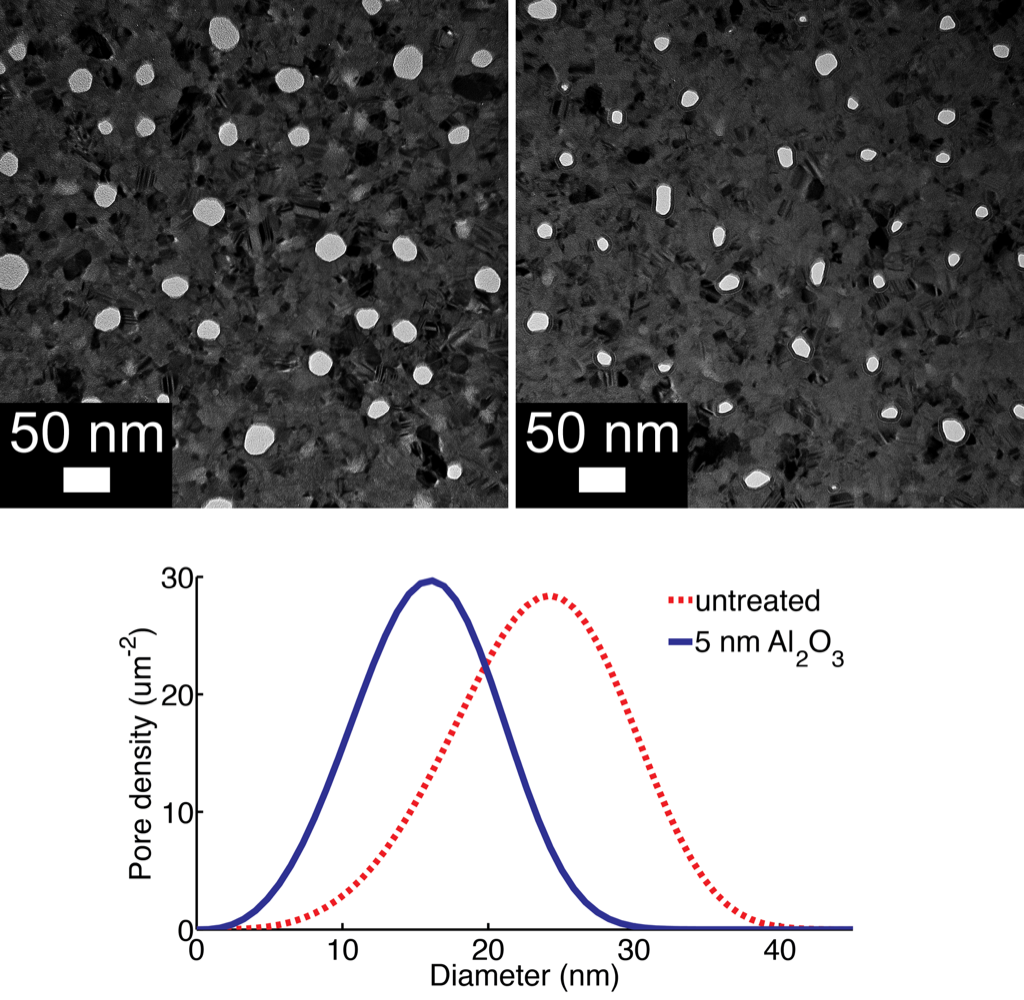
From the image and histogram, it looks like the recipe was successful in creating a uniform coating on the pore walls. Here is a higher res image.
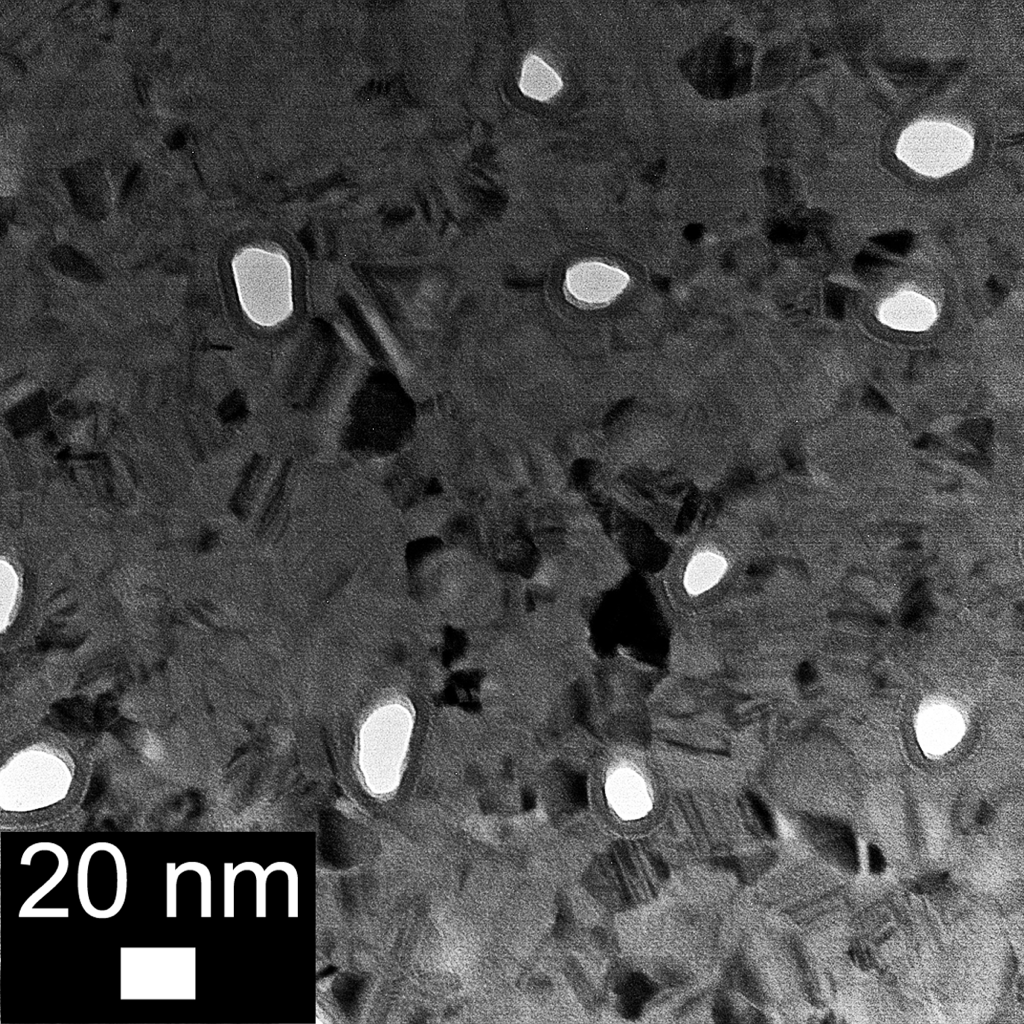
Close inspection of the pores shows that the walls are not perfectly straight, but have a slight taper. From these initial results, I think ALD will be a very useful method for pore size control with single nanometer resolution.
Next up are function tests with water permeability and separations.
Very nice. I’m looking forward to seeing if there are any performance enhancements or oddities…