Rhodamine transport in pnc-Si and PET transwells
This is some preliminary data that I put into my F32 postdoc fellowship application. It is a comparison of rhodamine transport through pnc-Si and PET transwells. These studies were done with PBS as the buffer. Sample volume = .1mL, donor volume = .3mL, receiver volume = 1mL, initial [rhodamine] = .5mM. I set the experiments up, took samples every 5 minutes for 2 hours and got the ABS @530nm. I used the little orbital shaker in the lab (so room temperature).
I calculated the umol rhodamine transported and then normalized to active area (n=3):
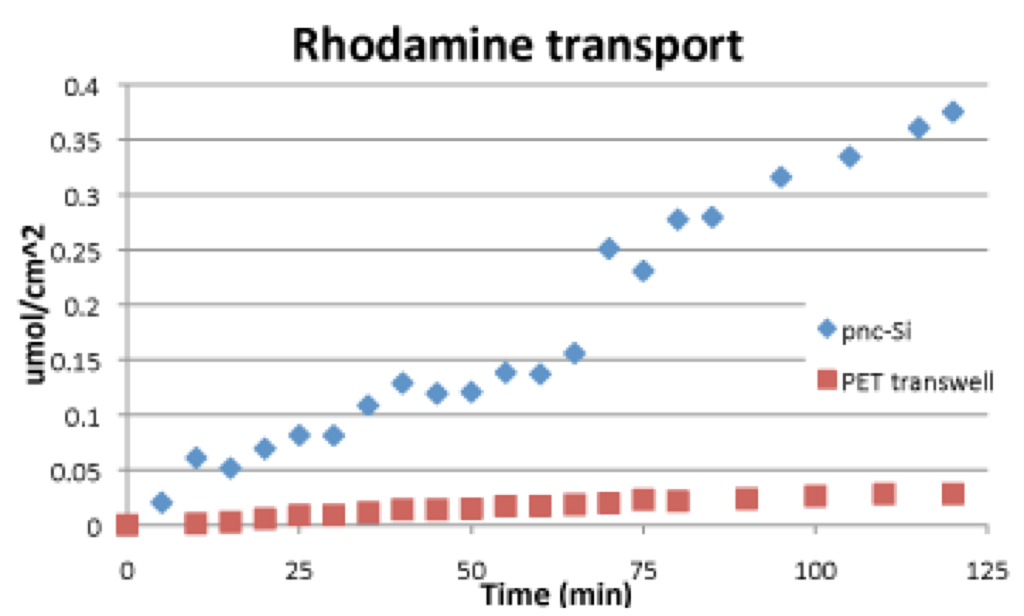
Normalized transport is ~ an order of magnitude better in pnc-Si!
I then followed a data analysis protocol in Hubatsch, et al. (Nature Protocols) for sink conditions in order to calculate the apparent permeability. After correcting for donor and receiver concentration changes during the experiment and doing a linear regression, I got:
Papp(transwell) = 1.6*10^-6 cm/s
Papp(pnc-Si) = 2.22*10^-5 cm/s
The good news is that the pnc-Si is more permeable to this small molecule dye. The bad news is that these values are low for membranes without cells. I’m not sure why this is (temperature of experiment?, not fast enough mixing?, poor detection sensitivity because of absorbance?, large loss since rhodamine is sticky?). I think I will hold off on transport experiments until we get the Tecan, but this is a good set of preliminary data.
What number should we get for membranes without cells?
I remember reading somewhere that Papp should be a couple of orders magnitude lower than what I measured. I’m having trouble finding the reference though. These values are around the same order of magnitude for permeability through membranes with cells. Also, the SECM data for pnc-Si was 10^-2.