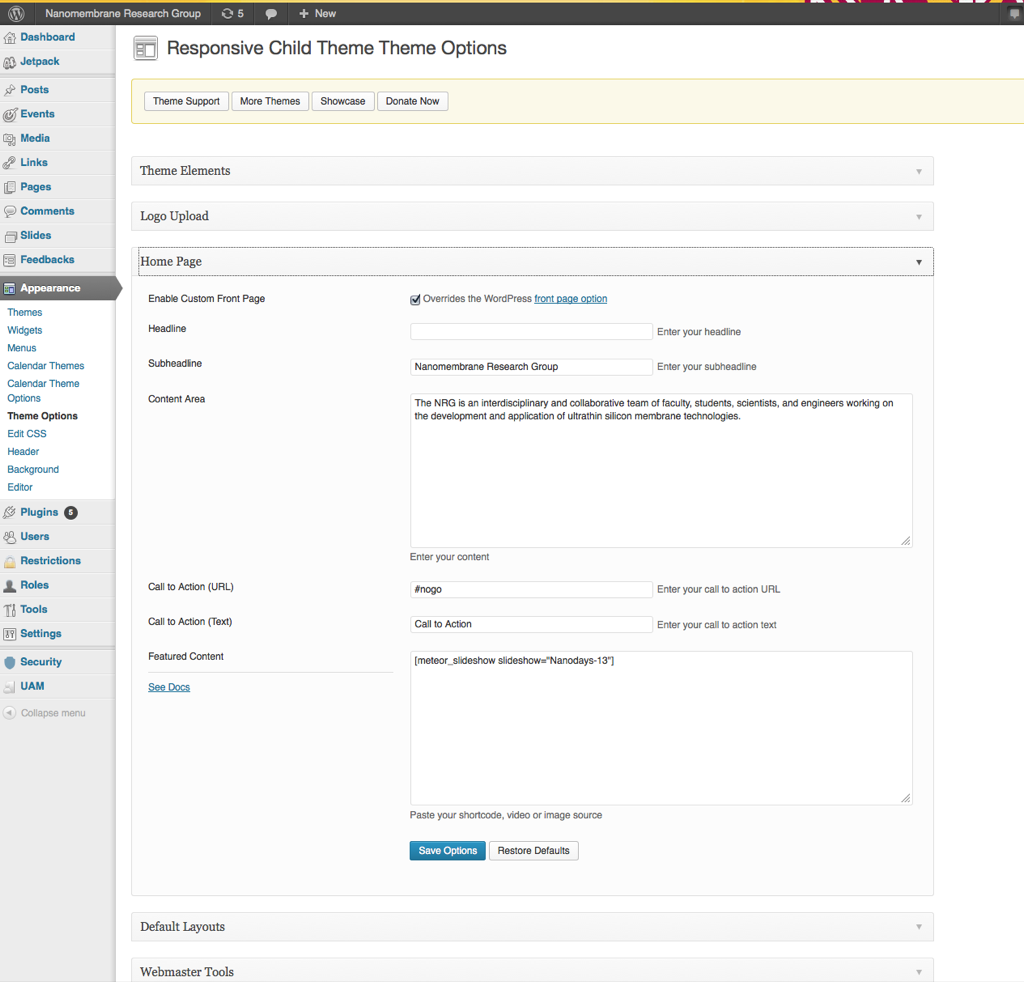
Where to Change the Slide Show
Dave and I characterized the membrane samples using the 4-point probe system at Kodak research Lab. It is NOT the previously discussed micro-4-point probe. The spacing between two probes is about 2mm. We first tested a quarter bare wafer#388 at five points (see the diagram below). The average sheet resistance is around 80 ohm/square.sites (1)…
My recent work has focused on wetting the inner portion of an attocavity with isobaric cooling to create condensation. We are trying to attack the problem of wetting through the nanomembrane without breaking the membrane. A perfectly dry membrane will always rupture before the critical radius for wetting the backside of the membrane is achieved. To…
The goal of the experiment was to use a fluorescent dye to label live cells in order to measure proliferation over several days. To avoid cell toxicity, the intensity of the fluorescence was reduced to ~1.5%. Human umbilical vein endothelial cells (HUVECs) were seeded in a a 96-well plate at a density of 5000 cells…
As a proof-of-principle, Henry and I have been working on a microfluidic device for flowing blood cells/particles across cultured cells on pnc-Si. More on why this is important later. We’ve come up with a prototype and I’ve been testing it out. I will include schematics later but here are the first couple of movies I’ve…
What I had in my two previous posts described as permeability graphs were in fact total volume passed/ total time passed graphs: What I thought I saw was that cake layer formation was dependent on the filter geometry. There is some justification for such a dependence in the literature – These folks found that spacer…
Because of the failure of bonding the electrode to the top gasket in my last design, I have been trying to make improvements to my fabrication to make the electrode/gasket surface more planar. Things I have tried: 1. Pressure during curing. I placed a 500g weight on top of a microscope slide on top of…