Electro-osmosis update
Here’s some data from my electrophoretic trials with polymer membranes.
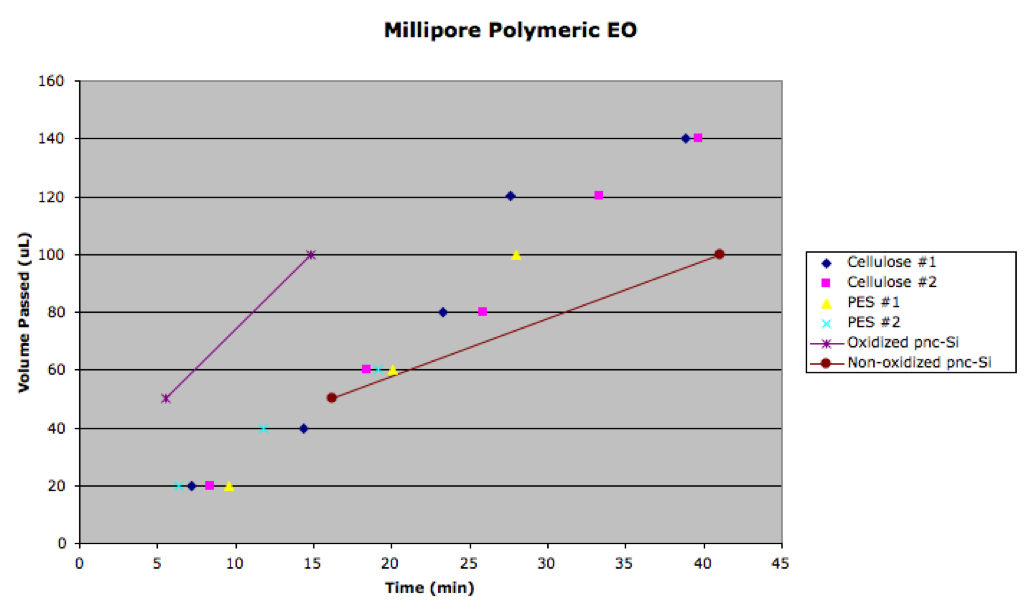
On this chart, both PES and Cellulose fall on the same line. In my last post I said that PES membranes didn’t seem to pass water, although I found that I was just setting up air bubbles much easier in this system because of the hydrophobic nature of PES. Our non-oxidized membranes are a bit slower than the polymeric membranes, but our oxidized membranes are actually much faster. I’ll try to get some more long term data using out membranes, and I will also try to find some membranes with different active areas.
Is the flow in polymer membranes known/published to be electroosmosis? It seems odd that PES and cellulose would be so similar in EO flow rate, given how different their structure is. It seems like this would be an argument against EO as the cause of flow in these membranes…
Well Zidney’s group seems to think it’s electroosmosis. And of course there’s a lot of error in measuring how the rate liquid transfer so maybe they’re more distinct than this.
I suppose the differences could be in the error. However, if PES is hydrophobic and cellulose hydrophilic, there should be huge differences in the surface charge, and therefore EO flow rates. Any way you could test a track-etched membrane to see if it also shows the same flow rate?