Fibroblast adhesion study using controls
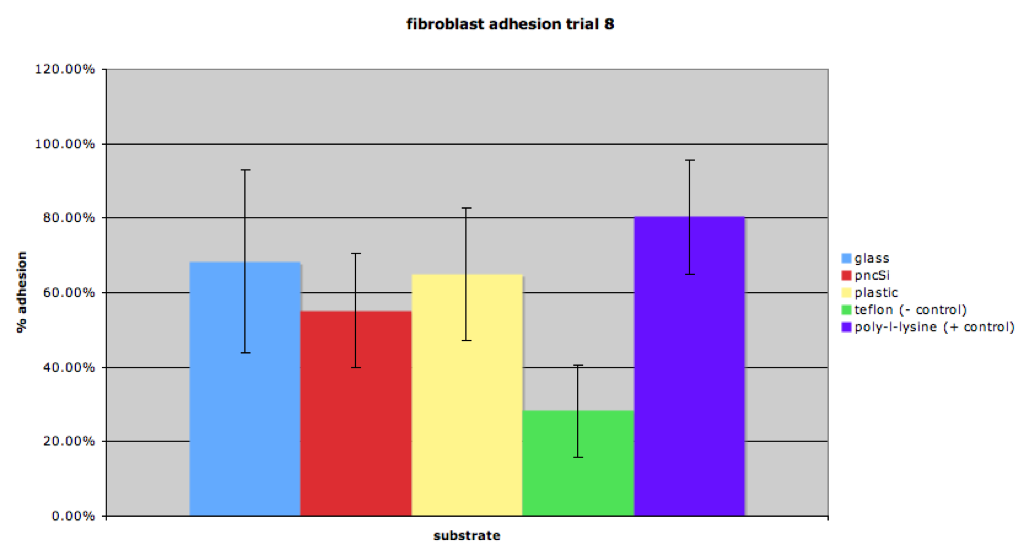
Fibroblast adhesion experiment was done using poly-lysine coated plastic and teflon coverslips as positive and negative controls repectively. Poly-lysine is a polypeptide that gives the cells a sticky surface to adhere to. Teflon coverslips are used as negative control because they do not promote cell adhesion. Difference in morphology of cells could also be seen between teflon and other substrates. Fibroblasts could spread and adhere properly to the substrates (glass, plastic, pncSi, polylysine) unlike teflon in which the cells appeared rounded thus improper adhesion.
The results were found to be quite convincing as depicted by the chart above. Few more trials should reduce the standard error of means.
(Adhesion on pncSi was found to be on slightly lower side. This could be attributed to the low density of cells available due to the loss of cells across the membrane slits on the chip. This can be avoided by using solid chips with no membrane slits.)
HUVEC adhesion study is being carried out and similar results are expected.