Membrane delamination experiments
I spent some time testing the various steps of the transfer and wetting process to see if I could find the cause of membrane delamination that I saw earlier. The result seems to be that time is the main culprit. Here is the membrane just after transfer (dry between the membranes initially, steam after transfer to flatten the NPN):

The NPN fractured badly but the piece on top of the free-standing membrane is intact and in good contact, as far as I can tell. Unfortunately this is a monochrome CCD camera on the higher-end microscope, so no color images are possible at this stage.
Initial wetting went smoothly after steaming to increase the hydrophilicity of the membrane. Something of note, however, is that just because the NPN shows a color change does not mean it is well-laminated: in the sequence of images following, pay attention to the capillaries in the NPN to the right of the membrane. Immediately after steaming, the capillary swells up, obviously full of water that prefers to wick between the membranes over staying on top of the hydrophobic surface. As the steam evaporates, the capillaries shrink and lose their water content – but note that it appears at the end as though it is well-laminated except in the center (color change) but in reality there is a small area around it that is disconnected. This process is reproducible as many times as I want. The punchline is that when there is water between the membranes, it seems to prevent adhesion even if they appear to be in good contact. This is possibly the cause of my earlier failure: since I used steam between the membranes, I probably had a poor seal.
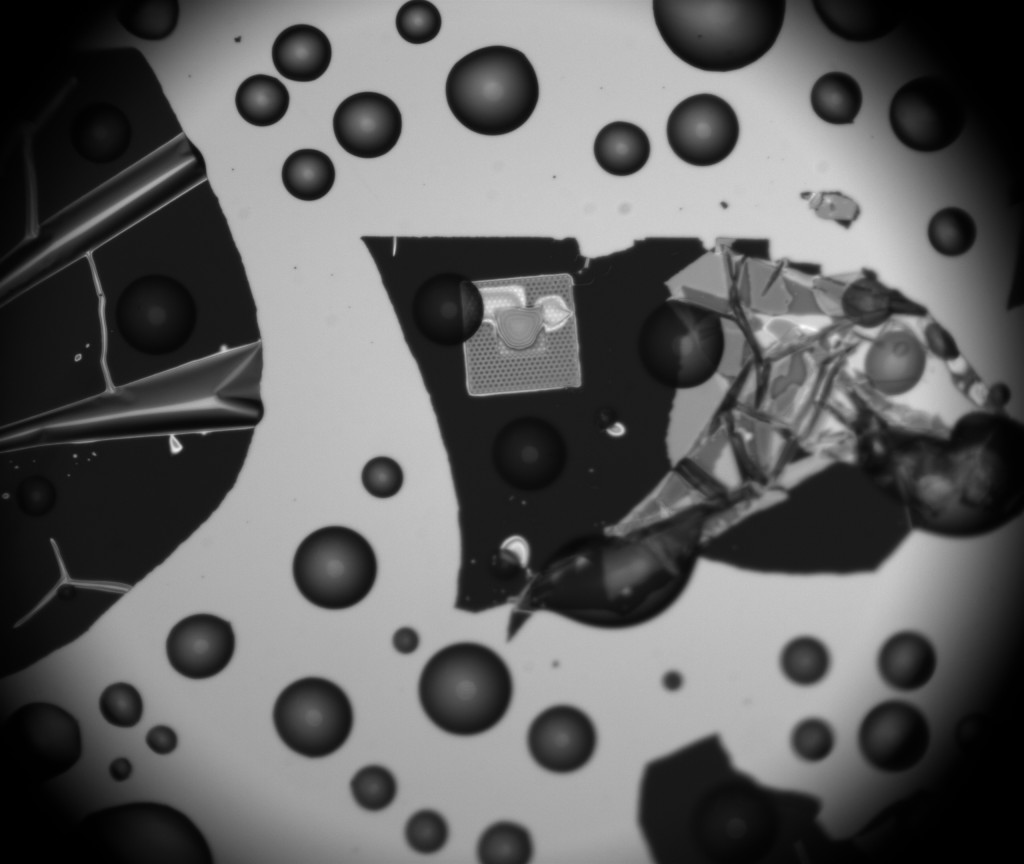
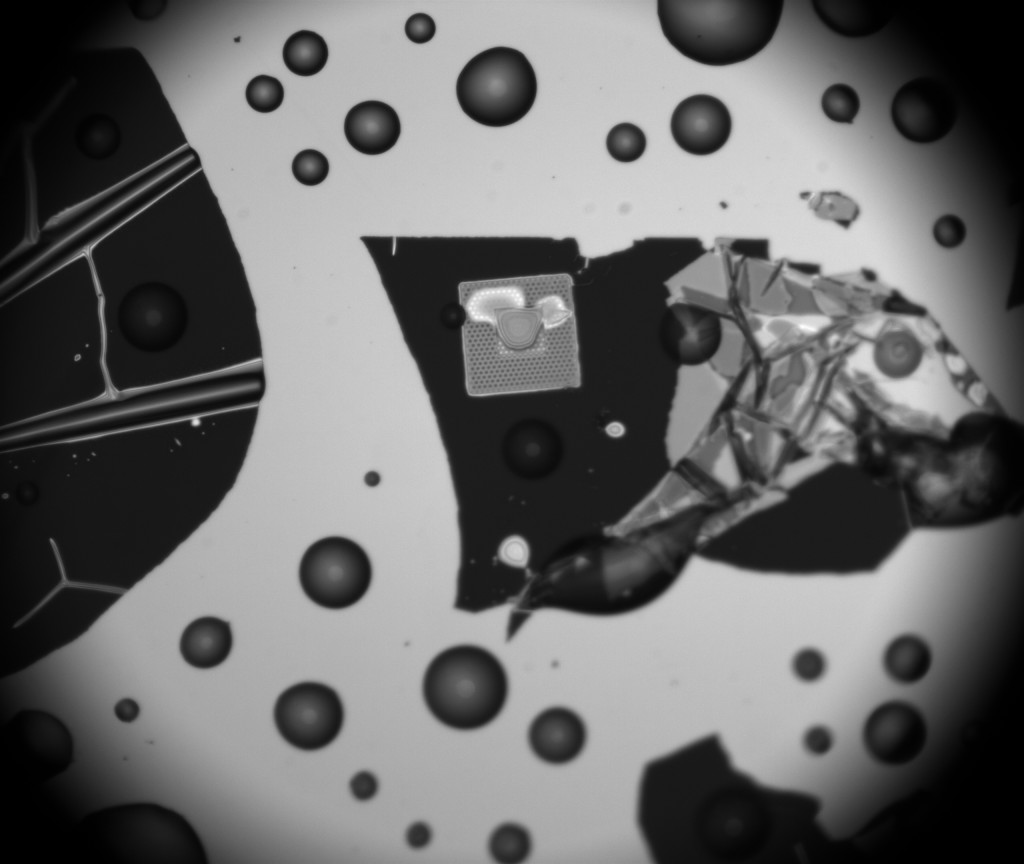

Note in the final image you can see the holes emptying of water concent as well.
After this, I wetted the membrane in 3.6M LiCl. There are no obvious signs of osmotic pressure effects, though there is some rippling of the membrane near the oxide posts. I am wondering if the water is causing it to lift off from the posts and balloon outward in that spot. It’s hard to tell without an angled view, but it seems as though the NPN does not seal to the oxide there as well as it does to the nitride around it. What do you think? (Note that this image is flipped 180 degrees from the last series).
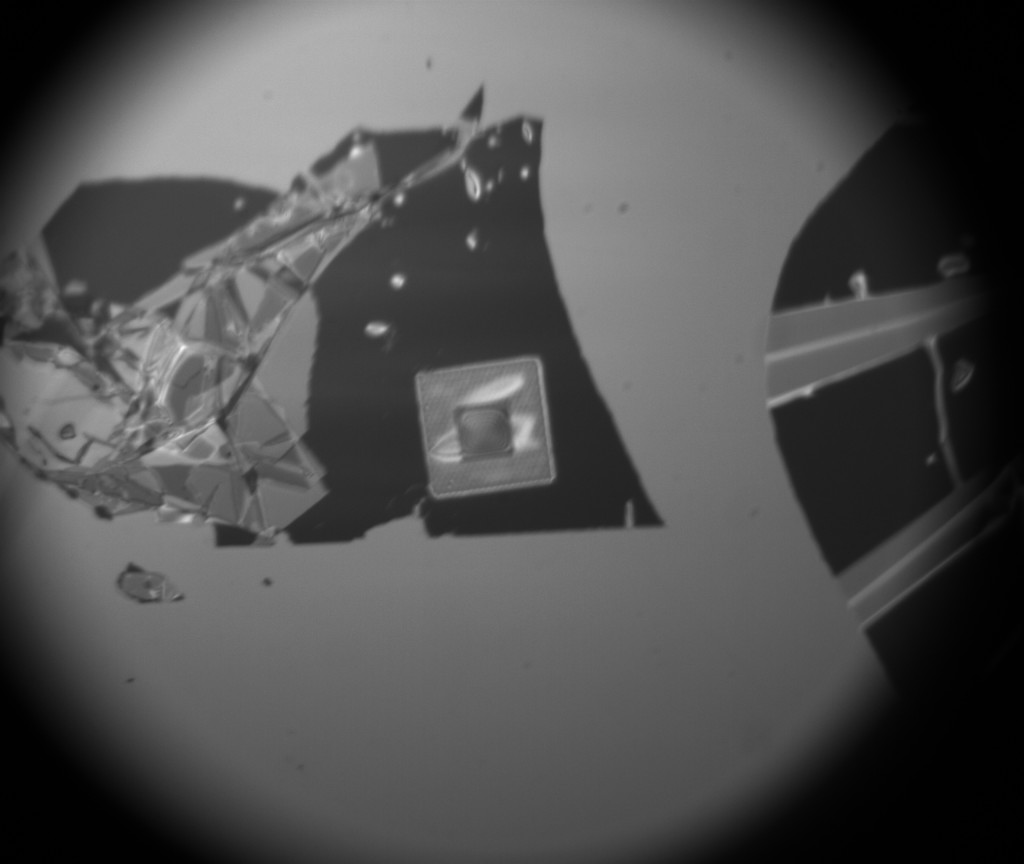
However, osmotic pressure didn’t seem to cause any damage, nor did flushing the flow cell with LiCl, so no nasty surprises there.
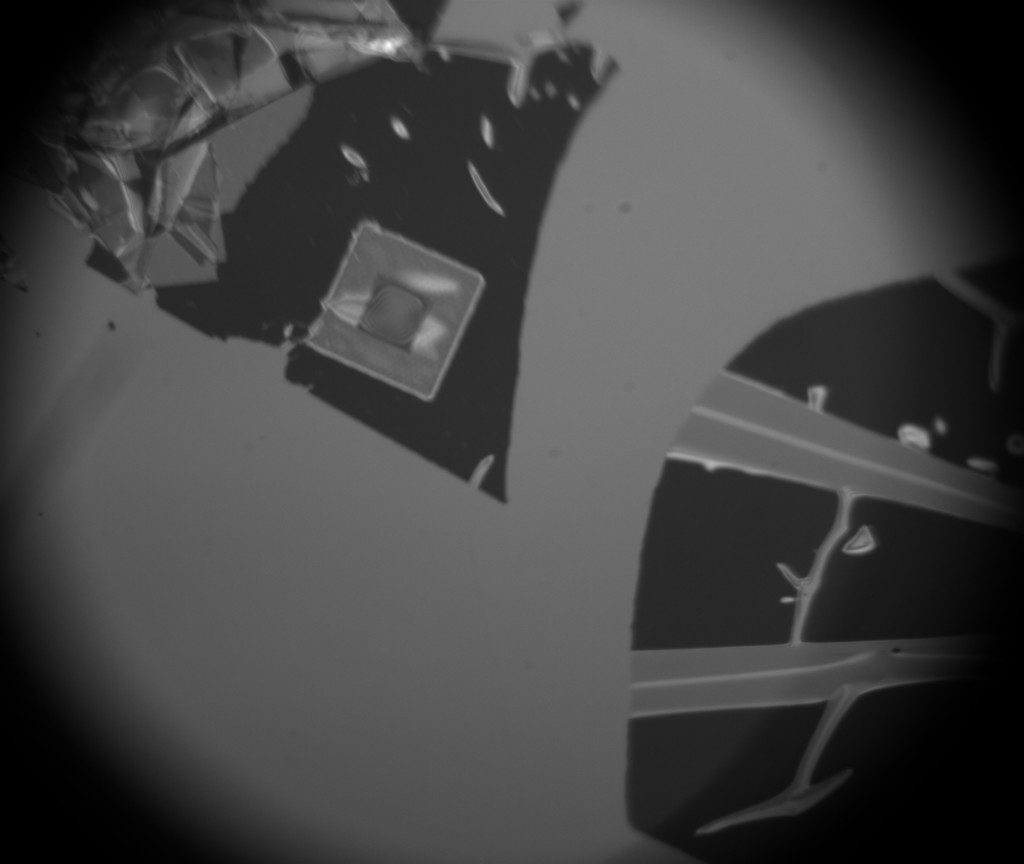
I left it in liquid overnight. In the morning, most of the NPN had delaminated again:
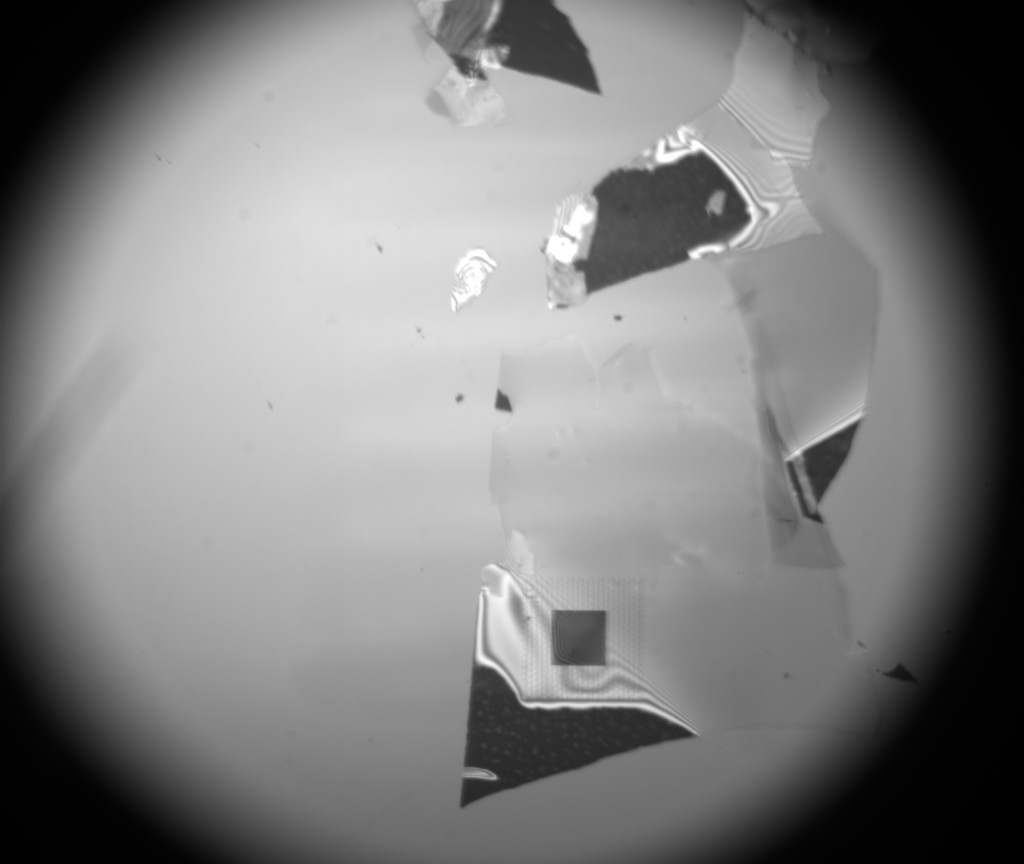
I’m fairly sure the NPN is still there, because you can see a faint outline of it (annotated below with a blue outline), but it is clearly no longer in contact with the substrate. There is a complication here, which is that the flow cell apparently has some leaks and the side with the NPN was partially dried out overnight despite being sealed in with liquid, but together with the results above with the capillary action in steam treatment it suggests a picture whereby water prefers to creep slowly between the membranes, displacing the NPN over time. This is something that might be more easily studied in your flow cells, so let me know if a long term experiment in high salt in the flow cell is feasible to test this.
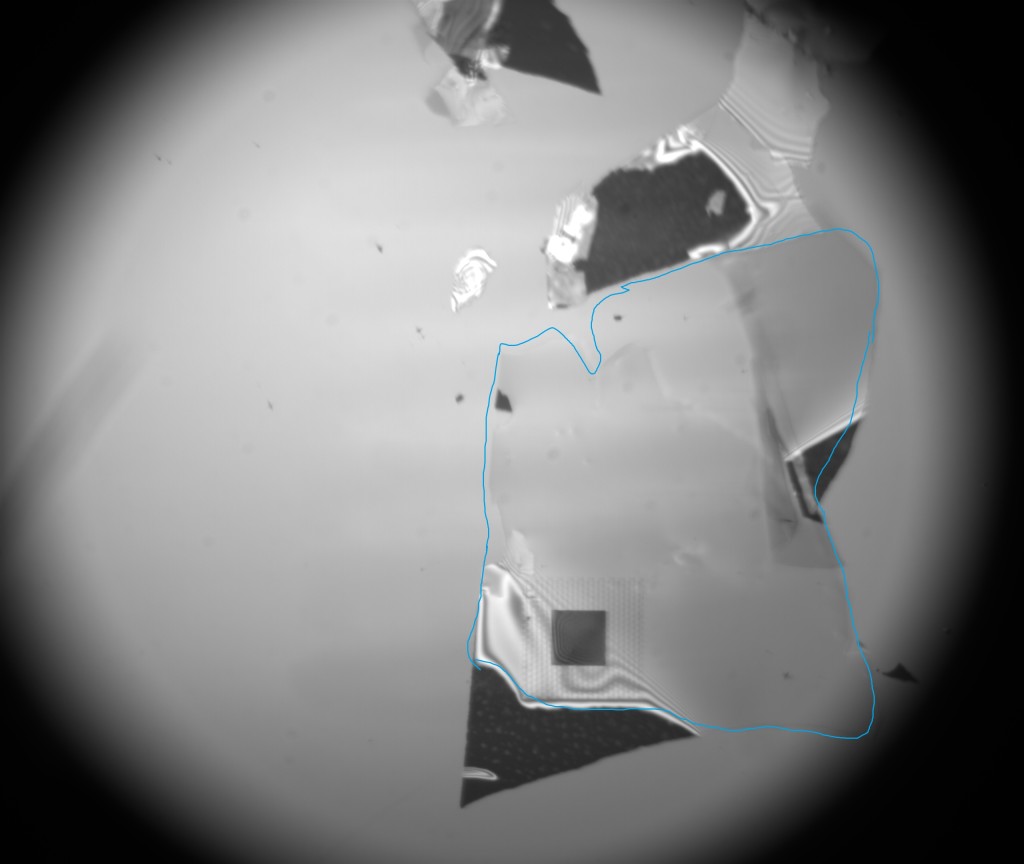
For the time being, I will endeavor to do my experiments quickly enough that this effect does not have time to ruin my results.
Tucker is working on a post that (I think) will show that the membrane can be damaged when an air/dry interface moves over it. So the damage might have been caused by drying in your case.
Similar to your thinking, we believe that water is staying under the membranes for a while when we dry it. That is why it re-wets so readily. The membrane is ‘floating’ on a small layer of water but maintains some affinity for the surface. This part is currently mysterious to me but SiN is much more dense than water and the structure is large enough that its weight will help keep it down. As long as we can keep the structure from moving, I think the floating membrane will work as good as a sealed one for a pre-filter application. Still we are experimenting with UV/ozone bonding to the oxide to prevent movement and create a seal.
I see Tucker just got his post up.