Membrane Conditions and Transport
Last week, I ran a few experiments to see how certain membrane conditions affected the transport of fluoroscein.
The first experiment presented here contained three sepcons: one with 3 pinholes, one with only 1 intact slit, and another without slits to use for the background. The controls were HBSS and fluoroscein.
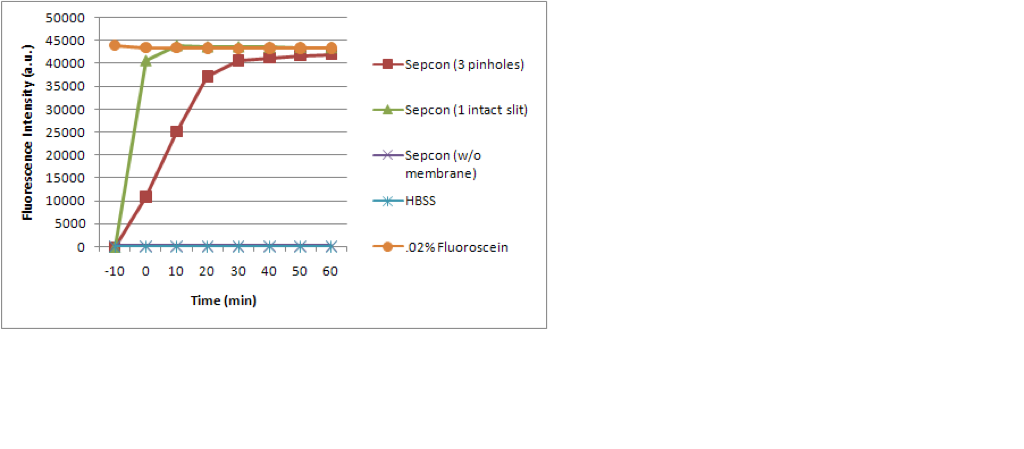
The sepcon with 1 intact slit readily approached the fluorscein control and fluoresced as much as the control within 10 minutes indicating the obvious: 1 intact slit is useless in transport. The sepcon that contained the membrane with 3 pinholes approached the fluorscein control quickly as well and is drastically different from an intact membrane as can be seen below.
The second experiment contained three sepcons: one where the membrane was wrinkled, one with 1 pinhole. and another without slits to again use for the background. The controls were HBSS and fluoroscein.
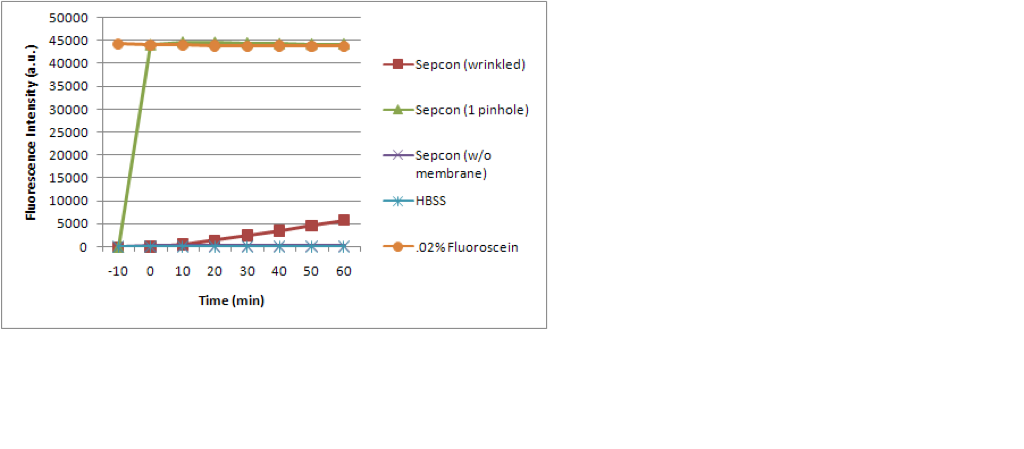
The sepcon with one pinhole readily approached the fluoroscein control: the membrane broke. The sepcon that contained the wrinkled membrane followed the same pattern as an unwrinkled intact membrane as can be seen in Barrett’s post showing that a wrinkled membrane affects transport little to none.
Permeability coefficients coming soon!
Is the red curve in the bottom graph pnc-Si with 1 pinhole? Where is the curve for the intact but wrinkled pnc-Si Sepcon? I think there is something mislabelled or missing from the graph, or I’m totally reading it incorrectly.
Perhaps you could also comment on the size of the pinhole? It seems unlikely that a single tiny pinhole in the corner of one membrane could enable so much transport, unless there is some type of forced flow in addition to pure diffusion. Theoretically, how far should fluoroscein diffuse in 10 minutes, based on the diffusion constant? Thanks..