5nm gold separations
I set up separations of 5nm Au nanoparticles in both H2O and KCl in a new system. The stir cell isn’t always reliable for separations due to leaking and contaminating (?) particles from the plastic. To perform these separations, I added 20ul of sample to a sepcon and wetted the backside of the sepcon with either H20 or 10mM KCl. I tried both diH2O and 10mM KCl in these separations. Intact membranes from SC 073 were used.
Absorbance results:
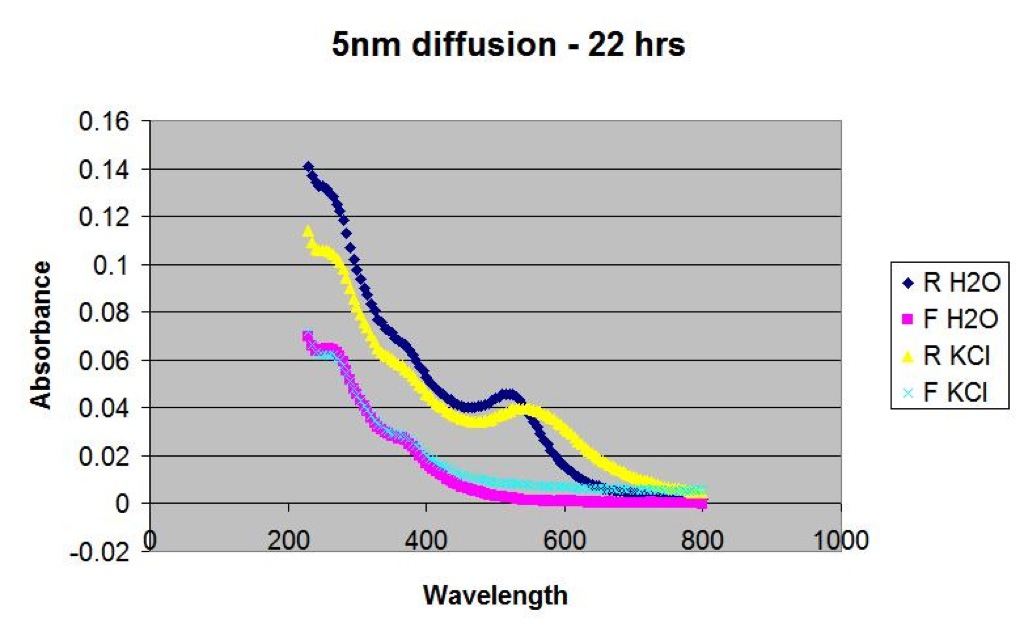
Both filtrates (pink and cyan) show a diluted spectrum similar to the retentate but missing the 525nm peak, so it may be possible that gold is passing in both H20 and 10mM KCl. There’s a chance that the lower wavelength stuff is just due to citrate and other contaminants, and I plan to check this out with some very large particles. There’s not too much distinction between the two, so it’d be difficult to assess how the changes in Debye length for the two solutions affect the results. When comparing the two retentates, it looks like there may be some degree of aggregation for the 5nm in 10mM KCl solution. The peak at 525 is shifted and flattened out a little bit.
I went back and tried sizing these samples. The Malvern couldn’t pick up any signal at all in the water sample. However, I did get data from the KCl sample. Here’s the number distribution:
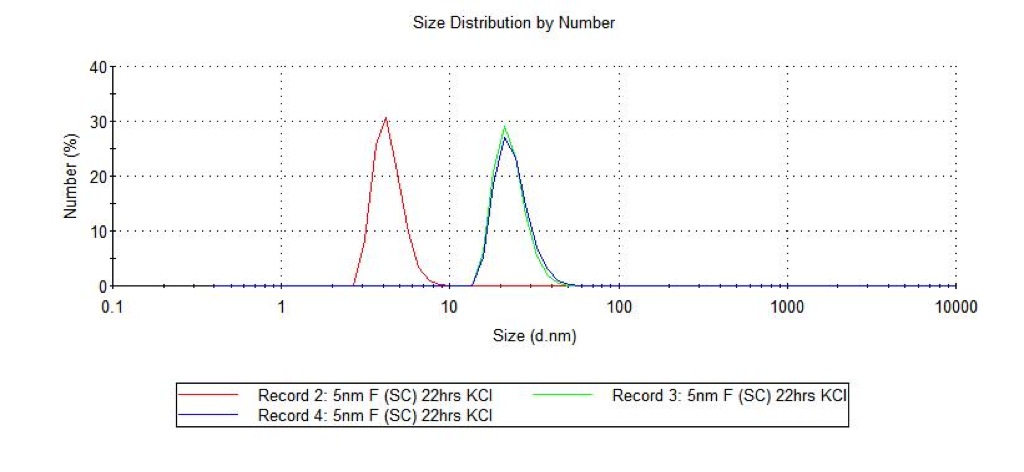
One of the runs is coming out around 5nm and the other two are closer to 20nm. Sometimes the Malvern goofs the size if the solution is too diluted or there are contaminating particles. The fact that there’s actually a signal in the nm range could potentially mean that there were detectable 5nm particles here.