Critical Flux of Ultrathin Silicon Membranes in Tangential Flow Filtration of Protein Solutions
This post is an accumulation of the results obtained from my research thus far. To recap, my intent (for my masters thesis) is to provide context for critical flux optimization in NPN microfluidic devices, particle capture, and compare critical flux in NPN to traditional track etched (TE) devices. Note that “critical flux” is the flux below which a membrane (for a given fluid and flow conditions) in tangential flow filtration experiences no fouling with ultrafiltration and can operate indefinitely. This can be measured by recording the trans-membrane pressure (TMP) present in a device and seeing whether or not there’s an appreciable increase with time. If a membrane is fouling TMP increases in order to maintain flux while a non-fouling membrane under critical flux will experience no TMP change. Mathematically we can assess this simply by looking at slope. TMP rise via fouling in these systems is distinctly linear for the experiment duration (up to the membrane burst pressure limit). TE devices are expected to perform worse due to their thickness. Specifically, we posit that a higher TMP leads to a more robust formation of protein cakes on the membrane surface. A lower TMP promotes the formation of a “flowing” protein cake layer.
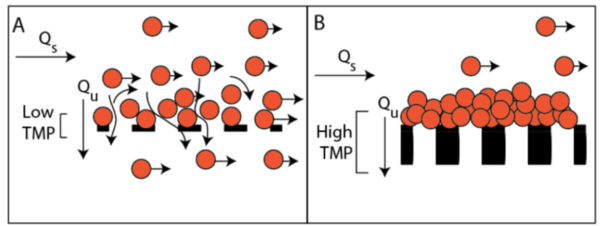
The protein serum used in all of these experiments is Bovine Serum Albumin (BSA) suspended in 1x Phosphate Buffered Saline (PBS) while the NPN used had a porosity of 18.8%, 10^7 pores, and an average 60 nm pore size. The track etched membranes used also had similar properties. The first image shown is a cross section detailing the typical setup for experiments.
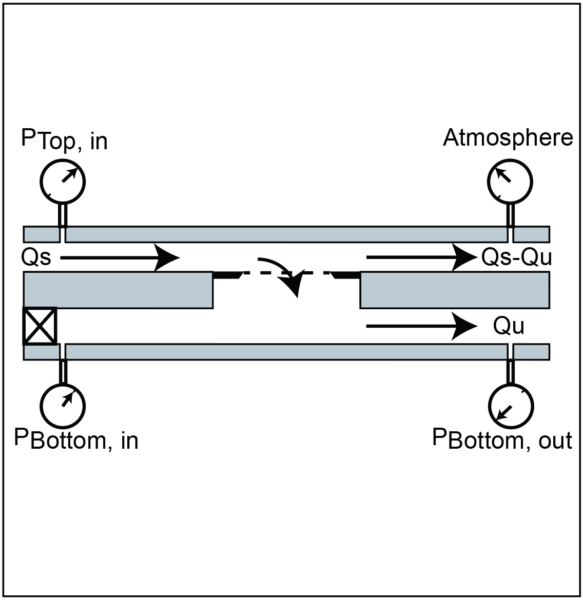
Both outlets and inlets have pressure sensors attached in series, giving us an average pressure in the top and bottom channels. The first portion of these experiments dealt with optimizing the experimental process in order to ensure consistent results. The process for collecting data is adapted from literature (Li and Zydney, 2017), where a flux-stepping technique was used to illustrate critical flux. Specifically, ultrafiltration rate is increased by 10% of supply rate every set amount of time (45 minutes for NPN, 15 minutes for TE) and transmembrane pressure is recorded. The system fails when TMP begins to increase from baseline. Baseline here is defined as the point at which the pressure rise is independent of the mechanical pulling force of the ultrafiltration syringe. In this work, a deltaP of 50% greater than baseline was used as a failure condition. Stricter conditions can be adapted and ultimately lower every critical flux value recorded.
We first looked at the effect of centrifuging protein and using the supernatant in experiments. The membrane used in these trials are 2.7% porosity with an average pore size of 50 nm and the 1 mg/ml BSA solution is supplied at Qs = 30 ul/min.
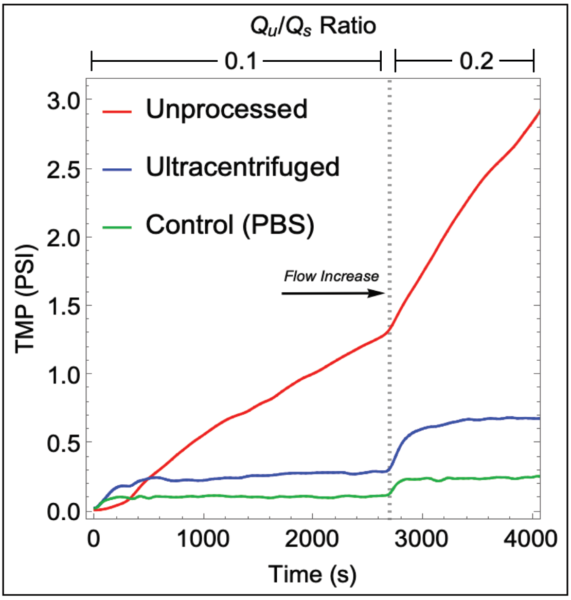
By ultracentrifuging BSA in PBS (via Beckman TLA-55 Rotor at ~100,000g) we see an appreciable difference in critical flux properties. Unprocessed fluid fouls a membrane immediately while processing fluid leads stability in pressure. Note that the concentration of ultracentrifuged BSA was verified via spectroscopy and a standard curve protocol we established. There was no difference in protein concentration between centrifuged and unprocessed samples.
Membrane porosity was next in the optimization trials. One would reasonably suspect that higher porosity membranes would results in higher critical flux with a lower TMP. This intuition is indeed correct as the next two figures show.
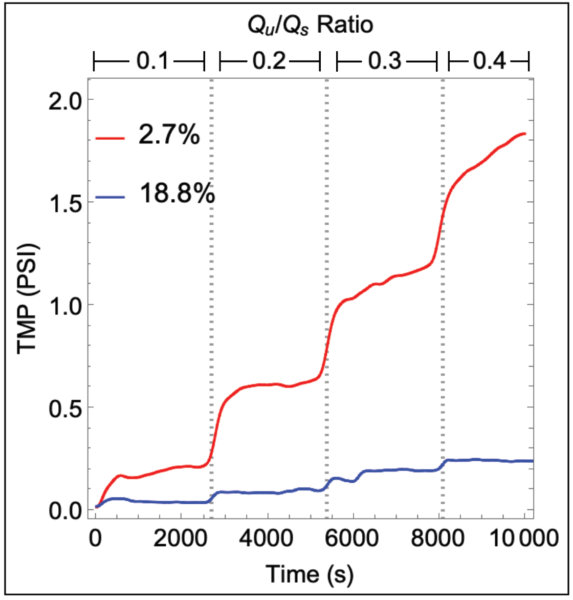
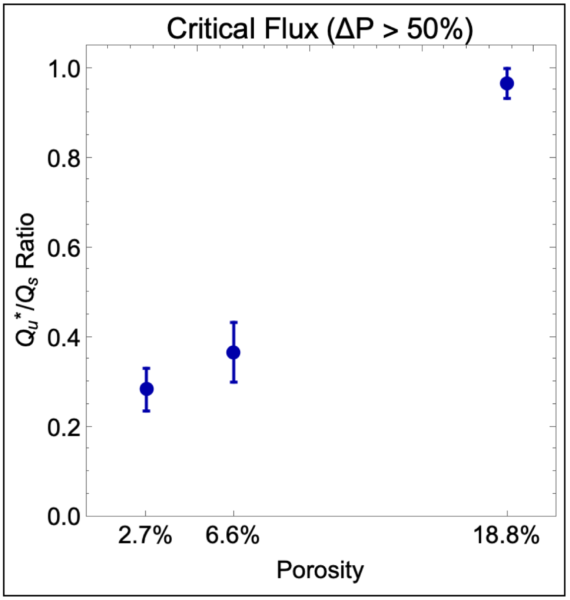
Using a supply rate Qs = 30 ul/min, 1 mg/ml BSA in PBS, and a 10% flux stepping protocol, we found that higher porosity chips have a higher critical flux with a much lower TMP. Part of this difference is due to the inherent geometry differences between low porosity membranes and high porosity ones.
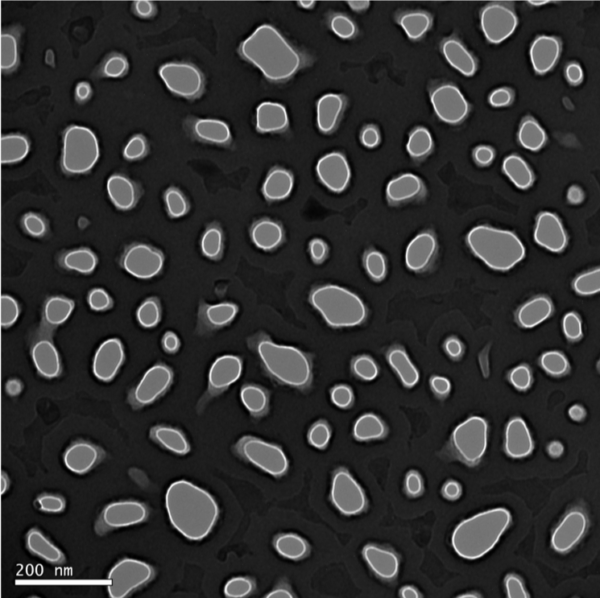
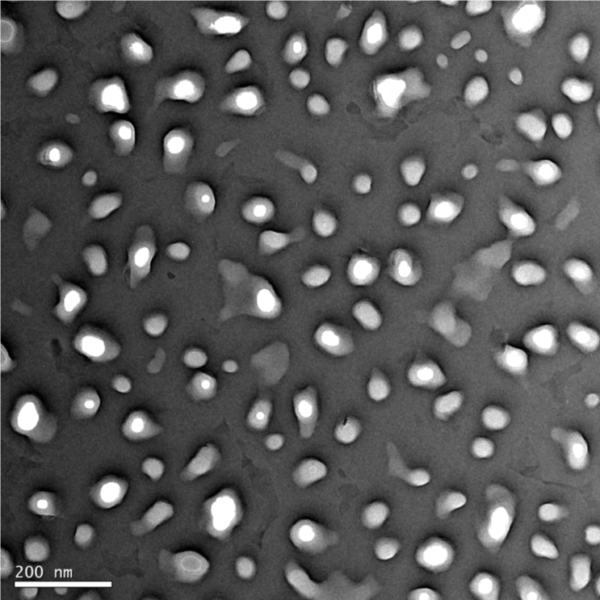
The first image is the 18.8% porosity membrane used while the second is the 2.7%. The 18.8% has fuller pores with less dead space while the 2.7% has many “divets” and tapered pores.
After these experiments we needed to conduct a parametric sweep, specifically looking at how protein concentration and supply rate (shear on top surface of the membrane) effected critical flux in NPN.
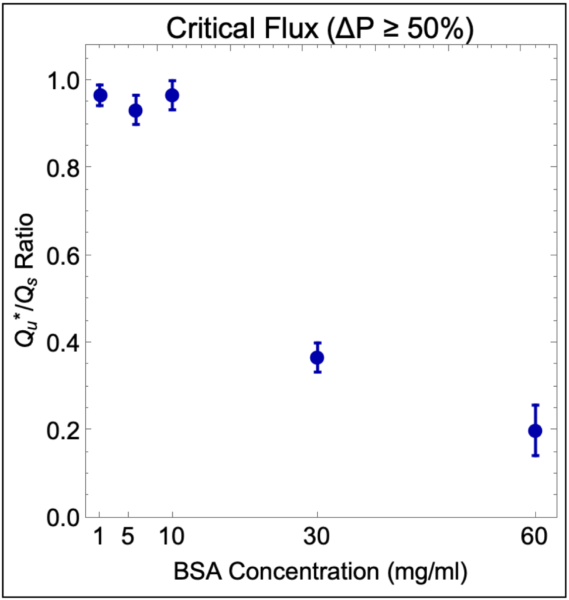
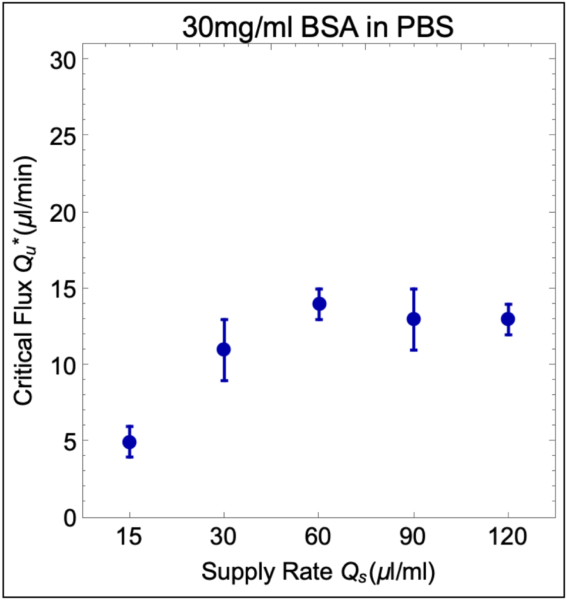
With regards to protein concentration a sharp drop off in critical flux capacity occurs after processing 10 mg/ml protein. For NPN, 30 mg/ml was chosen for shear evaluation due to it being in the middle of two extremes in terms of flux ratio. Shearing results indicate to us that increasing flow rate beyond 30 ul/min results in no change in critical flux while going slower lowers critical flux (likely due to increased friction in the system). It is important to note, however, that there is a possibility that going even faster may increase critical flux.
These experiments were repeated for TE devices (with the exception of shear, work in progress).
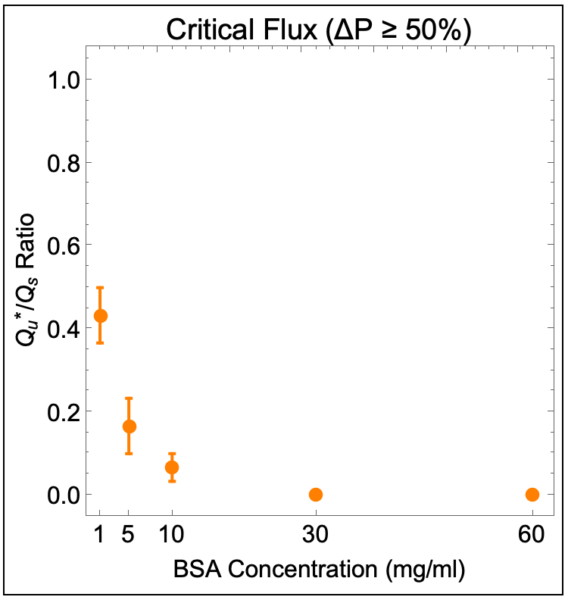
With this result in mind, our hypothesis is indeed correct, TE membranes will exhibit worse CF properties than NPN. Again, this is due to their thickness and higher transmembrane pressures.
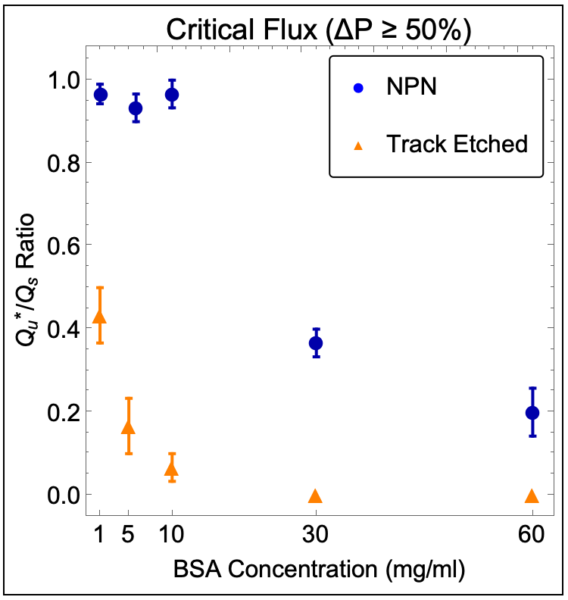
Just a quick comparison between the two data sets overall. Papers from other authors typically use 1 or 2 mg/ml BSA with TE membranes so its not a surprise that we’re seeing failure at higher concentrations. Now lets look at shear flow.
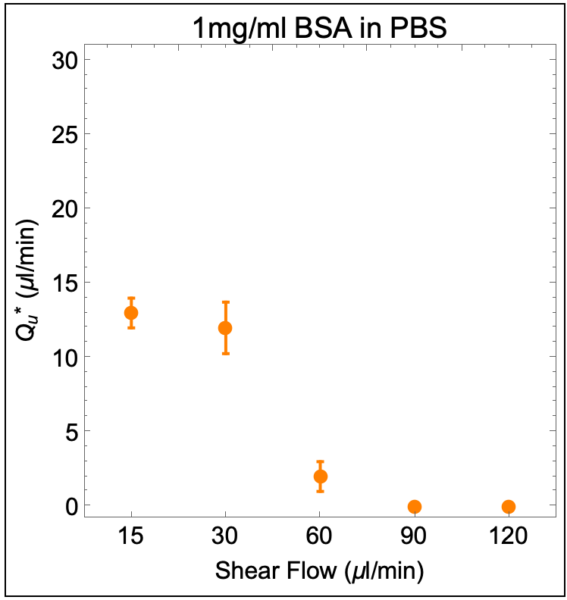
Interestingly, these membranes fail to perform at higher flow rates. We believe that this is likely due to the polymer membranes flexibility that results in pores collapsing at higher flow rates due to higher top channel pressure.
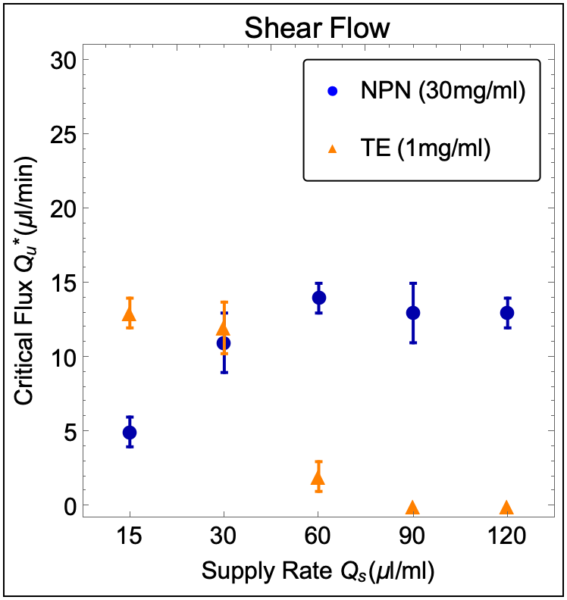
A comparison between NPN and TE. NPN performs better at 30x the concentration.
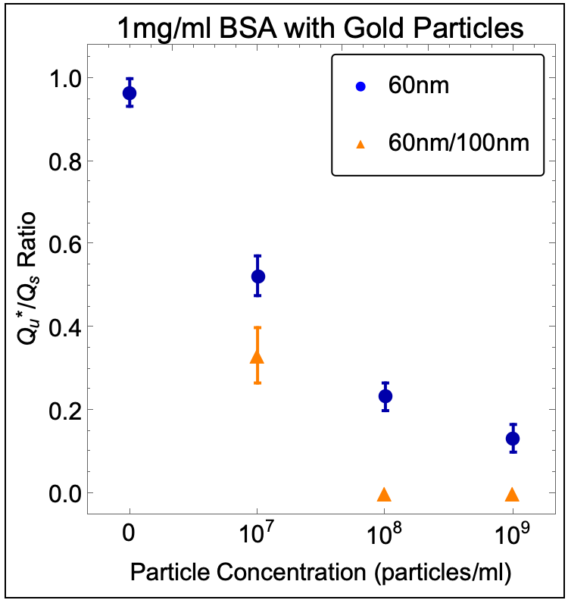
A practical application of a TFF platform is exosome capture (Kilean’s work, check out his post here: https://trace-bmps.org/the-completion-of-the-first-stage-of-the-gauntlet-knocking-aim-1-out-of-the-park/) and here I apply the tangential flow filtration platform to gold particle capture. Note that I’m specifically looking at critical flux instead of capture, however its important to note that we achieved roughly 75% particle capture in all of these experiments.
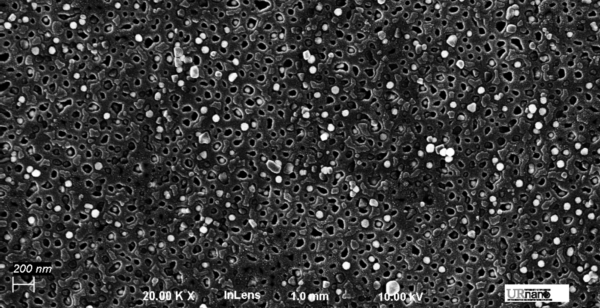
And here’s an SEM image of gold particles captured from a 10^7 particles/ml experiment. A decent number of particles are trapped in pores and might be hard to see due to contrast.
These membranes have roughly 10^7 pores, so it stands to reason that 10^7 particles will saturate the membrane (given average pore diameter of 60 nm). This is not the case, as some pores are 100 nm plus in diameter and carry ~20% of the flux through the membrane. This is despite them being a small fraction of the membrane surface area. Mixing in 100 nm gold particles mitigates the effect of these pores.
Something interesting to note, adding BSA to gold particles seems to mitigate particle aggregation. Kilean’s post touches upon this in detail (you better be grateful for all the attention I’m givin’ ya Kilean!) but the gist of it is that proteins form “coronas” around nanoparticles that may act as buffers that prevent aggregation.
With all this mind I’m still working on getting two more essential figures. These detail pressure differences between NPN and TE membranes.
Thanks for reading.
References:
[1] Li Z, Zydney AL. Effect of zinc chloride and PEG concentrations on the critical flux during tangential flow microfiltration of BSA precipitates. Biotechnology Progress. 2017;33(6):1561–7.