ALine mod-µSiM: Version2
Modular µSiM Version 2 (V2)
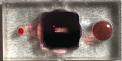
Holds ~30 µl of media in the bottom channel. Designed for cocultures, ELISAs, and other assays that are easier with greater channel media volumes.
For more surface area and volume information on mod-µSiM V2, see ALine Modular Device Geometry.
Passive Pumping
Another feature of V2 devices is their ability to passively pump media across the channel. This may have applications in the permeability assay, where we no longer would have to move the device to get our source concentration image.
Reduces likelihood of Contamination between Channels
Recall Version 1 design:

The small ports of the V1 design risks media spilling from the ports into the well when replacing media in the lower channel. This can lead to cellular contamination in cocultures or treatment contamination when directionally stimulating cells. I saw this contamination in an hCMEC/D3 and iPSC-derived pericyte coculture.
Note, I placed a coverslide over the large, open well and flipped the device to image inside the well.
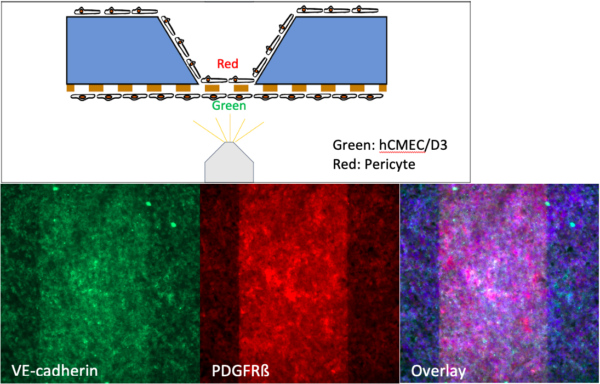
While I should only see green VE-cadherin (hCMEC/D3 marker) outside of the transparent window region, there is clear red PDGFRb (pericyte marker) as well. This indicates pericytes have contaminated the well from the bottom channel. I believe this happened while replacing media in the bottom channel after seeding. While pipetting techniques could mitigate this issue, changing pipetting technique could lead to increased risk of adding bubbles into the channel. The V2 design may be a good solution to the problem.