Cell Growth on pnc-Si
A couple of summers ago a Penn State summer student named Joe Fantuzo was working in the lab measuring cell growth rates and cell spreading on pnc-Si membranes and comparing the results to glass coverslips and tissue culture grade plastic. At least that is what we hired him to do. Joe spent much of that summer (and this past summer when he returned for a second stint) watching membranes discolor in culture media and compiling lots of examples and conditions in which it happened. Much of Joe’s work is documented on the NRG web pages under ‘data.’ A summary of his discoloration studies is here.
And a list of conclusions drawn from these studies is here.
At the same time that Joe noticed that the membranes were discoloring, he noticed that the freely suspended portions of the membranes were breaking. Remarkably, the cells on membrane surface above the wafer kept growing, and so Joe was able to compile some growth data. The data was a bit difficult to interpret because Joe consistently started with fewer cells on the membranes than the control surfaces. In preparation for our Millipore visit last Friday, I re-examined Joe’s old data and realized that I could do a better job of extracting some of the information we were after.
The equation that defines an exponential growth process is …

Where N is the cell density at time t, No is the initial cell density, and r is the per capita growth rate (rate of division per cell). When an exponential growth curve is plotted on a semilogy plot, it should look linear with a slope equal r/2.3.
Here is the figure I derived from Joe’s data. Note that I plotted the slope expected for r = 1 which corresponds to one division per cell per day. This is a very typical division rate in cell culture.
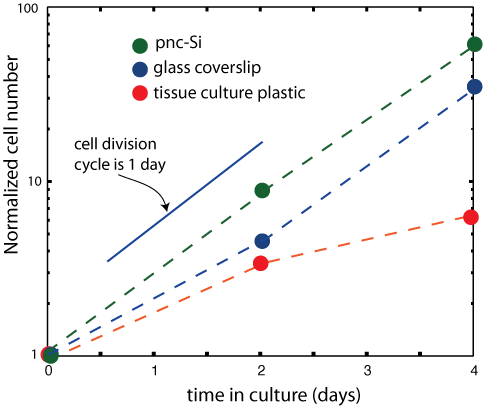
We can see that while the cultures are growing exponentially, they each have a growth rate of ~1 division per day on all the surfaces. The rate drops off for tissue culture plastic because there are more cells to start with and the culture reaches confluence at 4 days while the others are still expanding.
This data comes with the caveat that the surface is changing beneath the cells as they grow. Clearly the cells don’t care, but we do.