Upping the ante
I guess we weren’t sure if I was actually drawing rhodamine back through the membrane or just bleaching it. So I made a new apparatus which consisted of a sawed off sepcon mounted on a slide with channels etched into the lower plastic of the device to connect a pbs resevoir on the slide to the bottom of the membrane. I can add 200ul of rhodamine to this device and this helps to avoid the bleaching phenomenum at these timescales.
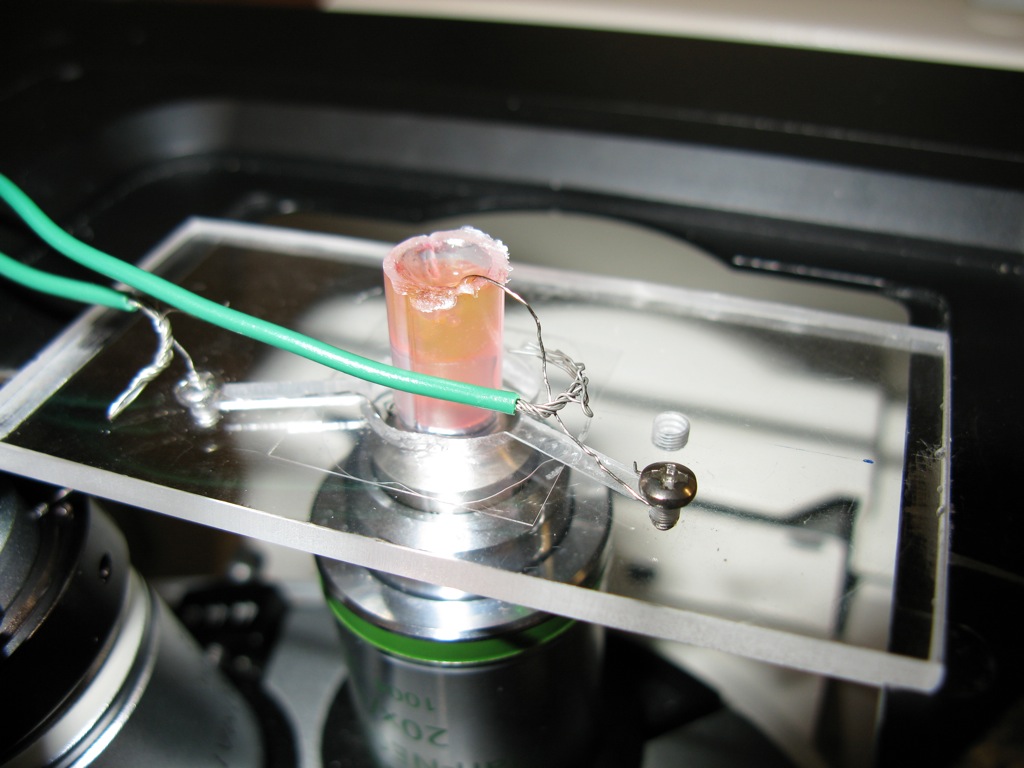
I had some initial trouble setting this up since I can’t use DIC to find the slits because the sepcon was still too tall. This meant that the rhodamine had already diffused out to a pretty good degree and I was unable to catch that with the camera. As I went to build a second chamber, I turned on the power so that the rhodamine might potentially be sucked back up into the sepcon (which I doubted since so much squished out). I went back to the scope, realized a good deal of it had gone back in, and flipped on the timelapse.
In the following video (which is .avi right now), I took a couple of frames then switch the polarity. The rhodamine came out, and I switched the polarity back. It goes back in, so I switched the polarity again. After it comes back out I switch it one last time. It goes back in, and as I try to switch it again I realize I no longer have current because the reservoir dried up. At the very end you can see the much slower passive diffusion as I struggle to figure out why my connection is no longer working.
I am beyond convinced – impressed. I’m glad that SepCon idea worked out. How many grooves did you have to make in the bottom?
What was the voltage and elapsed time?
I tried to make 4 grooves, but I’m not sure if all of them were completely effective. One was deeper than the others. Voltage was 15V (I had turned it up because of my impatience to fix the experiment and get the rhodamine to go back inside). Elapsed time of the movie was about 4.2 minutes, and it took about 5min before I decided to make the movie.
Very cool indeed! What was the polarity? Rhodamine electroosmosis and electrophoresis go in the same direction, right? Do we have a dye available where EO and EP fight each other, like Alexa? This would be important to understand, since a protein mixture will contain species of various charge and polarity.
If I’m mixing this up, sorry, rough morning…
Rhodamine is + charged so it goes toward the negative electrode. When the movie shows it flowing out I have the + electrode in the sepcon and the – electrode in the reservoir.
The electro-osmosis goes in the same direction as rhodamine travel. I find out if we have alexa or an other negative dye on hand.
An other option would be to see if changing membrane charge changes the direction of electro-osmosis, because if we could silanize the membrane then rhodamine EP would potential be against EO.
At this point, changing the dye is the easier method to determine the dominant transport mechanism. You can ask Tom, but my recollection is that most dyes are negative, and rhodamine is the rarity.
I tried a couple of different things today that I didn’t think warranted a new post, but they were attempts to answer your questions, Chris.
I lowered the voltage and checked the pH as electro-osmosis occurred, but even at 3min the pH in the negative well was way above 10.
I tried FITC (Alexa 488 is a modified FITC I think), and although it appeared to go to the positive electrode, I think once it got there the high pH bleached it. The molecular probe alexa dyes should be more pH resistant, so I think that’s going to be the way to go.