AFM – AJA oxides
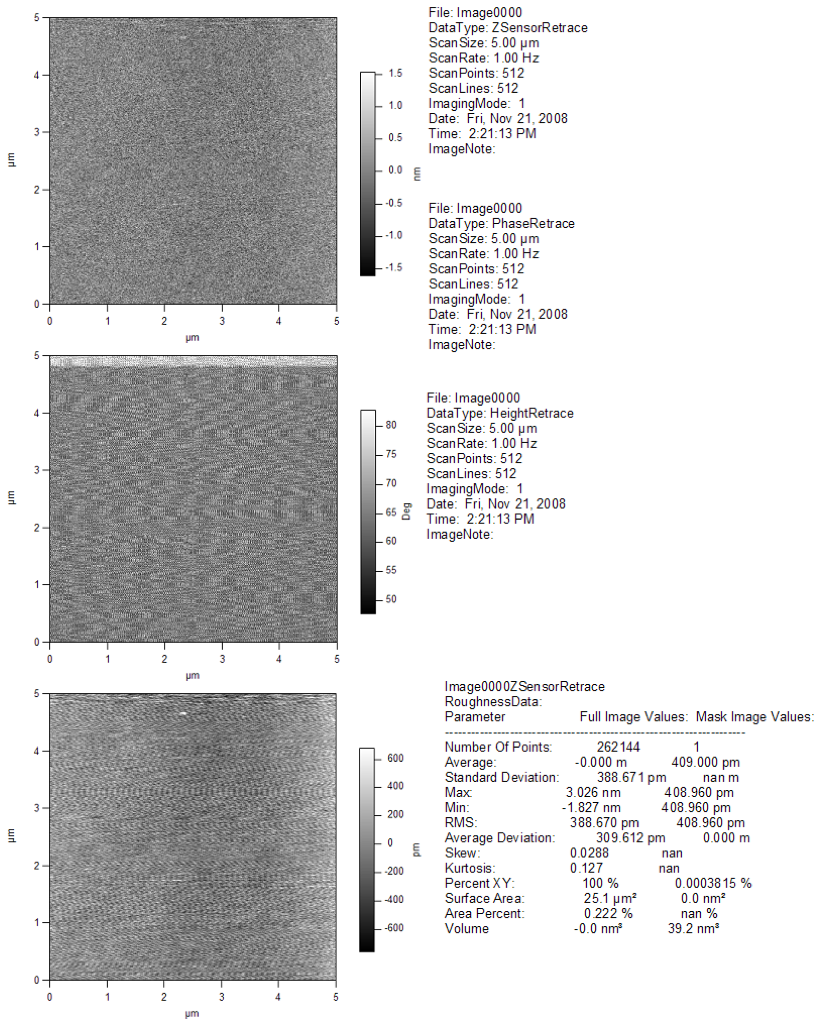
I got a couple of wafers from Chris last week – 50nm oxide deposited at room temperature or 450 degrees. For each wafer, I saved the zsensor (top), phase (middle) and zsensor (bottom) scans. I also calculated the roughness (the table looking thing on the bottom of each image. I had some problems with imaging again. I had to increase the tapping force to the limit (almost) for the phase to stay in repulsive mode. And even then, it didn’t stay in repulsive mode too well. I’m also not convinced that I was simply imaging noise here. Any thoughts? The phase images seem to have some surface information in them – the oxides have some phase features, so maybe not.
The bare VA semiconductor wafer; RMS roughness ~0.388 nm.
The 50nm AJA oxide at room temperature, RMS roughness ~ 0.231nm.

The 50nm AJA oxide at room temperature, but a 2um, not 5um scan, RMS roughness ~.259nm.
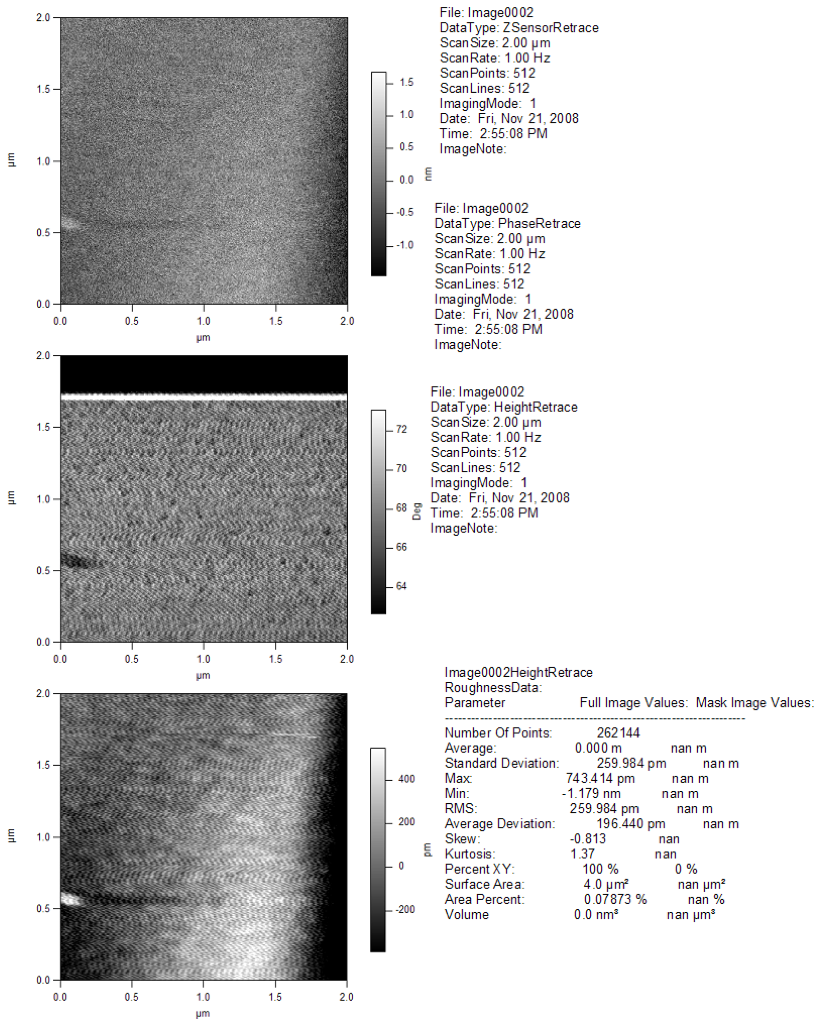
There’s a bit of a tilt error in this one. Also you can see where the phase flipped from attractive to repulsive mode (from the black area in the phase image). A positive thing about this data is that the RMS roughness on the 2um scan was about the same as the 5um scan.
The 50nm AJA oxide at 450, RMS roughness ~ 0.322nm.
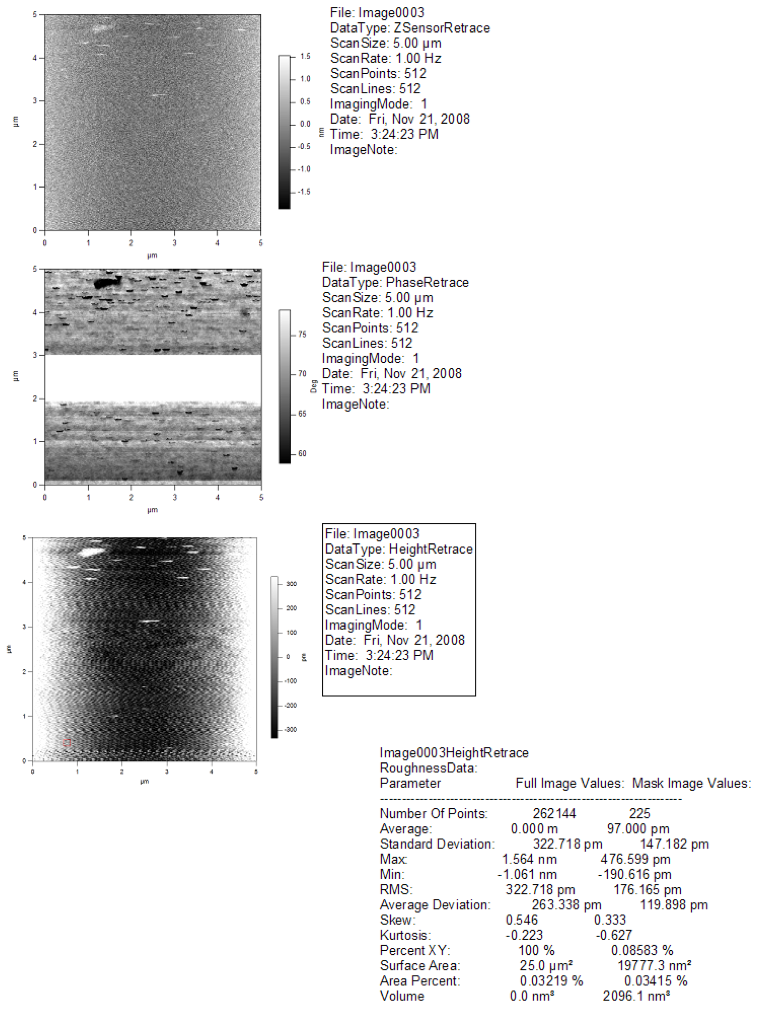
You can see the obvious phase hop in this image also.
This is generally good news – our deposited films have a roughness that closely resembles the bare wafer itself. However, the imaging issues make it difficult to trust the data. I suppose that we can conclude that our deposited oxide films are pretty smooth.
I’m not sure what the phase features could be, since the height data looks clean.
What did the Asylum people have to say about your imaging difficulties? Measuring Si wafers or coated wafers are some of the more common applications of their tool, so they should have seen this before. I wish some of these problems would have happened when Keith was here. Have you tried breaking the wafer into smaller pieces to reduce vibrational modes? Our wafers are a little thinner than normal, but this shouldn’t cause a problem.
Thanks!