Stabilizing Gold in Salts using Protein Adsorption
As mentioned previously, gold colloids are not stable in high salts because salts reduce the repulsive forces between particles and cause aggregation. I have been able to dissolve naked gold colloids in 10mM KCl without aggregation, but the particles crash out at 100mM KCl. There are a couple of strategies that can be used to stabilize gold colloids in salty solutions, but most require modification of the surface.
When we initially wanted to perform nanoparticle separations with the membrane it was because proteins were unpredictable, but we realize there are sources of “fuzzyness” with particles including:
1. The effects of the Debye length in low salt conditions reducing the size of the “apparent” pore radius by an unknown amount.
2. Adding coatings to nanoparticles increases their size and may change their interactions with the pore.
If we can accurately size the particle after surface modification, we can reduce the “fuzzyness” from source #2. Here I’ve tried to modify the gold particle ladder by BSA adsorption and measure the new particle size by Malvern Zetasizer.
I followed a protocol from Bioconjugate Techniques:
1. Add 100uL of particles to a tube containing 10uL of protein – use different concentrations of protein to find stabilization point.
2. After incubating for at least a minute, add 100uL of 10% NaCl (10% NaCl is about 1.7M).
3. If solution remains pink you’re good, but if it turns purple you’ve got aggregation.
Results:
5 and 20 nm particles worked well with 1mg/mL BSA. I couldn’t get 40 and 60 nm particles to stabilize even going as high as 10uL of 50mg/mL BSA. When I sized the 5 and 20 nm particles, there was a huge spread in sizes. I guess even though the solution remained pink, there was still some aggregation.
Next Steps:
A couple of things bothered me with this protocol. I thought the 10% NaCl was way too much. Also there needs to be a way to reduce the amount of uncomplexed BSA in solution. The following is my own protocol based on the previous one:
1. Add 100uL of particles to a tube containing 10uL of protein.
2. After incubation, add 100uL of .1M KCl. (The resulting concentration is .05M).
3. Spin down solution in ultracentrifuge 15min at 30k rpm.
4. Decant solution and resuspend in .1M KCl (Resulting concentration closer to .1M KCl).
Results (all particle sizes are after spin):

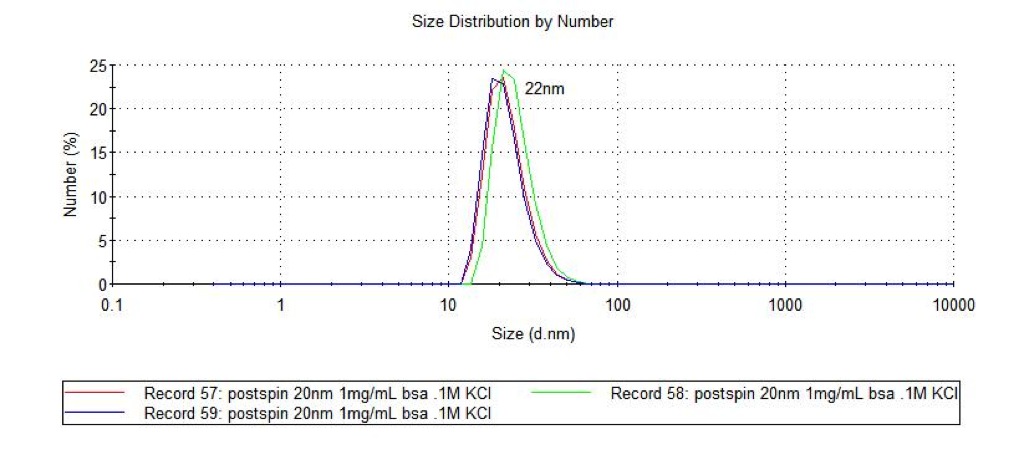
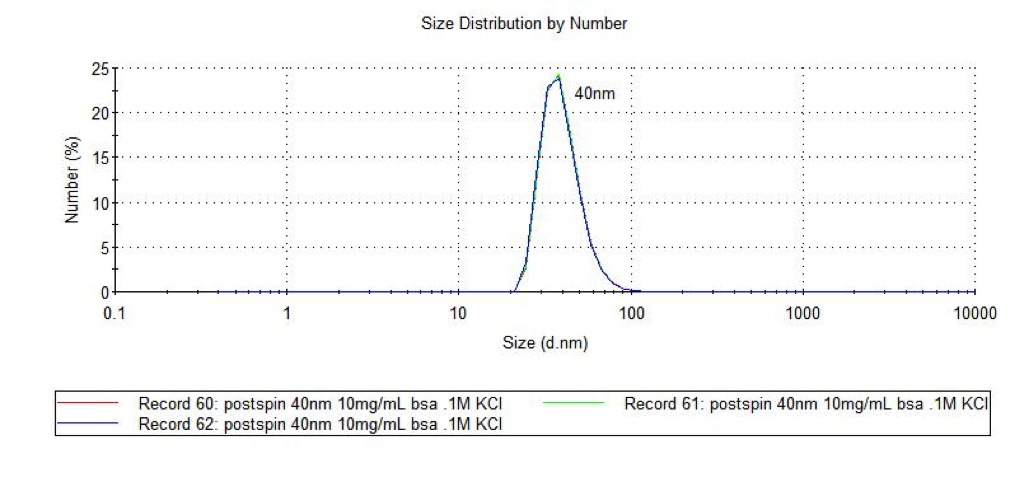
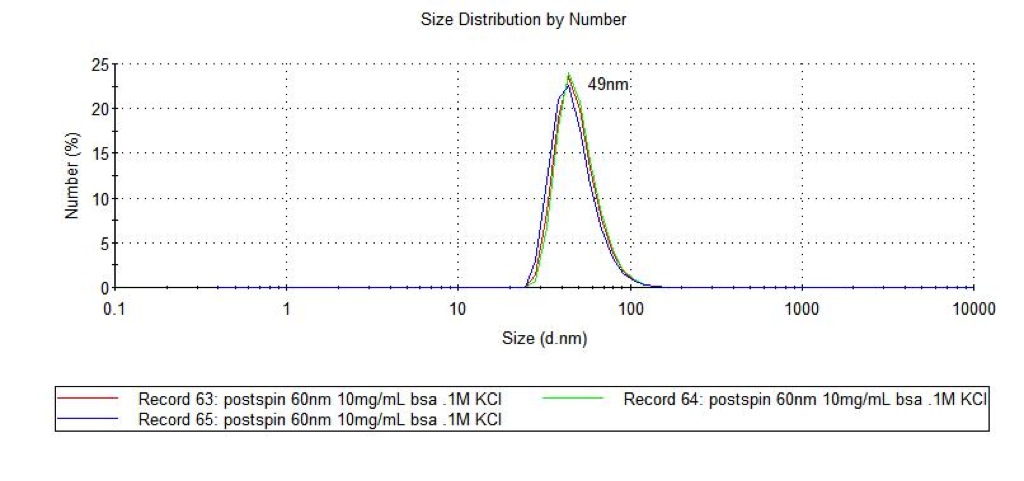
Compare to unmodified:
| Manufacturer’s Size | Pre-Modification | Post-Modification |
| 5 | 8.6 | 12 |
| 20 | 17.6 | 22 |
| 40 | 32.6 | 40 |
| 60 | 45.4 | 49 |