Carbonization is time dependent
After seeing a reduction of pore size at 750 C, I decided to run three different soak times at a fixed acetylene concentration of 1 LPM. As expected, the longer soak time resulted in more occlusion.

It seems that the carbon growth is almost linear: 5 min treatment shrinks the pores by 5 nm and 10 min by 10 nm and 15 min by ~ 15 nm.
Here is a HRTEM image showing the boundary between the amorphous carbon ring and a Si nanocrystal:
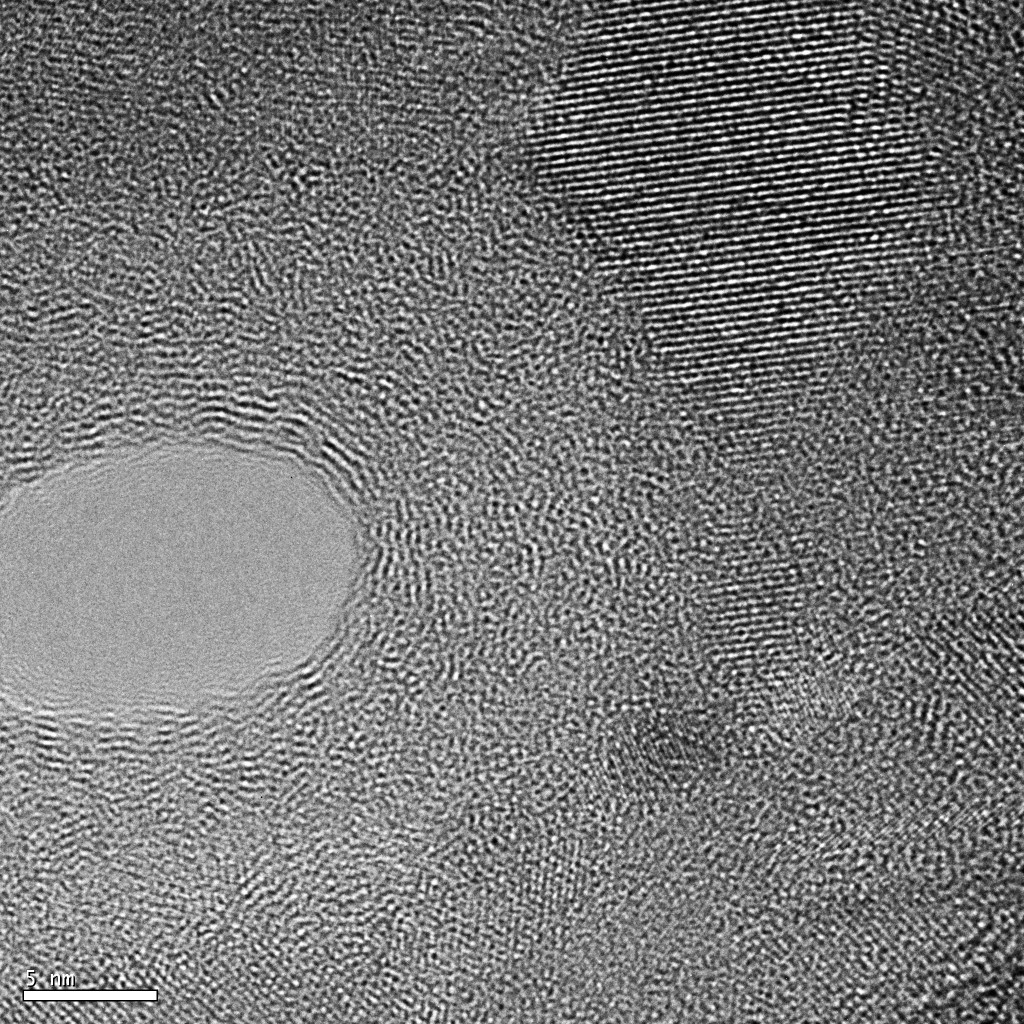
750 C; 1 LPM C2H2; 10 min
Wow, is the ordering that you are seeing on the inner wall of the HRTEM image of the pore, real? Since it does not appear in your other high-res images, it looks real to me. The spacing is just about right to be graphene, which would have a considerable number of implications, as our pore walls would start to resemble those of the CNT folks. We may also find interesting transport properties, if there is any truth in those theories.
You had mentioned something about “graphitization” at certain temperature regimes mentioned in some of the carbonization literature, I think. I wonder if there is a relation here? I’ll try to take another looks at those papers, but feel free to beat me to it…
It’s possible that graphene is growing… one paper observed graphitization at 800 C and we’re certainly close at 750 C. Interestingly, there’s no ordering when the carbon ring is < 5 nm but after a certain thickness epitaxial growth starts.
Makes sense to me. This is also a possible explanation for those odd chunks of carbon that you have been seeing protruding over pores before they are actually occluded. This is very odd because there are really no obvious PVD kinetics that would lead to features like that. However, graphene is a relatively stiff material and the interlayer adhesion is not strong. This would set up the potential for sloughing off of a few sheets here and there that could overhang the pores. If you happen to see such a feature overhanging a pore in Brian’s scope, it may be worth taking a closer look to see if you can actually make out a graphene lattice.
I wonder if this formation would be enhanced if you did a very high temp anneal following the deposition, after the acetylene is turned off. If some of the graphene has already started to seed, I wonder if the other carbon may also start to organize.