Bulge Testing of pnc-Si
Inspired by JP’s work with the Veeco Wyko, I attempted to fit pressure-displacement curves with the equation for thin film deformation (Vlassak and Nix 1992) for two membrane geometries: 100um x 100um and 1000um x 1000um.
The relationship between displacement and pressure is:

P = pressure, d = displacement, C1 and C2 are geometric coefficients, t is the thickness of the membrane, σ0 is the residual stress in the film, a is the length of one side of the membrane, ν is Poisson’s ratio, and E is the Young’s modulus.
Assuming a residual stress value of 100 MPa and Poisson’s ratio of 0.22 (ballpark for polysilicon), we achieve a good fit when the Young’s modulus is set to 530 GPa for a 200 um x 200 um membrane and 400 GPa for a 1,000um x 1,000 um membrane. These moduli are similar to that of silicon nitride membranes (Vlassak) and slightly higher than polysilicon thin films.

It is important to note that the fit is very sensitive to membrane geometry and I’ve assumed that the squares are exactly 200 um or 1000 um. We know that this is not the case, so the calculated modulus will be slightly off.
Great looking data and fit. Seems like a good excuse to engage Vlassak directly: vlassak@esag.deas.harvard.edu
This is promising data so far but there is still a bit of work to do. I am going to measure deflection of 30nm membranes and compare results.
I also believe the estimated residual stress (taken from polysilicon) may be too high for our film. This is evident looking at the Pressure-Displacement equation above. In the linear region of the curve, the residual stress dominates. In the cubic region, Modulus Young dominates. Polysilicon Pressure-Displacement curves usually demonstrate a fairly obvious linear behavior before reaching the cubic regime. Looking at the Pressure-Displacement curves for pnc-Si you will notice the linear region is practically non-existent i.e. the curve behaves mostly cubic. In my opinion, this suggests that Modulus Young may be more significant in deflecting pnc-si membranes when compared to deflecting polysilicon.
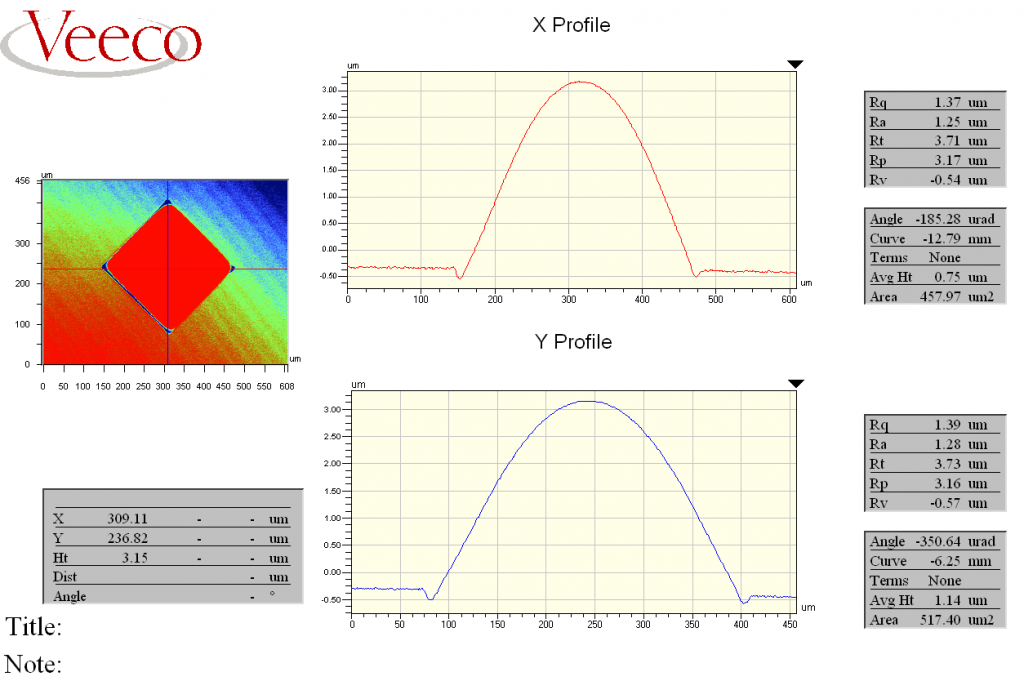
Dave-we should measure the true dimensions of the membrane active area. This should reduce our current estimated value of Modulus Young (500 GPa).
I agree, we need start varying the parameters we can control (thickness, membrane dimensions) to verify these results. I’d also like to look at how the numbers may/may not change with porosity…