BSA Size/Zeta-Potential and BSA-DDM Complex Results
Yesterday I used the Melvern to determine particle size and zeta-potential for BSA in DI-water. For the particle sizing I used a concentration of 2mg/mL but I had to increase the concentration to 10mg/mL in order to get an accurate zeta-potential measurment.

As shown above the size measurements provided an average diameter of approximately 5.6nm. Again these readings were obtained on a 2mg/mL solution of BSA in DI-water.
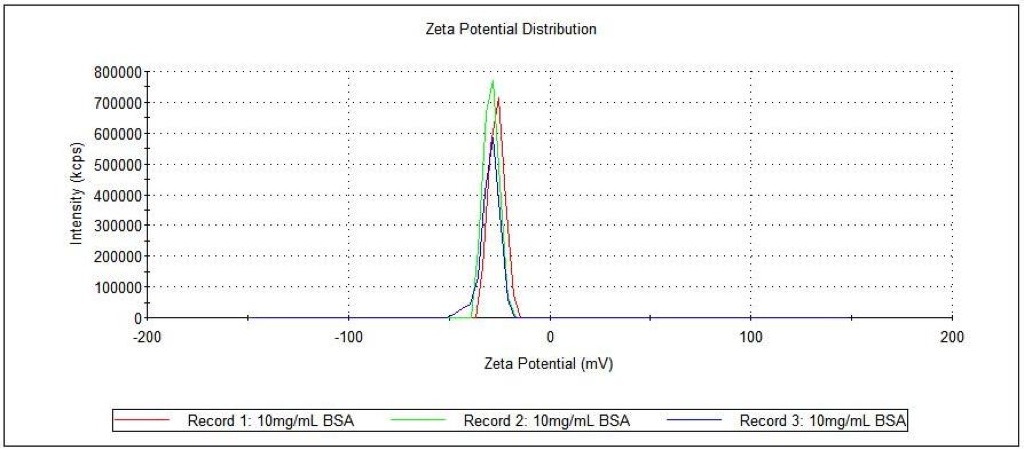
As shown above the zeta-potential readings provided an average value of approximately -28.3mV. These readings were obtained on a 10mg/mL solution of BSA in DI-water.
Having sized both the DDM micelles and now BSA I created a 50%/50% by volume solution of 0.5% (w/v) DDM with 2mg/mL BSA. The point in doing was to hopefully be able to detect an increase in particle size due to the formation of a BSA-DDM complex.
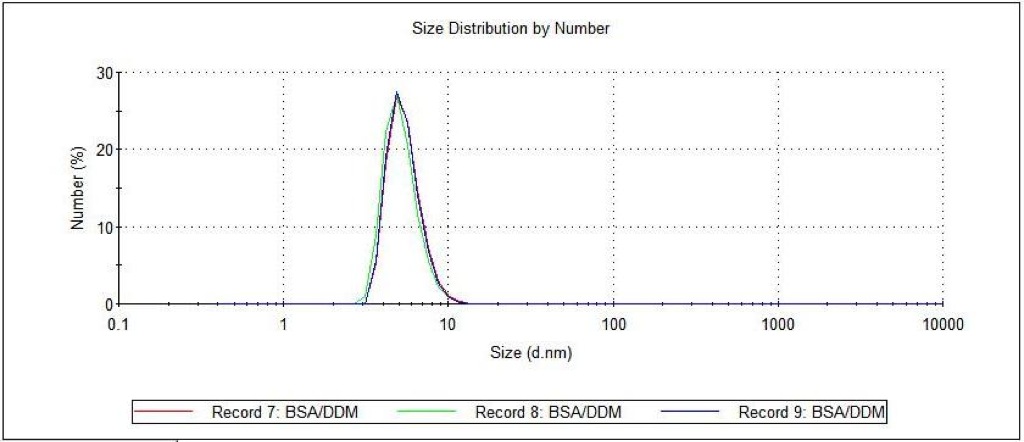
The image above shows the size results from the 50/50 mixture of DDM and BSA. The average particle diameter comes out to be approximately 5.37nm. If you recall my previous post I found that DDM micelles have an approximate diameter of 5.15nm, with BSA having a diameter of about 5.6nm. Assuming that BSA-DDM complexes are forming we should observe an increase in particle size in the above plot, which we do not.
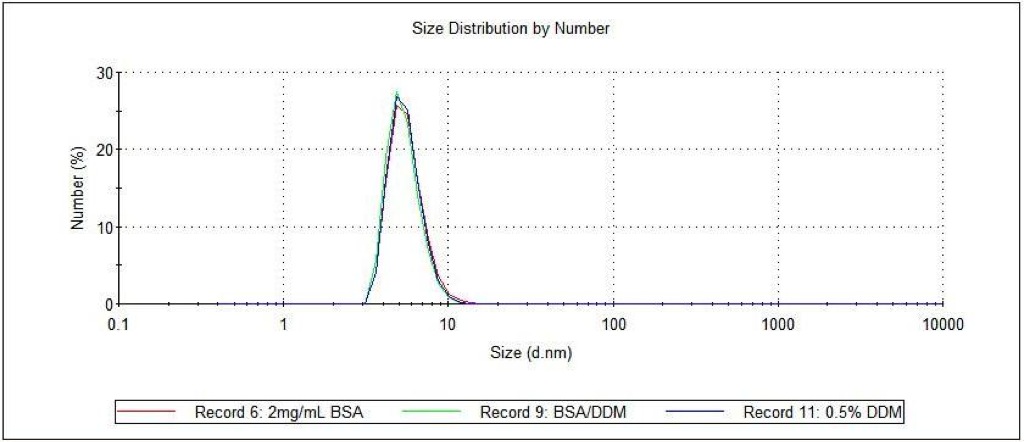
The above image overlays a representative peak for BSA (red), DDM (blue), and BSA-DDM complex (green) particle diameters. From this image it can be clearly seen that there is not size shift observed for the BSA-DDM complex, in fact all three size distribution peaks lie directly on each other. When I created the 50/50 volume mixture of DDM and BSA there was not a very long time period between when I made the solution and when I placed it within the Melvern. I am going to try to allow the solution to sit for an extended period of time to see if this helps with complex formation. In addition I am not sure of the exact protocol for protein solubilization in detergent solutions, there may be an important step that I am missing such as application of heat, etc. I am going to check with Professor Dumont to see if he has any ideas.