BSA adsorption study on NHS-PEG surfaces-II
I carried out experiments to test the adsorption of 1 mg/ml of BSA on NHS-PEG surfaces.This time the APTES layer was deposited from solution phase on to the silicon surface in contrast to vapor phase (YES) deposition. Again adsorption of BSA on different layers was confirmed using spectroscopic ellipsometry.

Protocol for surface modification:
The chips were left in piranha (3: 1 of con. sulphuric acid : hydrogen peroxide) solution for 30 mins, after which they were extensively rinsed with ddH2O and N2 dried. Following this they were reacted with APTES (1% v/v in anhydrous toluene) for 20 mins. Afterwards they were rinsed extensively with anhydrous toluene and then N2 gas dried. After this step the chips were reacted with 6 mM of NHS-PEG ( in dry DMF) for one hour. Follwing this the chips were rised with 70% ethanol ( ~ 2-3 rinses) and then rinsed with ddH20 (~ 2-3 rinses) following which they were dried under N2. After this the chips were subjected to 1 mg/ml of BSA solution (in PBS), and left @ 4oC for overnight incubation. Next day the chips were first rinsed with PBS and then with ddH20 and finally dried under N2. After every step the thickness of the corresponding layer was measured using spectroscopic ellipsometry.
Results:
The graph below shows the thickness of APTES layer (solution phase) and NHS-PEG layer formed on planar silicon chips.
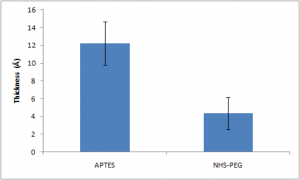
The graph below shows the thickness of 1 mg/ml of BSA on different chemical layers as measured using spectroscopic ellipsometry. (error bars correspond to standard deviation of the thickness measurements from the average value across two chips)

Discussion:
We see from the thickness measurements that the BSA adsorption on NHS-PEG modified surfaces is negligible in contrats to its adsorption on APTES and on clean silicon surfaces. Again this experiment was conducted only once and as such difficult to say if this will behave the same way when repeated again.
Also from the thickness measurements of the chemical layers we see that the APTES goes down as a much thicker layer (~ 12 Angstroms) and has a higher variability in comparison to when deposited from vapor phase (reffer to my previous post).