Streaming potential vs. EO derived zeta potential
You can use any electrokinetic phenomena to determine zeta potential since they’re all related. Here I’ve determined the zeta potential of untreated (non), plasma oxidized (ox), and silanized (asi) samples using both streaming potential measurements and electroosmotic flow rates.
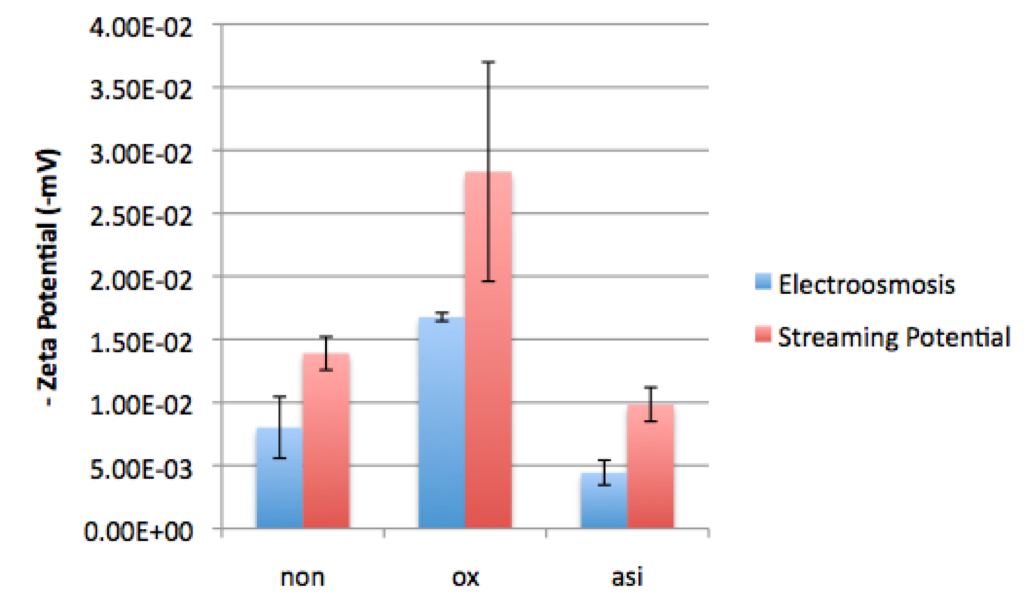
These measurements seem to follow the same trend, although the EO is lower in all cases. One paper I read comparing EO and SP derived zeta potential had EO being much higher than the SP calculations, however I think the take home may be that SP is generally though to be a better measurement because it’s more stable. There’s a lot of pH and ion concentration changes during EO that may have an adverse effect on the measurement.
The oxidized bar for SP has one annoying outlier that is making it look bad, and in generally I feel that I get more precise SP measurements at lower salt concentrations (this may be related to the mismatch between EO and SP as well).
One final comment – amino silanized chips are not positively charged by either method. Perhaps surfaces get a better + coverage and can shield diffusing molecules, but without good + pore coverage you won’t see the zeta change signs.
Have you tried membranes oxidized in the YES system? Based on the contact angle measurements, it appears that the YES oxidation does a better job of activating the surface than the ozone system.
Is the silane APTES deposited in the YES system following a plasma clean? Have you tried repeating the alexa and rhodamine diffusion expts at low/no salt to confirm that the surface charge is indeed still negative?
The streaming potential (red) bar for the oxidation is plasma oxidized in the YES system. I stayed away from the UV/Ozone system this time because of all the PDMS bonding that’s been going on there. I plan to get some plasma ox data from EO soon to be consistent.
Protocol for silane: plasma clean, h2o activation, aptes deposition. I haven’t redone alexa/rhodamine experiments with yes system.
I’ve been thinking about this a little bit, and it would not surprise me if the Alexa and rhodamine experiments still show a contrast with the APTES samples. I think these EO and streaming potential measurements are determining an “average” surface charge, but in actuality, we likely have pockets of positive and negative charges on the pore wall and adjacent surface. I suspect that the actual surface is positive amine groups at the tip of the silane, about 1 nm off the surface, and the surface is covered with negative charges. Steric hindrances prevent the silane from binding to every surface hydroxyl. The negatives probably outnumber the positives, but the positives are sticking out into the pore, potentially affecting any positive diffusing species.
Has anyone seen any papers dealing with heterogeneous arrangements of surface charge? It must be a fairly common issue.
This is a good thought. I’ll keep an eye out for papers.