High porosity film reproduced
I reported last week that a 15 nm silicon film deposited with 05 W substrate bias yielded a highly porous film. This week, I wanted to confirm this effect as well as compare it to films deposited at 10 W and 25 W (our baseline). We find that the 05 W is reproducible and the transition between a high-porosity film to a “standard” film is very rapid (between 05 W and 10 W).
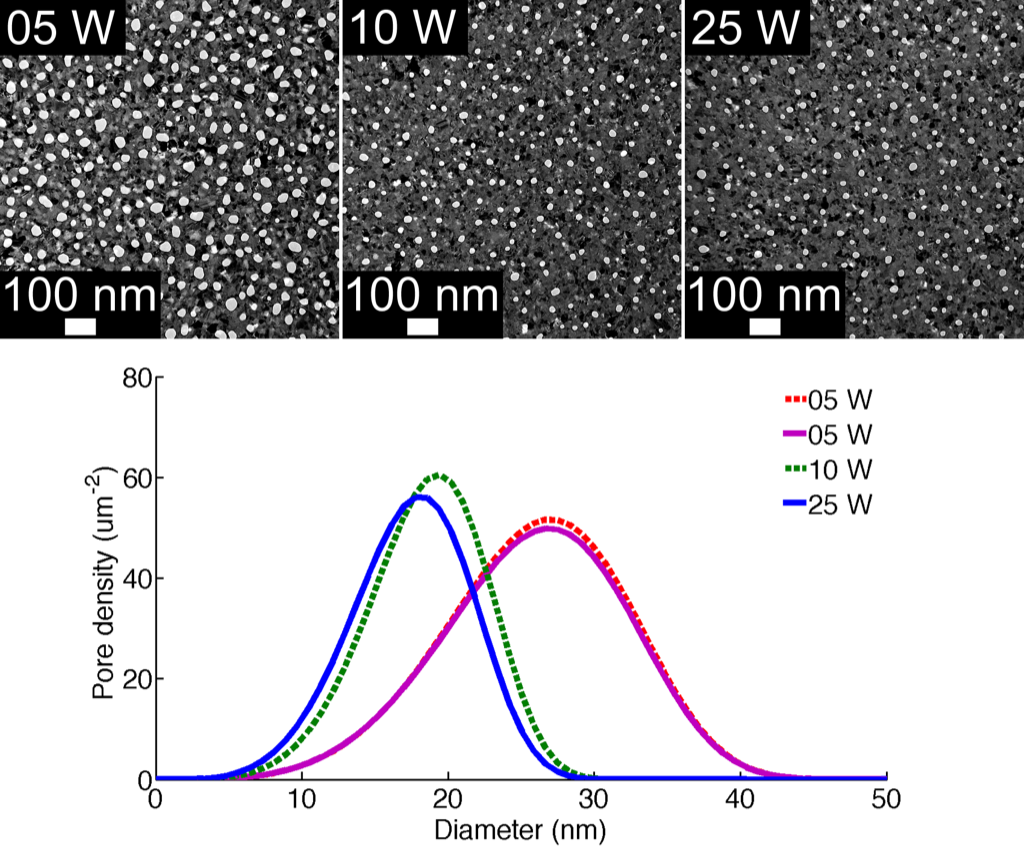
fantastic- now why is this transition so sharp…
It is clear that there is something going on between 05W-10W. My thought is that at 05W we have enough surface energy during the deposition to create an optimal density of nucleation sites without “over-densifying” the film so that in the subsequent growth stage the pores can grow freely i.e. atoms overcome energy barrier in the amorphous state and can move more readily.
At 05W-10W, something changes in the amorphous structure such that the atoms are no longer as mobile during the crystallization.
Joe and JP are currently working on some stress measurements using the RIT profilometer to investigate whether we can interrogate a difference between 05W and 10W samples.
To check the density of nucleation sites in the amorphous film (e.g. dangling bonds) we would need to utilize something like electron paramagnetic resonance (EPR/ESR).
Another interesting side-project would be to measure the thickness difference between 05/10W samples. There is 3x increase in porosity (from 5% to %15) so by conservation of mass we should see a ~%10 increase in thickness.
Dave – How do the porosities compare?
Is one of the 5W curves from your previous fabrication run, or were both of those produced this time?
Dave – I’m not sure why you conclude between 5-10W is the sweet spot. From your data last time and this time, it appears that 0 and 10W are low porosity and 5W is high porosity. Is there any data the suggests the max is not between 0 and 5W?
The two 05W are from two independent runs on different weeks with a cleaning in between. Porosities are both ~15%.
You’re right to say there may be a maximum between 00 and 05W so we’ll have to try a 02W.
Very interesting!
How long ago was the 0W bias wafer run? I assume that we are confident that if 0W was run with this set that the porosity would be tiny?
All the action here is definitely between 0W and 10W, but little more can be said. How much is the deposition rate changing in this range of bias? If you need to run wafers to establish a dep rate, these experiments can get very time consuming, but maybe the dep rate can be estimated? I’d like to see a run (0, 2, 4, 6, 8W) or (0, 3, 6, 9W) to narrow in on understanding this morphology/bias relationship. Is the substrate bias stable at 1W or 2W or 3W?
Also, is a 25W bias used for the Oxides?
In addition to looking at the thickness change, I think looking at the membrane film roughness would also be useful. At these porosities, the Si film must be getting thicker (no good way to explain a 10% density change), but this thickness change may not be distributed uniformly at the nanoscale, so a little AFM would be enlightening.
This is a fascinating and unexpected result. Most engineers regard the substrate bias as an on-off effect to improve film density. I had expected to see a steady increase in porosity from 0W to 25W based on our stress-driven pore formation model, not a sharp non-linear spike in porosity…
did the porosity increase exclusively because the pore size increased or was there an increase in the pore density as well (or not or even a decrease)> This could be important because one thing I’d like to aim for among other things is to create a very large number of small pores, in order to achieve a high pore density and subsequently making the pore diameter go down to below 2 nm by for example carbonization.
The porosity increase is due to both an increase in avg diameter and density. Comparing the 05W and 25W membrane, the density was 2.5e10cm^-2 and 2.0e10cm^-2, respectively i.e. %25 increase in #.
I am currently working on a temperature series @ 05W. If the hypothesis is correct that 05W is the optimal bias for seeding pore nucleation and growth, we might see some interesting things…