Multi-step annealing of free-standing OSO stack
It is well believed that the pore formation is directly related to the silicon crystallization. In this post, I’m gonna further show that how does the crystallization process affect the pore formation. The crystallization process can be divided into two stages. The first one is the nucleation of silicon atoms. In this stage, crystal nuclei start to form during heating.The previous study of silicon crystallization by Spinella and Lombardo (JAP, 84, 1998) shows that the interface of amorphous silicon and silicon dioxide is the preferred site. Since there are two a-Si/SiO2 interfaces in our three-stack, so nucleation initiates from both two interfaces. We suspect that this stage also initiates the tiny pits formation.

The second stage is the grain growth process. During this stage, those silicon crystal nuclei, also known as crystal seeds, keep growing to form big crystals as the heating keeps going on. We suspect that those pits eventually coalesce to become open pores as the result of silicon atoms migration. As a result, the open pores also grow bigger due to more silicon atoms migrate to nearby silicon crystals for the further growth of the crystals.
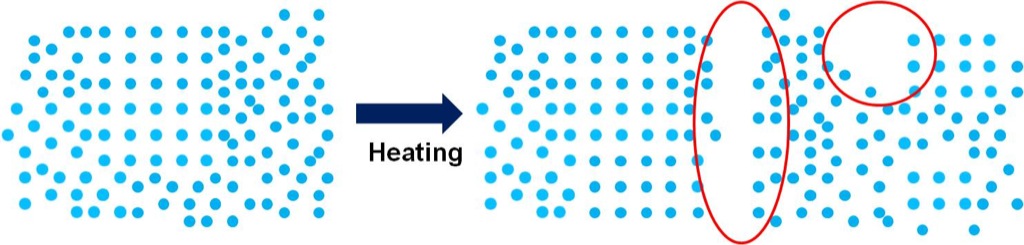
Once the crystallization process is clear, we can start to play with those two stage using the multi-step annealing. Basically the multi-annealing means that we first intentionally anneal the sample slightly below the crystallization temperature to create tiny amount of crystal seeds and then anneal the sample above the crystallization temperature to fully crystallize the sample. By doing so, the grain size should grow bigger compared with the direct annealing since the pre-created crystal seeds directly grow to big crystals without nucleation initiation. With this idea, the pores formed under multi-annealing heat treatment should be bigger than those formed from directly annealing.
Experiments were done on oxide/silicon/oxide free standing stack. Sample 20/15/10 was first annealed at 550C for 5 minutes. Then the sample was ramped up to 1000C and cool down without any holding time at 1000C. The control sample was just ramped up to 1000C and then ramped down.

After annealed at 550C for 5 minutes, the diffraction image shows that the sample is still amorphous state. Even though no clear crystals are observed in the sample, it is believed that the first annealing does affect the amorphous silicon film, maybe by introducing tiny amount of crystal seeds.

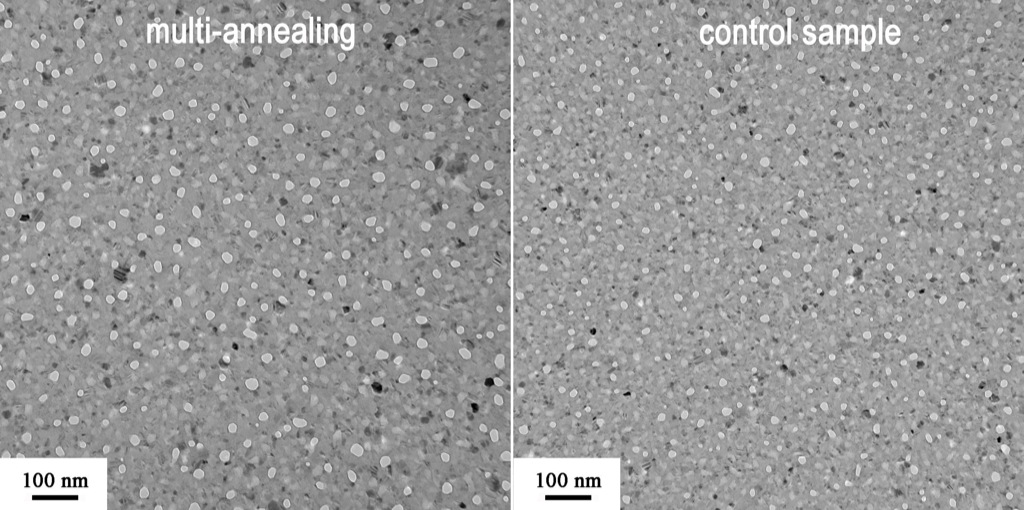
The followings are the TEM images of multi-annealed sample and the control sample after annealed at 1000C. From the TEM images, it can be seen that the pore size of multi-annealed sample is indeed larger than that of the control sample. It is also noticed that the crystal sizes from the multi-annealed sample are also larger than those of the control sample and it does match our theory.
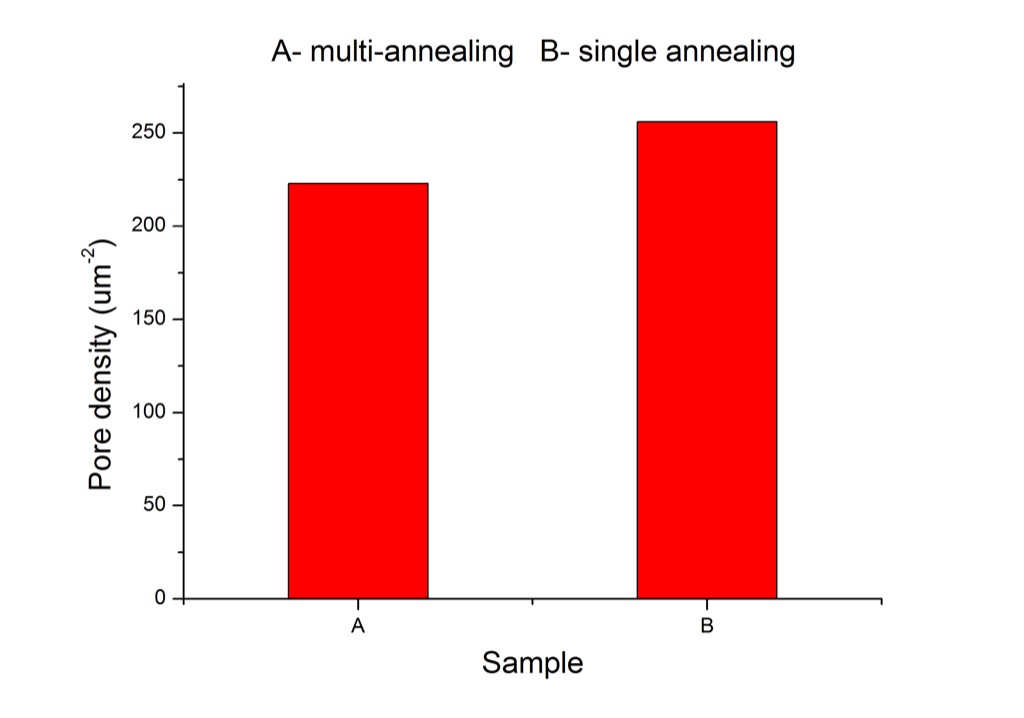
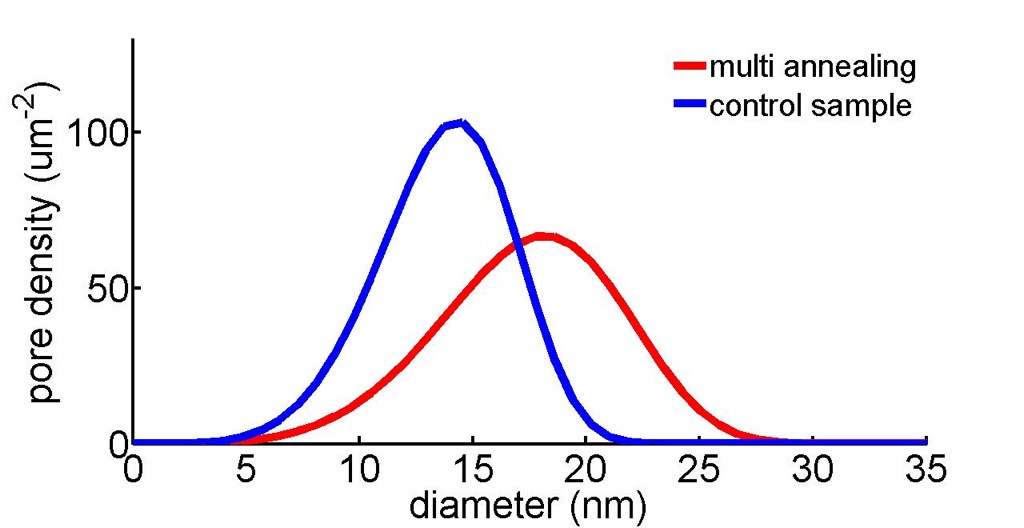
The next is the porosity and pore size plot from those two samples. Those two plots clearly show that the multi-annealed sample yields a higher porosity and larger pore size compared with the control sample. This result confirms our suspect.

This experiment proves that the crystallization process greatly affects the pore formation. It seems that the grain growth stage is the main stage that open pores are formed. The nucleation stage also plays an important role in the pore formation. It is very possible that pores are less likely formed if the nucleation stage dominates the whole crystallization process.