NSF/GOALI- URNano-Fisher projects/goals
The overarching goal of this collaboration is to expose students and faculty at primarily-undegraduate institutions to the technology & expertise available at the University of Rochester. We would like to make this kind of experience a recurring theme at URNano, and we expect to lay the foundations of such a program during the Summer of 2014.
We have designed this project in a modular way, with the intention of putting forward feasible aims but allowing us to move on to more complex goals as time and results allow.
Our specific goals can be divided in 3 areas:
a) Building of research capacity at Fisher.
—–> We would like to to produce our lipid-based nano particles in a cheaper and more reproducible way. To this end we will manufacture microfluidic platforms that allow for the rapid mixing of lipids in aqueous solutions, forming micelles that can be custom loaded and surface-modified. This technique has been reported in the literature, we simply seek to put together and characterize one that fits our needs.
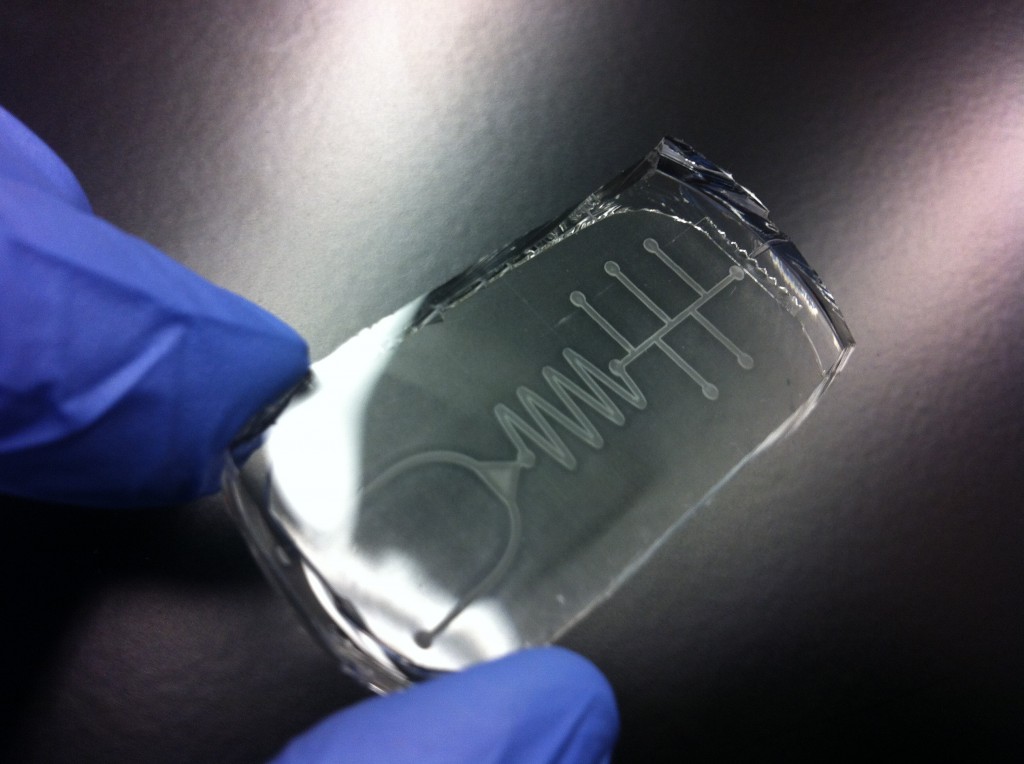
—–> We would also like to produce our own microfluidics chip at Fisher. We have dabbled in this (see picture, students used power point and a laser printer to make a mask) but we currently have no effective way to produce leakage-free devices. With help from the McGrath team we should be able to design an strategy to overcome this hurdle.
b) Production of instructional materials for the Nanobiology course @ Fisher.
—–> Last Fall I was able to integrate nanoparticle extrusion and chip design into a Nanobiology course. Our aim here is to manufacture re-usable chips (for in-class use) and to design protocols for students to produce their own with the equipment available at Fisher.
—–> We would also like to explore the possibility of designing a “lab” that integrates the use of nano membranes (perhaps a simple dialysis experiment in a colorimetric assay).
c) Collaborative research with the McGrath group.
—–> Our main research goal is the (nanomembrane-mediated) separation of antibody or nucleic acid-conjugated nanoparticles from free reactants. As you know, unbound antibodies (e.g.) can severely limit effective targeting of a particle. We have some expertise with both the production of particles and the in vivo and in vitro testing of these preparations.
—–> A secondary research goal is the in-chip testing of nano particle uptake by macrophages. We would like to simulate capillary shear flow in cell cultures and measure particle delivery in vitro.
I hope this is informative. Thanks for the chance to work and share with the group : )
For a summary of objectives and other info, go here: logic
I should add to the post above that the goals are not listed in any particular order, I expect we can work on them in parallel : )