ITO Etching
Found a Master’s thesis from RIT that details etch rates for ITO films in Hydrochloric Acid.
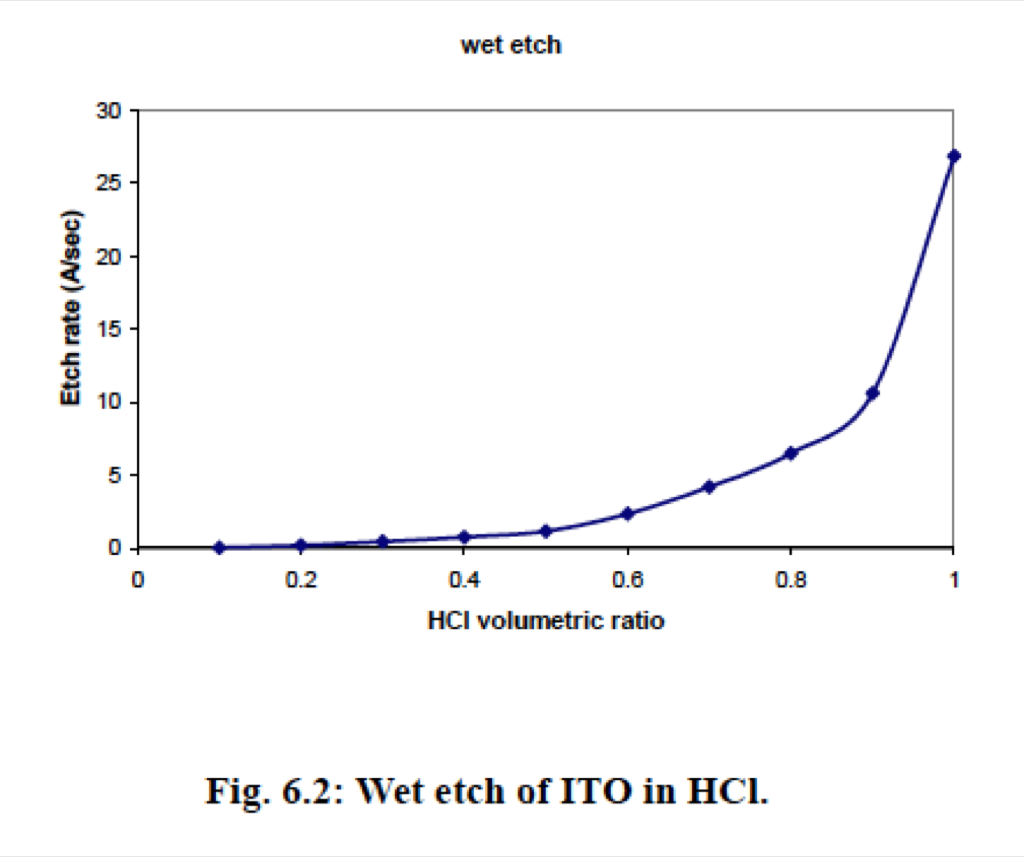
I originally attempted to do an etch using 1M HCl, but as the graph shows, this is not enough to produce an etch rate. I found this information out later, as 37% aqueous HCL = 12M solution, from http://openwetware.org/wiki/Hydrochloric_acid. Using the 6.25N=6.25M HCl solution in the basement (roughly equivalent to a 0.5 HCl volumetric ratio), I performed a few different etch times on my 150-300 Angstrom films and measured the resistance afterwards. The etch rate of my films was somewhere between 0.3-0.6 Angstroms/sec. For one sample, I stuck two pieces of PDMS on top of the film as an etch mask, hoping to create electrically isolated areas on the slide.
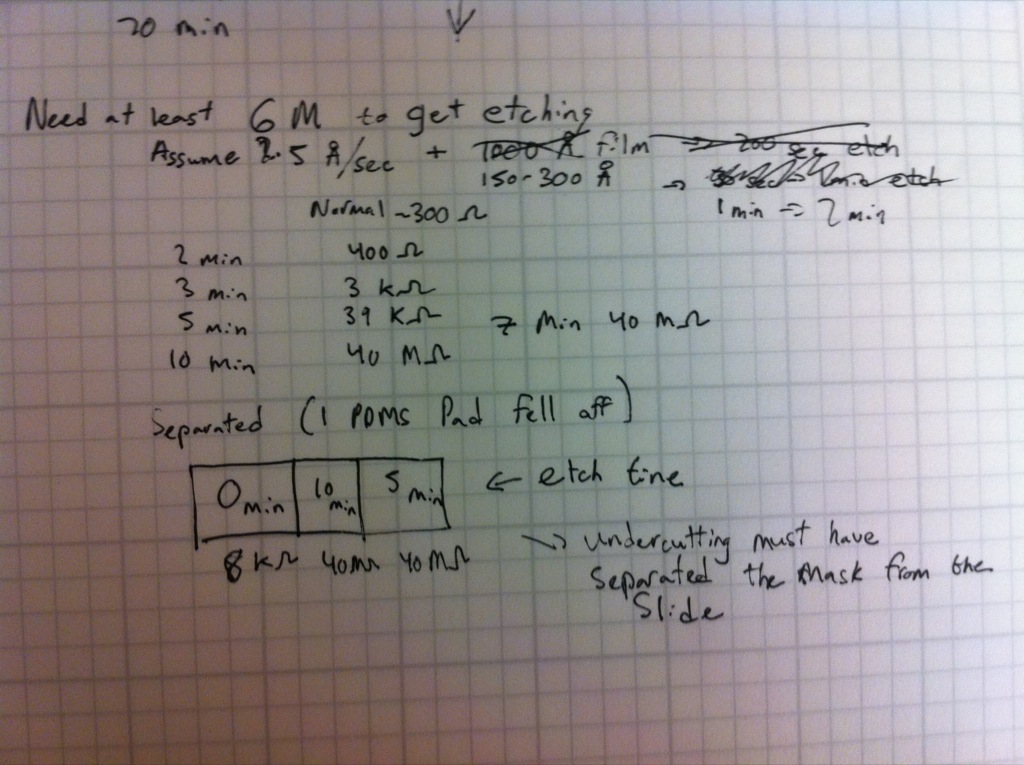
As the film gets thinner, the resistance increases. The PDMS did not adhere well as an etch mask, but was reasonably sufficient for over a long window of 10 minutes (the piece that stayed on experienced ~3 minutes of etch). I imagine the silicone sheets will have similar properties to the PDMS. The wet etch is isotropic, so I expect that the undercutting is roughly 150-300 angstroms, which should be negligible for our purposes.
UPDATE:
After the adherence failure, I tried to use vacuum to promote better contact between the PDMS and the ITO film. I was able to produce electrically isolated areas of 500 ohms on a piece using 7 min etch in HCl, while another piece did not etch completely (18 kohms). Cleanliness is next to godliness for making sure that the PDMS and ITO adhere.