Make Sure to Filter Salts Before Passing Them Through Sepcons
Previously, I had gotten some inexplicable results showing that increasing salt concentration decreases the flow through a membrane.
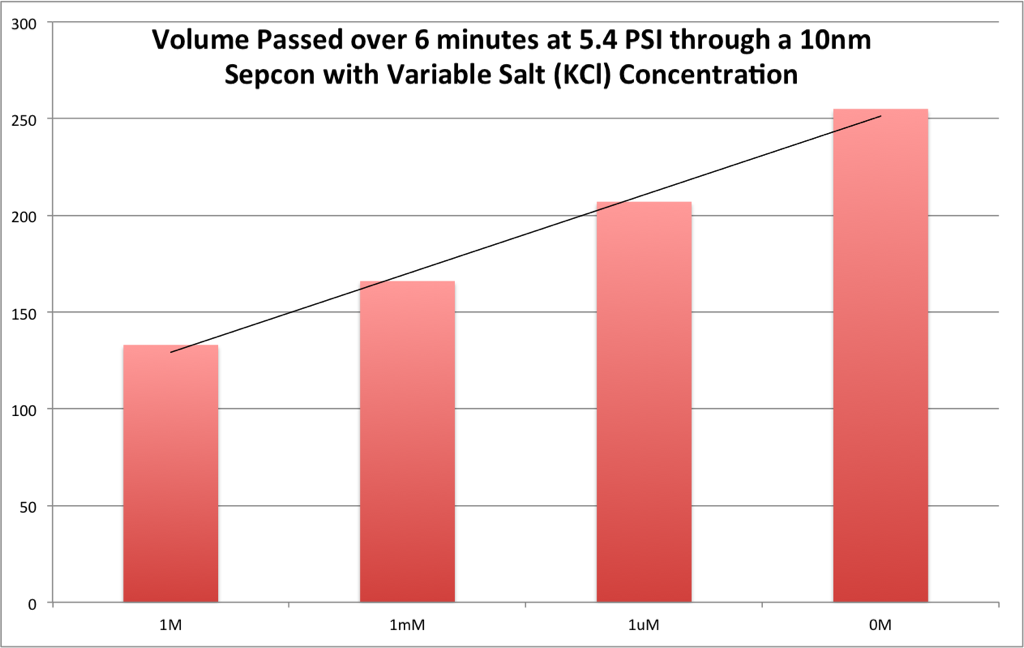
This makes no sense (and goes against our previous data) because we would expect electrostatic forces to counteract the flow, an effect called counterelectroosmosis by Zydney:
“The situation in the presence of a net fluid flow through the pore (i.e., in the presence of an applied pressure gradient) is significantly more complicated due to the development of a variety of electrokinetic phenomena under these conditions. In particular, the fluid flow generates an electrical (streaming) potential across the membrane due to the unequal partitioning of the positive and negative ions in the pore. This streaming potential generates a flux of counterions opposed to the convective flow,with this counterion flux reducing the overall solvent flow from that which would be expected based simply on the applied pressure gradient (this effect is often referred to as counterelectroosmosis). ” – Electrostatic and Electrokinetic Interactions during Protein Transport through Narrow Pore Membranes, Pujar and Zydney, 1994
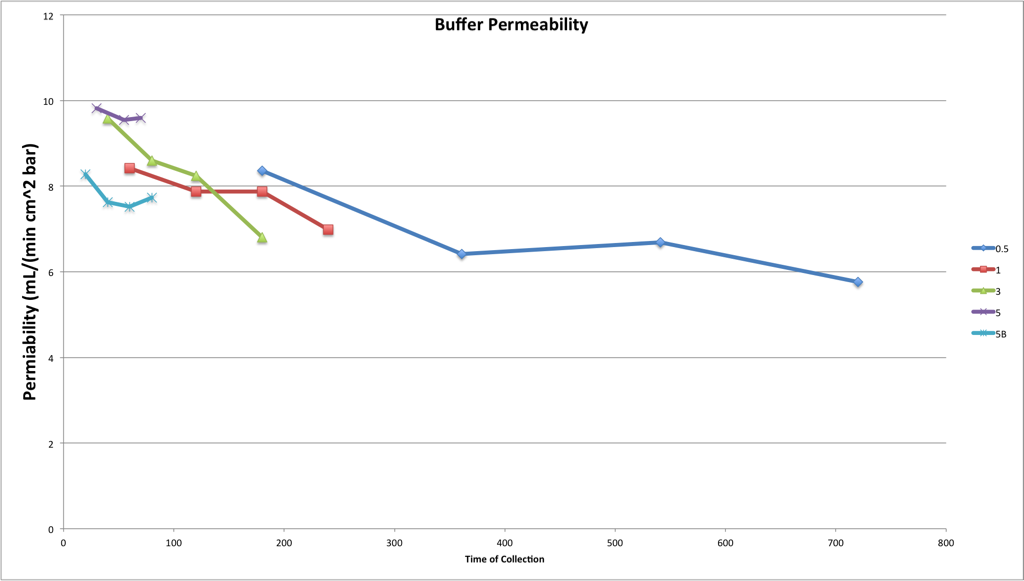
I believe now that the weird data can be explained by impurities or aggregates in the salts I was using. The same Sepcon was used for all four data points (in order of increasing salt concentration). Over time more of the pores must have become plugged. Below is one of my previous graphs showing a decrease in PBS flow through a membrane over time:
I did some pressurized flow over time on some KCl and PBS (and water) solutions after filtering both salts through a 0.2 micron membrane.
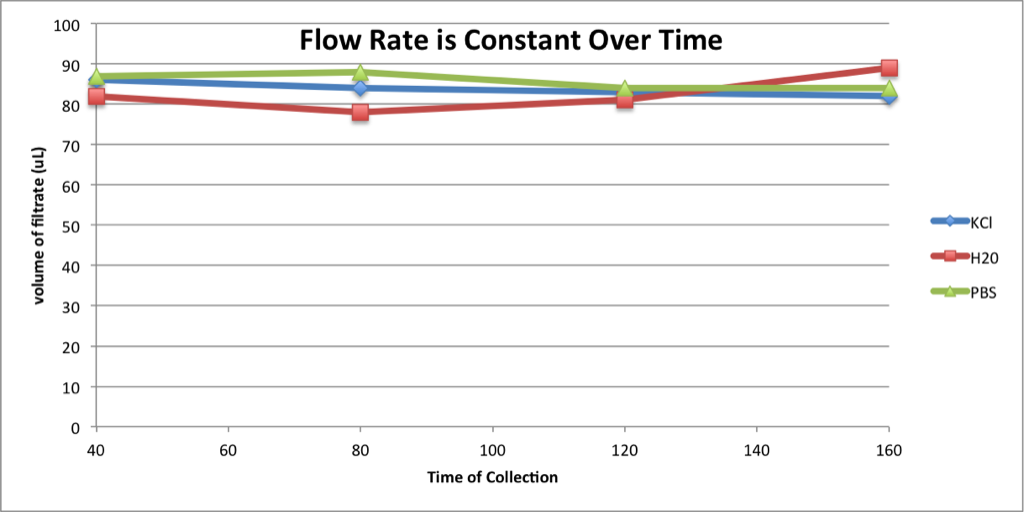
So using a filter on salts is a necessary pre-step for Sepcon separations.
Note that our decrease in flow because of gunk in our solute is not a new problem – Dave Fang had a similar problem with the large nalgene container previously and got a similar graph for decreasing flow over time.
High membrane charge is important to seeing the counter-osmosis effect. We might want to charge the membranes in UV ozone (verify with contact angle measurement) and repeat. Even better would be to measure the membrane zeta potential with streaming potential device.