Solutions to the Adsorption Problem
In my last post I reported findings that the bottom well of a CytoVu assembly is capable of adsorbing protein at about 0.03 ug/mL, or 0.75ng of protein. This is a fairly small value, but for the purposes of a sensitive separation such as the FLAG tests that I’ve been working on, it can be critical. Thus, a method must be formulated for preventing this adsorption. The two primary candidates are a pre-experimental blocking by incubation of the well with BSA, and a relatively high concentration of carrier BSA mixed with the experimental solutions.
In order to determine which option would yield the best results, I set up a simple experiment with three CytoVu bottom wells. The first was allowed to incubate a 5 mg/mL solution of BSA for one hour while the other two contained nothing. Then, into the first well as well as a control well was pipetted a solution of calf intestine alkaline phosphatase at 0.008 ug/mL in buffer, while the second well was incubated with a solution containing both 0.008 ug/mL phosphatase and 5 mg/mL BSA in the same buffer. After one hour of incubation, the solutions from all three wells were assayed for phosphatase activity along with a sample of the stock solution of phosphatase, at the same concentration and volume but never exposed to a CytoVu well. The results:
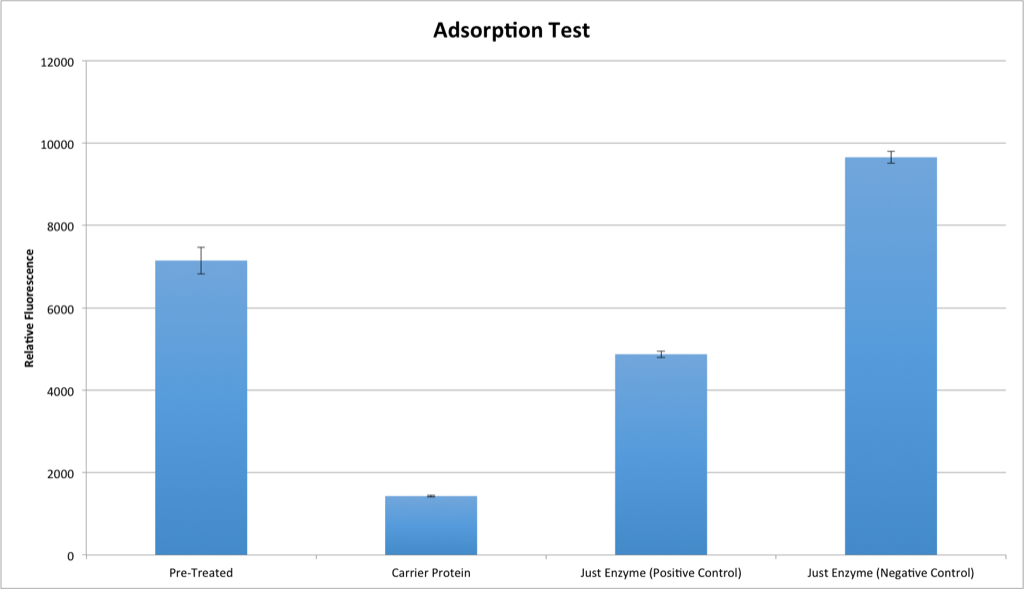
The most glaring facet of the graph is the fact that the carrier protein actually had a detrimental effect on phosphatase activity. The carrier protein case manages to display fluorescence lower than the case with no protein at all, which I had expected to be the minimum. In an attempt to explain this, I ran a separate test with fresh solutions — one of enzyme only and one of enzyme with 5 mg/mL BSA. The solutions were handled in precisely the same way, made at the same time, and their components taken from the same sources — the only difference between them was the protein.
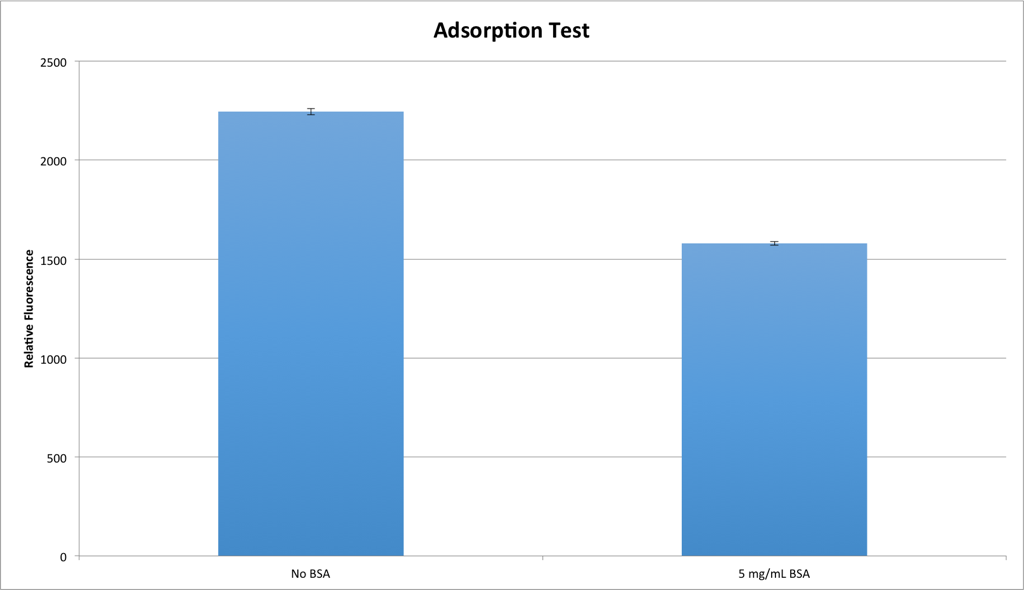
Clearly, then, the carrier protein is not a solution — at least at such high concentrations. Because the carrier protein solution would be faster and easier, however, I intend to spend some time determining whether or not some lower concentration of carrier protein would be sufficient to solve the adsorption problem while also not presenting any issues of its own. A ladder of protein concentrations should do nicely in order to determine where the maximum signal is with respect to the concentration of carrier protein, as well as where that maximum is with respect to the signal from phosphatase that has never seen a CytoVu well. I will update this post when that information comes in.
UPDATE: The results are in, and they’re quite pleasantly exactly what I had hoped for! In this graph the eight bars on the left represent the ladder concentrations (BSA from 1 mg/mL down to 0.0128 ug/mL by five-fold serial dilutions) while the right-most bar is the control — just phosphatase in buffer, never incubated in a CytoVu well. In other words, it represents the maximum signal where no phosphatase is lost to the well
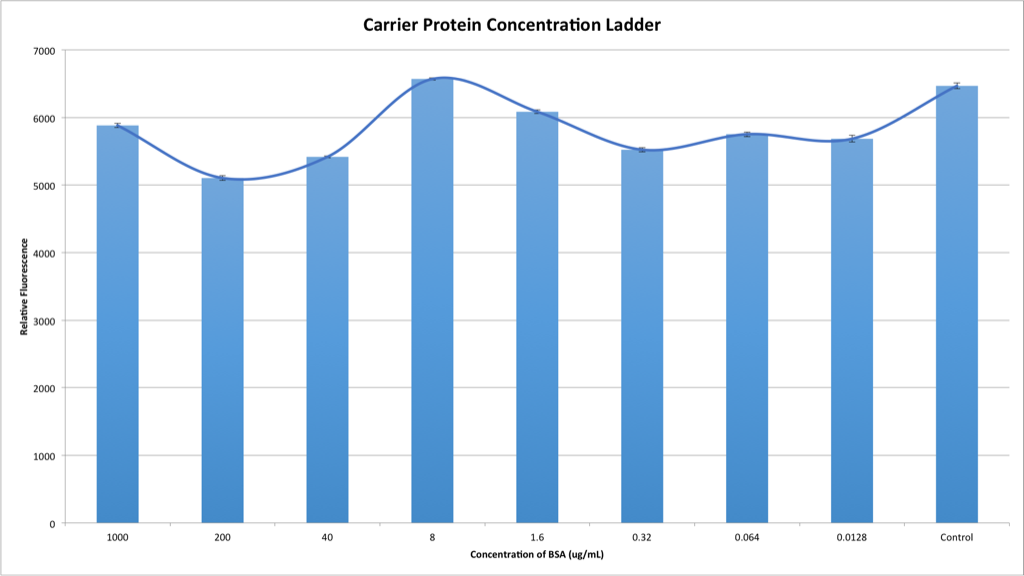
A clear maximum is visible here at a carrier protein concentration of 8 ug/mL, exactly three orders of magnitude higher than the concentration of bacterial alkaline phosphatase in solution with the carrier protein (0.008 ug/mL.) In fact, the sample with 8 ug/mL BSA had a slightly higher level of phosphatase activity and with less error, possibly due to the BSA preventing phosphatase adsorption to the walls of the plastic well plate used for fluorescence measurement.
Based on this data, I will be moving forward (backward?) to the FLAG separations once again, this time with roughly 8 ug/mL of BSA in the buffer. Based on previous work done by the NRG, I believe that the BSA will diffuse freely through the 50nm pores of the CytoVu chips and should present no threat to the integrity of the experiment. I’ll be making a new post concerning the rehashed FLAG experiment as soon as possible.
UPDATE: Alas, I continue to lose phosphatase somewhere between beginning incubation and sampling the well contents for phosphatase activity. Even after increasing phosphatase concentration four-fold and testing both the filtrate and retentate sides of the membrane, no signal comes from wells containing samples that have spent 24 hours in a CytoVu well. There are only two immediately apparent possibilities: either the BSA concentration used is suitable for one hour of incubation but not 24 hours, or the phosphatase degrades over the course of the experiment at room temperature (but not in the refrigerator.)
In order to test this, I will first try to ensure that the latter is not the case before preparing another, more difficult experiment to test the former. Thus, I will be leaving out 0.008 ug/mL of phosphatase in a centrifuge tube in a drawer at room temperature, and after 24 hours, compare its phosphatase activity to the same concentration of phosphatase that has been kept in the refrigerator. If no significant difference is observed, it’ll be time to move onto adjusting the BSA concentration to work over 24 hours rather than just over one. I’ll update here when I know more.
UPDATE: Aha! The culprit has been caught. Exhibit A, the relative phosphatase activity of samples left at room temperature versus in the refrigerator for 24 hours time:
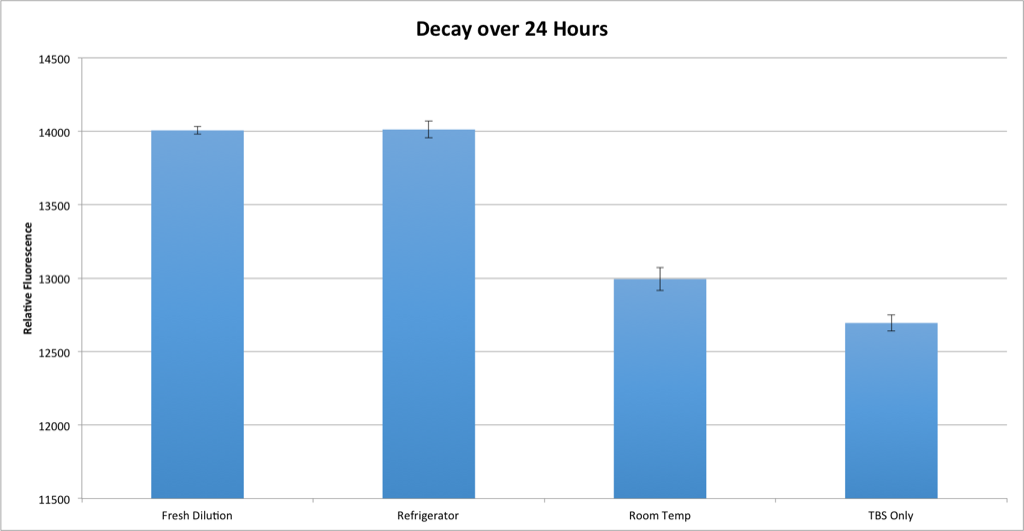
Exhibit B: The same, normalized such that buffer only is equal to “zero” and the fresh dilution of phosphatase is “one.”
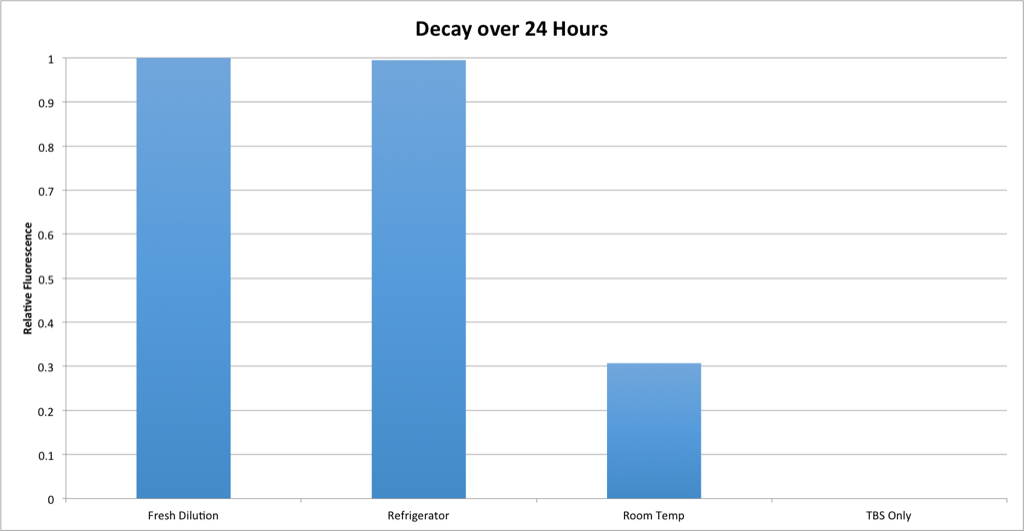
Over the course of the experiments, then, I would expect the signal from phosphatase-containing wells to drop to 30% the original max. The question is, is this enough of an attenuation to obscure all the signal from all the wells? If 100% of the phosphatase were recovered each time, it would not be, but I was never so ambitious as to expect 100% recovery. I will repeat the experiments (again) in the refrigerator, with carrier protein, and increased concentrations of reagents, in an attempt to finally get some signal out of this thing.
UPDATE:
| Sample 1 | t = 0 | t = 24hrs |
| Top Well | 0.0785 ug/mL | 0.0094 ug/mL |
| Bottom Well | 0 ug/mL | < 0.00032 ug/mL |
| Total | 0.0785 ug/mL | < 0.00972 ug/mL |
Possibilities:
Evaporation Would cause increased concentration
Condensation Was not observed and would have very small effect
Decay Already shown to be negligible under refrigerated conditions over 24 hours
Adsorption By process of elimination
Apparently the adsorption tests I ran can not be assumed valid for 24 hours and refrigerated conditions. I’ll rerun them under said conditions.