pnc-Si from PECVD
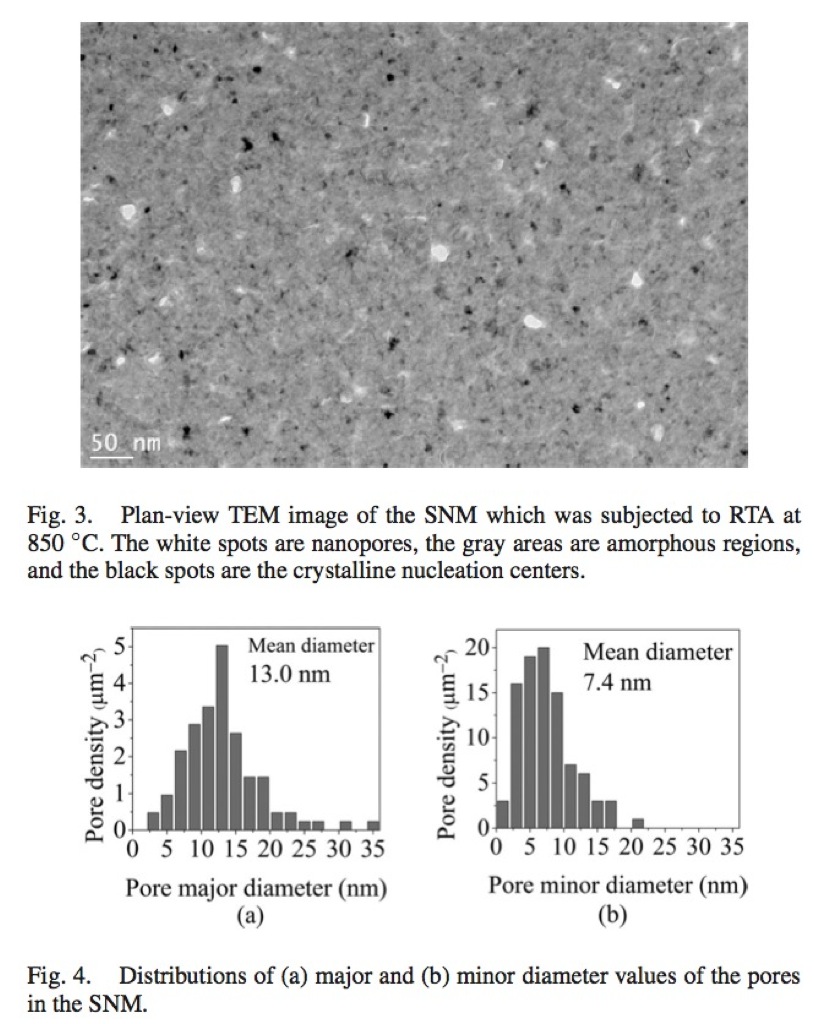
The group in the attached paper have found a way to form pnc-Si using PECVD. They use a 300-15-300 nm OSO stack with a 850 C (50 C/s, 30 s) RTP to form ~13 nm pores. SiMPore attempted this in the past, but was not able to form pores. Using PECVD would be faster than our current sputtering process, but the deposition rate is so high with PECVD that the film thickness might be harder to control. I think it was also assumed in the past that the precursor gases in the PECVD process made it incompatible with pore formation. PECVD’s have a variety of adjustable parameters, however, such as power, gas ratios, gas flow rates, frequency, and temperature. Apparently this group found a workable recipe:
(Here is the original publication this group made on the process, thanks to Bob Carter: Balachandra_Int’l J. Nanosci._2011
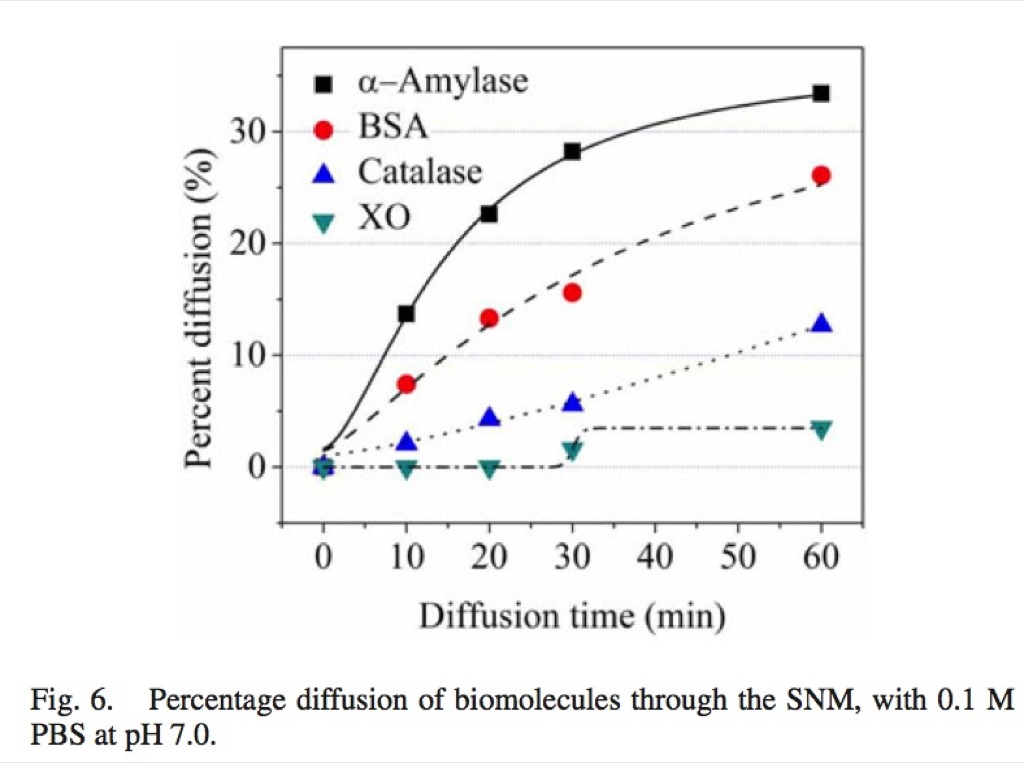
Below are images of the pores they formed and histograms of minor and major diameters. Also included is a plot showing the different rates of diffusion for biomolecules through the membrane. The reported sizes of these biomolecules at pH 7.0 are :
α-amylase (dh ∼ 6.4 nm)
xanthine oxidase (dh ∼ 13.6 nm)
BSA (dh ∼ 8.0 nm)
catalase (dh ∼ 9.0 nm)
This paper has some additional fabrication details. Can anyone access this paper?
H. V. B. Achar and E. Bhattacharya, “Nanoporous silicon membrane for
biomolecular separation,” Int. J. Nanosci., vol. 10, pp. 793–796, 2011.