Promoting adhesion of Nafion on silica using aminosilane
Aminosilane has been used widely to derivatize the surface of silica for the applications in analytical chemistry, biochemistry, and biomedicine. It also plays an important role in providing adhesion for Nafion coating on silica surface. The basic principle is described as follows.
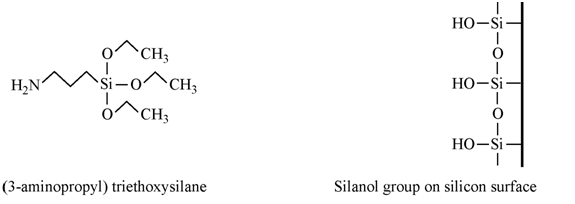
After oxidizing the surface of silicon, the next step involves the derivatization of SiO_2 at the surface using (3-aminopropyl) triethoxysilane in toluene. The silanol (SiOH) group on the surface reacts with the aminosilane, forming a siloxane bond and providing an amine functional group on the derivatized surface.
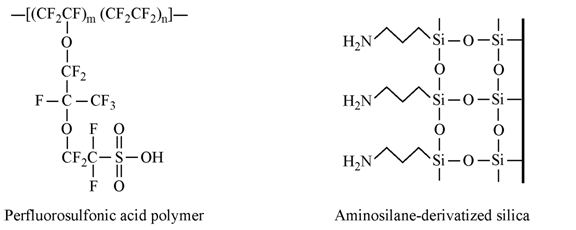
The perfluorosulfonic acid polymer, also known as Nafion, is introduced to the aminosilane-modified surface of silica. The sulfonic acid (HSO_3) group on the side chain of Nafion polymer reacts with the amine (NH_2).
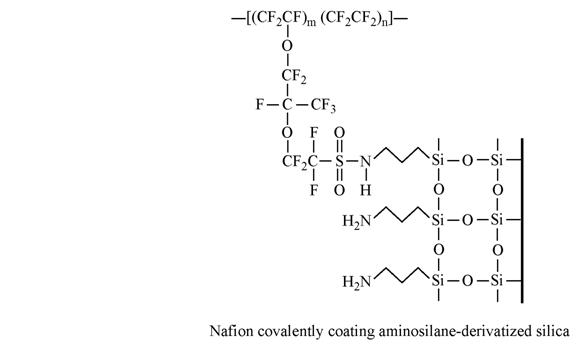
The sulfonation of amines results in the covalent coating of Nafion on the surface of silicon.

It is expected that when applying this technique, the pnc-Si membrane will inherit the cation-exchange capability of Nafion.