Native Oxide Etching for Micropores SiO2 Membranes
Bob and I are trying to determine which wet etch would be appropriate to use to remove the native oxide inside the pores before membrane liftoff. The issue is when removing the native oxide, we will remove part of the membrane.
So far, we removed native oxide from bare silicon wafers using 50:1 HF. For time points, 7, 15, and 30 seconds were used. Then, water droplet was added onto the wafers (see the image below). The oxide is hydrophilic and the silicon is hydrophobic. If the native oxide is removed, the water droplet should bead up. This was a crude measurement to see what time amount would be sufficient to remove the native oxide. The middle was slightly hydrophobic, which was probably due to the vapors. Water droplets was added to a reference wafer that has not been etched. The water droplets on the etched wafer were compared to the reference to determine its hydrophobicity. 15 seconds seems to be sufficient to remove the native oxide for 50:1 HF.
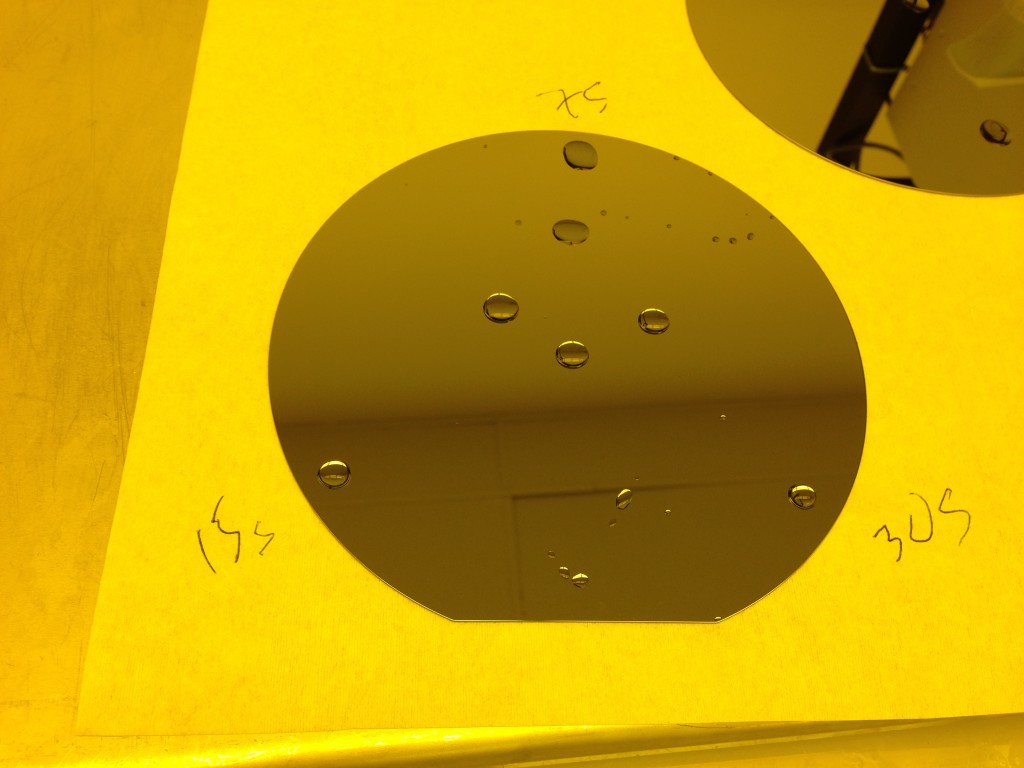
Wafer dipped in 50:1 HF
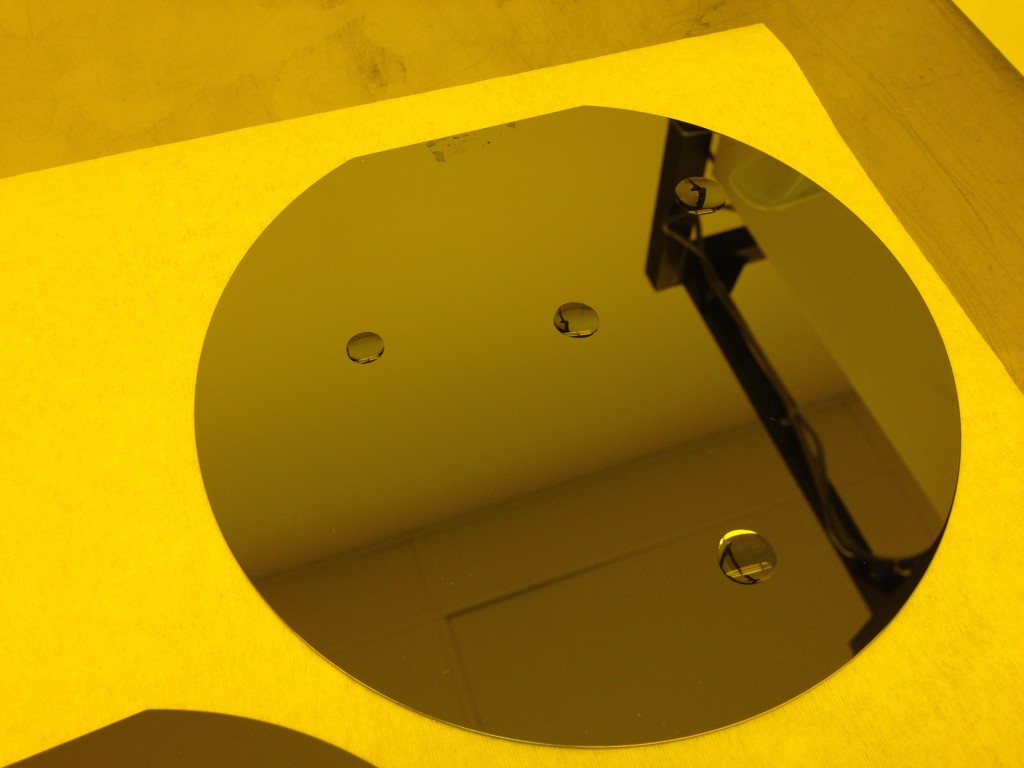
Reference wafer: Silicon with native oxide
From this, Bob etched a wafer with 300 nm thick TEOS layer in 50:1 HF to see how much it would etch in 15 seconds. The etchant only removed approximately 20 nm.
The question is would it be better to use a diluted BOE (with or without) instead of HF for uniform etching.
It’s my understanding that having a surfactant in the BOE would help you get a more uniform etching, especially inside nanopores. Unfortunately, I don’t have any first hand experience testing this theory.
Good luck!- Josh
The test you describe is generally done in the lab with a “pull test” to determine if the oxide is removed and it typically works quite well. You simply soak your wafer for the test period of time, then immediately dip it into to a DI rinse, and if it “pulls dry” the oxide is gone – hydrophobic due to hydrogen termination of the surface groups. The nice thing about this test is that it is immediate, since the “native oxide” starts growing back immediately, as you may have noticed in your study. In the pull test, I have found that it only works really well for the first dip in DI, if you dip it again, you get a couple water fillets left behind, and dipping it a couple more times leaves progressively more.
With a spectroscopic ellipsometer, you can also watch the “native oxide” grow in real time as the measured film thickness increases with each passing minute.
I don’t fully understand what you are trying to do, but here are a couple items that may be helpful:
1) BOE will leave behind more of a film than dilute HF when stripping a wafer. I did a lot of ellipsometry tests and found that ~1.5nm more “native oxide” remained on a wafer after BOE than after dilute HF. I think there are papers that talk about the formation of a fluorinated surface layer from the buffering in BOE, but I’m not sure anyone really knows. This is why dilute HF is used for RCA cleaning processes. However, this only applies if you are stripping down to a silicon layer.
2) Our TEOS is a nanoporous spongy glass, not a dense impermeable glass. This is why we use gas etching whenever possible, avoiding the capillary action of the etch into the porous matrix. If your process involves cleaning up large pores in TEOS, you have a balancing act of getting into the larger pores, but not getting into the nanopores of the TEOS matrix. This makes wet etch processes challenging with TEOS.
3) You could also us a vapor HF process. Just suspending a wafer over a dish of HF will remove native oxide, and there are vacuum tools that do this as well, although I’m not sure whether RIT has one.
4) “Native oxide” is only partially an oxide. It is a catch-all for all surface contamnation, including water and organics. If you can avoid the growth of this material in the first place, it would probably make your life easier.
5) The observed “native oxide” thickness on pnc-Si is typically much less than on a bare Si wafer, so the wafer is not a great surrogate, if your actual process involves pnc-Si. Not sure if this applies….
Chris,
Thanks for your comments. To clarify, we are creating micro-porous oxide layers (via TEOS) that we want to lift off using XeF2 dry etch. Josh Miller found previously with his liftoff work using nitride membranes, that a brief BOE strip was required to strip the native oxide that would form on the underlying silicon (at the bottom of the micropores). Without the BOE strip, the XeF2 etch was extremely hindered. The dilemma now w/ oxide membranes is that whatever means we use to strip the native oxide is also going to attack the oxide membrane (and at a faster rate since the TEOS oxide is nanoporous). Depending on how much trouble we run into, it may be helpful to talk with you for a few minutes to get some more specific input. I think the vapor process of simply suspending the wafer over a dish of HF solution is likely to be the best approach. JP was cautioning us against a wet process because of the issues of wetting the micropores combined with faster etch of the TEOS layer.