NPN and pnc-Si deflection tests
I went over to RIT to work with JP on measuring the deflection of NPN and pnc-Si membranes as a function of pressure. JP and Dave Fang did this work years ago, and we want to pick it up again to correlate with Sarah’s burst pressure data.
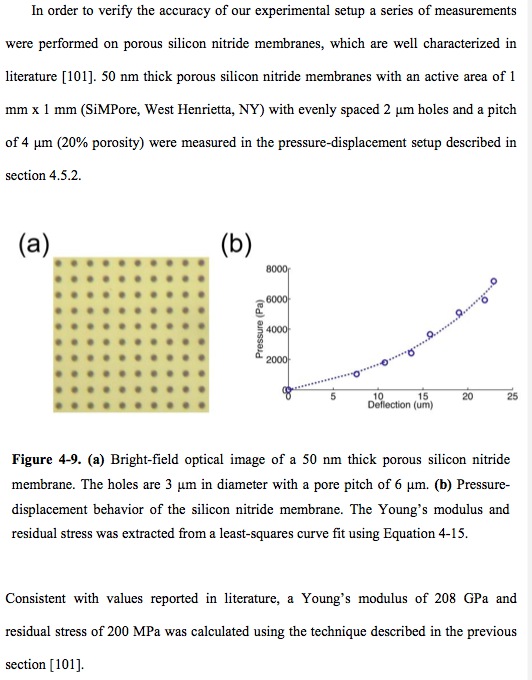
We used the Veeco Wyko (white light interferometer) to measure the amount of deflection at the center of the membrane for a given pressure. Dave’s thesis first looks at the deflection of a SiN membrane with nanopores and from that he calculates Young’s Modulus (208 GPa)and the residual stress (200 MPa) of SiN. (below)
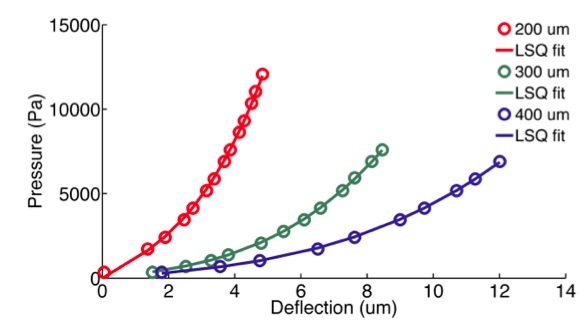
Next he presents data on pnc-Si with three different window sizes. Notice, there is only data for pressures up to about 2 psi (6895 Pa = 1 psi)
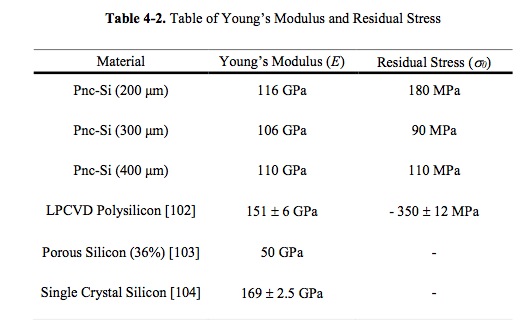
He fits the above curves with an equation found in a paper by Vlassak to get the Young’s Modulus and Residual Stress of pnc-Si in the following table.
We repeat these tests with chips from the same wafers Sarah used for her burst pressures studies and get the following plots:
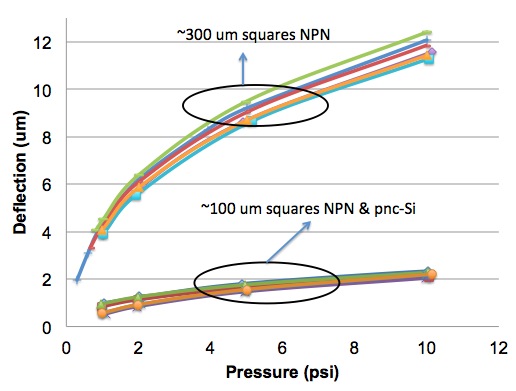
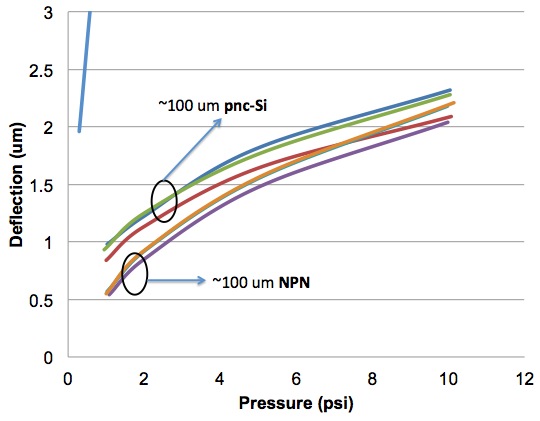
I typically started at low pressures and increased to 10 psi. On some samples, I reduced the pressure after 10 back down to 2 psi or so to verify that the membrane had not been plasticly deformed. They always returned to the same deflection at lower pressures.
I next tried to fit these curves with equations from Vlassak and Timoshenko. In order to do that, I measured the actual window size of each chip and they are summarized in the tables below. The coordinates are Sarah’s label so she can reference each samples location on a wafer. (The A,B, C is because I didn’t have coordinates for a few)

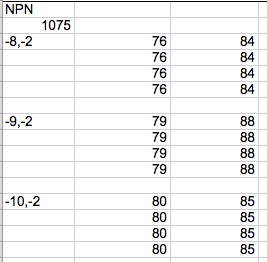
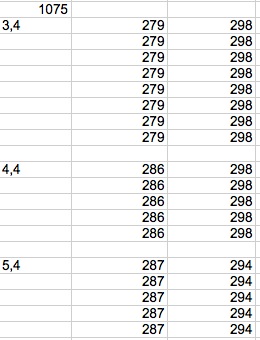
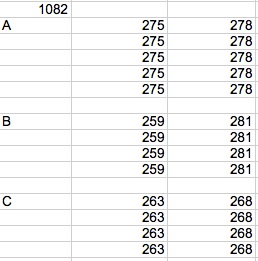
I used the Young’s Modulus and Poisson’s ratio reported in literature. In general, the Young’s modulus of a porous material is Eporous= Ebulk (1-porosity)
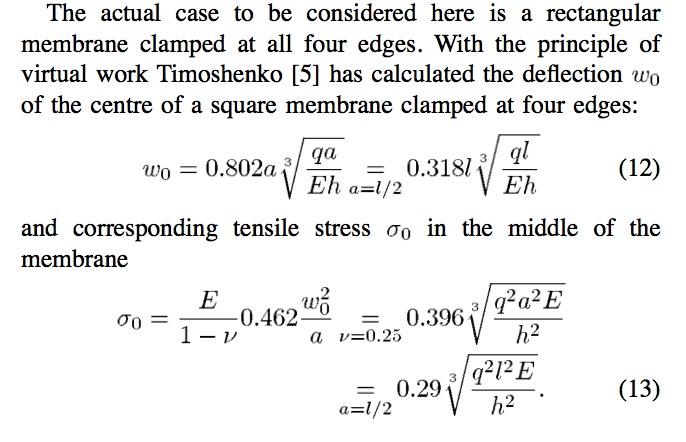
I haven’t actually looked at the original Timoshenko work, but the equation was provided in a paper by van Rijn. vanRijn-1997-Deflection and maximum load of mi
The equation looks like this:
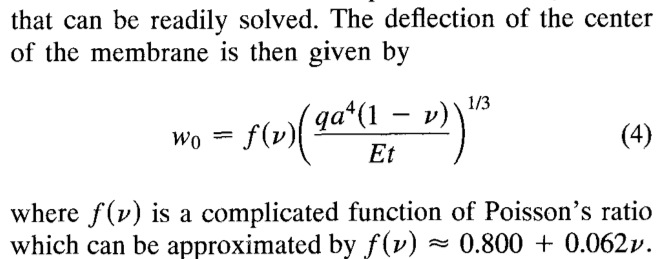
And the Vlassak paper 1992 Vlassak has a model for square and rectangular windows:
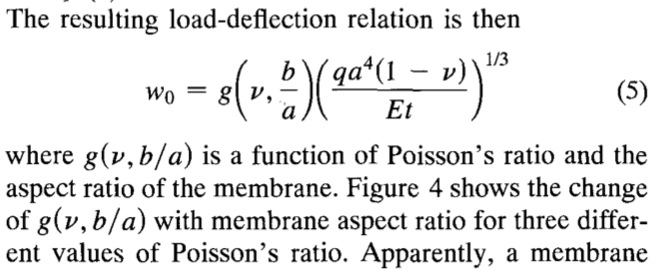
The function g(v,b/a) is provided in the following plot:
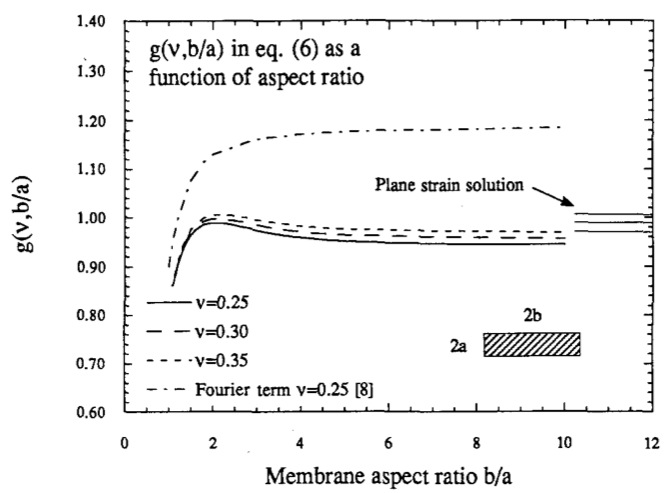
But our aspect ratios are pretty close to one so we can focus on the steep section of the curve to the left:
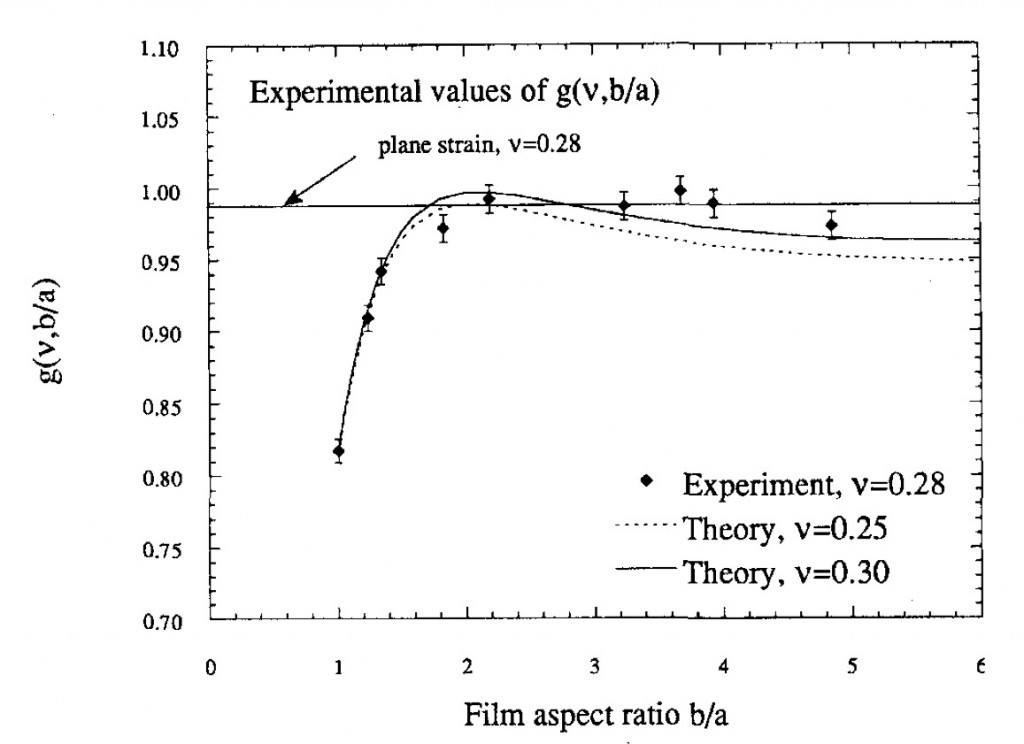
I did a linear fit to the line from 1-1.4 and got g(v,b/a)= -0.4125 (b/a)^2 +1.3225 (b/a) – 0.093.
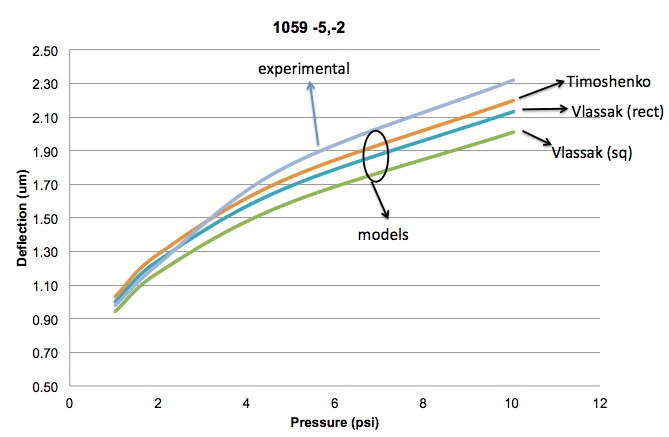
-All of the models do a pretty good job at low pressures, but then underestimate the deflection at higher pressures.
-These models don’t account for residual stress. (But Vlassak does provide a method for calculating the residual stress once the experimental data is fit.)
-The difference between the experimental data and the models are consistent between different window sizes and different materials.
I want to try a model where the young’s modulus reduces as deflection increases. I assume the porosity increases with deflection, so by our earlier equation, E may as well. The thickness may decrease as well, compounding the effect.