Effect of increasing dialysate flow rate on diffusive mass transfer of urea, phosphate and β2-microglobulin during clinical haemodialysis
This is a useful paper for our work on Hemodialysis. The authors examine the clearance rates of urea, B2 microglobulin and phosphate as a function of dialysate flow rate . Two things surprise me in this paper: 1) the clearance levels achieved are much higher than I’ve come to expect, and 2) the clearance only modestly improved with higher flow rates. The paper examines a large number of dialysis membranes and raises several issues – such as B2 micro loss to the membrane – where we might be able to offer benefits.
Quick overview …
- Blood flow was 400 ml/min
- Dialysate flow rate was 350 ml/min, 500 ml/min, 800 ml/min
- Ultrafiltration minimized (100 ml/hr)
- Clearance measured after 45 minutes (15 minutes?) of operation.
- Blood samples drawn from upstream and downstream sections of blood line
- Output of dialysate stream sampled.
- Concentrations corrected for cell (hematocrit) and protein fractions of blood: “blood water flow rate” vs “Plasma water flow rate”
- Loss of B2 microglobulin at the dialyzer
Note the thickness and length of the membranes in Figure 1.
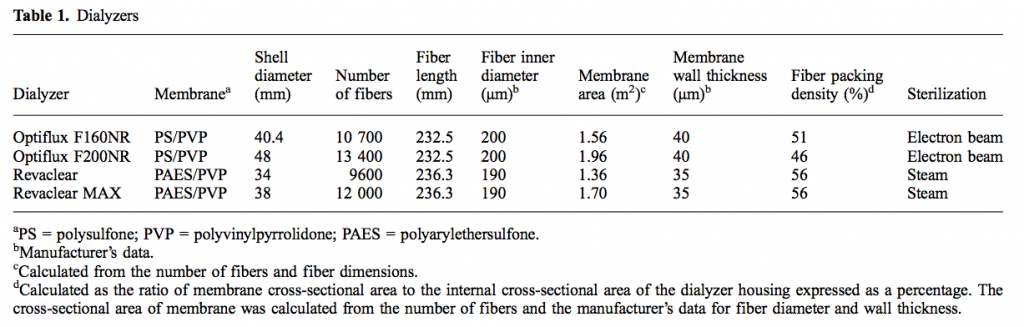 Urea permeability values are reported as 0.04 cm/min. Molecules much smaller than pores in our ultrathin membranes have an intrinsic permeability of ~3.6 cm/min (~100 times better) but achieving this will require excellent fluid design.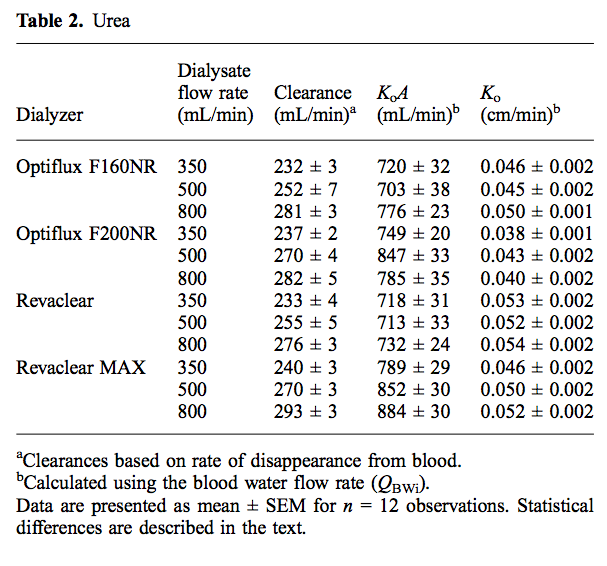
- Urea clearance, but not B2 or phosphate clearance is dependent on dialysate flow rate. They argue that clearance isn’t flow dependent but their data suggests otherwise.
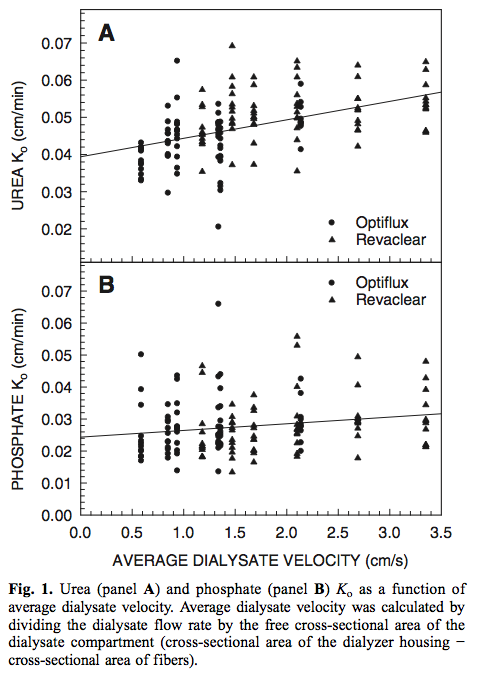
“Our inability to reproduce our previous finding of a statistically significant increase in urea KoA with increasing dialysate flow rate [3] is consistent with better dialysate flow distribution through the use of undulating fibers in the current study compared to straight fibers in our previous study, together with possible improvements in baffle design. Taken together, our data suggest that the blood-side re- sistance to mass transfer is limiting for small solutes in dialyzers incorporating features to promote good flow dis- tribution in the dialysate compartment, such as undulating fibers. Although strategies designed to increase dialysate velocity, such as increasing the fiber packing density for a given membrane surface area and fiber length, appear to have some effect on dialysate-side mass transfer resistance for small solutes, the resulting reduction in overall mass transfer resistance appears to be small in the setting of clinical dialysis where blood-side resistance is greatest.”