I’ve been gathering data for a paper using my microporous MgF2 nanomembranes so here are some sample figures for such a paper.
Herein, we are trying to create a porous, Raman-compatible substrate for use in cell culture. Researchers have used Raman microspectroscopy to perform quantitative non-invasive measurements of biomolecules in cells. It’s a very exciting technique. While silicon based substrates have excellent properties for cell culture, they have strong Raman background signals and absorb a lot of laser power at the illumination wavelengths we would like to use. MgF2, Quartz, and CaF2 are considered Raman-compatible for their substantially weaker backgrounds. Researchers currently deposit or culture cells on non-permeable coverglasses made of these materials. However, we have known that cells sometimes require a permeable substrate to adopt morphologies that are more consistent with in vivo studies of morphology. So using our microporous nitride substrates, we wish to create a substrate that will have both the permeability and the Raman-compatibility necessary to facilitate more accurate Raman studies of those types of cells.
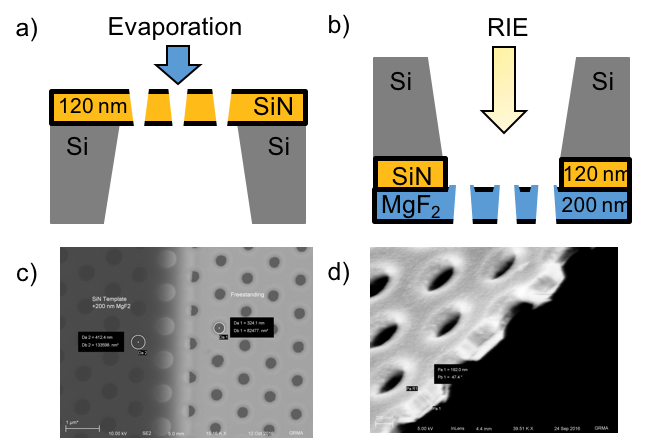
Figure 1. MgF2 nanomembrane material properties. (a)-(b) MgF2 relief pattern transfer, with cartoon crossections of microporous films (not to scale). Beginning with a freestanding film of microporous silicon nitride (a), MgF2 is evaporated onto the substrate (200 nm, 0.1-0.3 nm/sec, 250 °C, Platen Rotation), coating the porous substrate, resulting in a hybrid material. (b) The substrate is then inverted and purified using RIE (90% CHF3, 10% Oxygen, 75 mTorr, 100 W), releasing a freestanding nanoporous film of MgF2. (c) A SEM image normal to the membrane plane shows the infilling effect of the direct evaporation process, as the template pores narrow from their designed 500 nm diameters to approximately 325 nm. (d) SEM crossection of a partially etched MgF2 nanomembrane (with some template backing remaining), showing film thickness close to the targeted 200 nm.
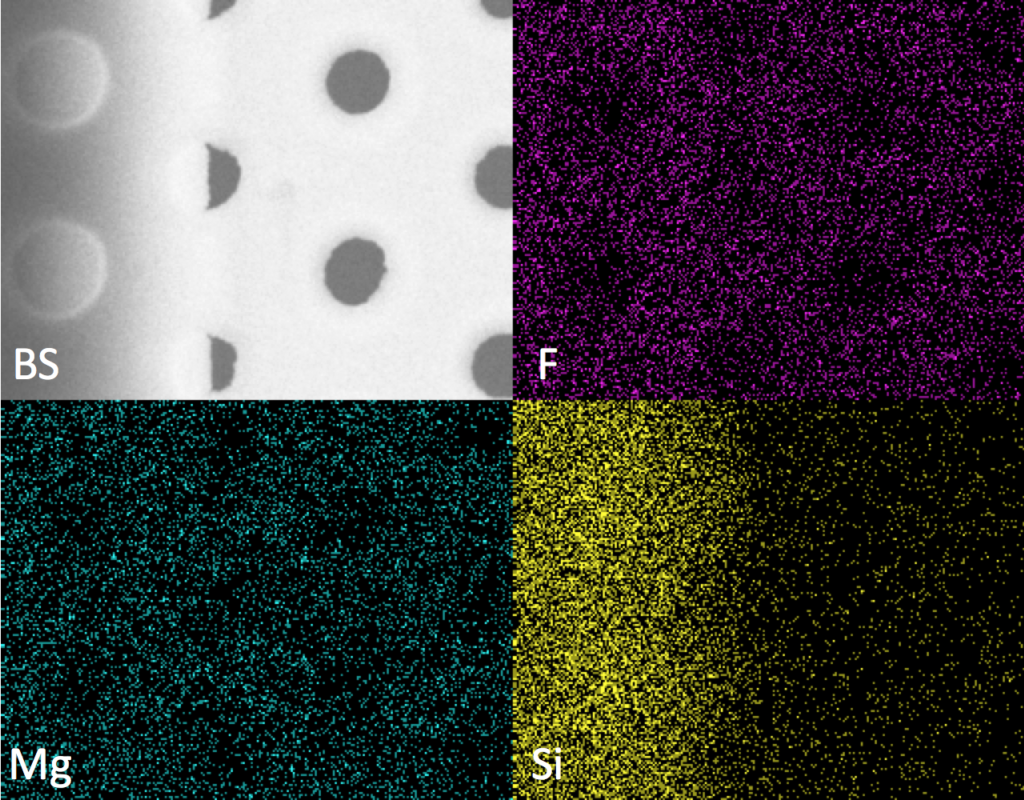
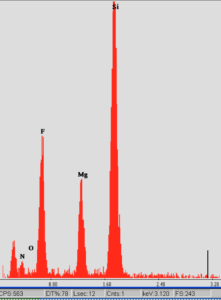
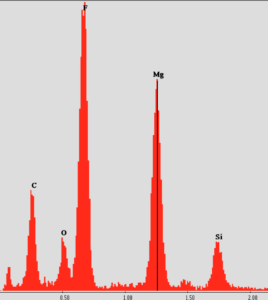
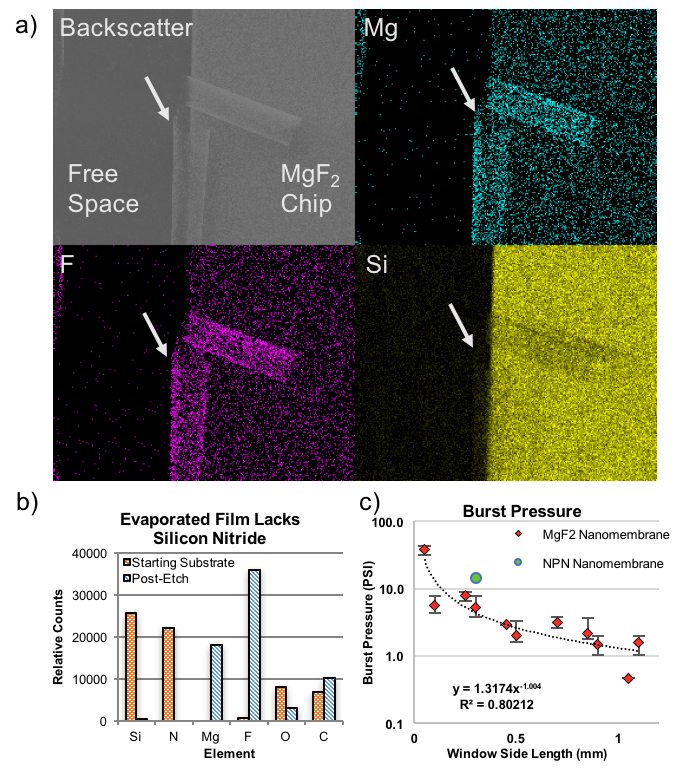
EDS measurement of the composition of the freestanding membrane. While the Mg and F signals are preserved across the freestanding region, the Si signal is not. The membranes are >85% MgF2 in the freestanding region. As a side note, there was some sample drift, so the image is blurred. This is a 30kX image.
Before Etch
After Etch
Previous Figure with 50 nm thick nanoporous MgF2. Here the burst pressure for the 200 nm microporous MgF2 is about 7 PSI, over a 5-slot structure instead of a square window.
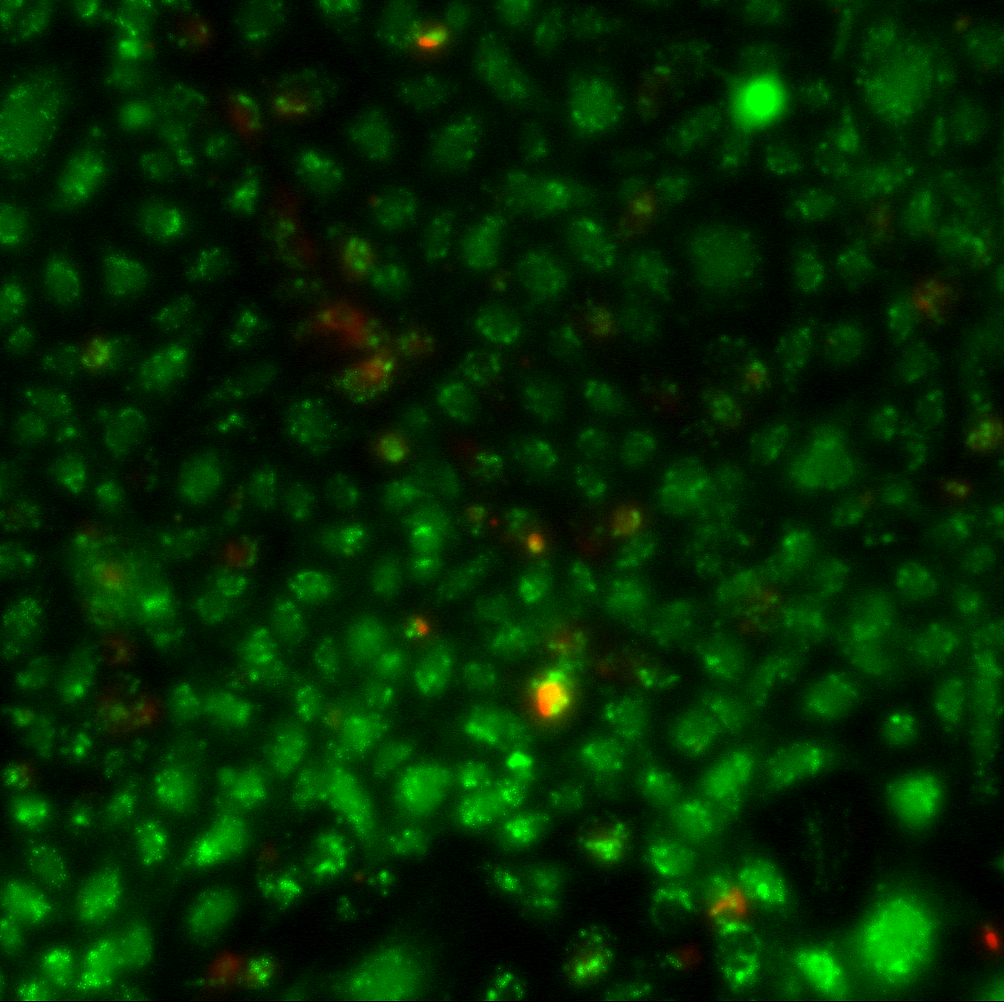
20X Live/Dead stain image of P6 HUVECS (Day 7) on fabricated microporous MgF2 grown in MCDB131 media. Eventually, we will use ARPE-19 Cells with tight junction staining which have a characteristic response to permeable substrates.
We will have to reestabilish the Raman background of the membranes, but the material composition looks to be the same as with my nanoporous material. HUVECS seem to stick ok without using any additional coatings.
Sabrina’s post showed that on a bench top, with ‘blood’ source and return at ATM, the transmembrane burst pressure was between 0.5 psi and 1.5 psi, (initial and after DI or PBS flow for four hours). Extrapolating from Burst pressure chip tests for the 10 mm long HD chips, we can expect the burst pressure to be somewhere between…
Here are the sizes of the particle ladder by TEM. I compare to the previous unmodified DLS results in this table. Manufacturer’s Size TEM size Stdev DLS Size 5 6.6 .6 8 10 7.8 .9 9.4 15 12.7 .9 13.2 20 16.0 1.5 17.2 30 25.7 2.1 28.8 40 34.3 2.3 30.7 The particles aren’t…
For a while now I’ve been working on developing and testing the practicality of using nanoporous membranes as filters for highly sensitive assays. Traditional filter-based assays are restricted in their speed by both the time it takes for a particle to find a pore as well as the time it takes for the particle to…
15um beads on discolored membrane surface, having some slits where the beads are not found The localization of microbeads suggest that they have fallen across the slits in the membrane Transparent membrane with microbeads on its surface These membranes are not treated with cell media, hence are not discolored. There’s a slit which appears to…
In order to test the sealing of the capillary tubing the PDMS I made a batch of PDMS with a recess in it (from a dime). Once this cured I used the UV Ozone process (@25C) to bond the PDMS to a glass microscope slide. When I arrived this morning the system was fully bound….
In response to last meeting: We tested more controls to help support our idea that the ADSC are migrating toward HUVEC network and prematurely breaking them down. We used a 100% Geltrex coated cytovu gasket to test if ADSC are attracted to something in the Geltrex causing them to migrate. The ADSC did not migrate…