Cell-Basement Membrane vs Basement Membrane-SiO2 Interactions in a Shear Influenced Device
Introduction
When concerning the issue of adherence on any substrate, the main two interactions that matter most are that of the cell interacting with the basement membrane (whether cell produced or artificially added) or the interaction between the protein based basement membrane and the substrate providing structure for cell culture; in our case SiO2 membranes. Cell-BM interactions are mainly regulated through integrin complexes termed focal adhesions (FAs). BM-SiO2 interactions, however, are mainly charged based. To solve the issue of cell delamintation under shear, we must first elucidate what mechanism is responsible: cell-BM failure, loss of BM-SiO2 interaction, or both. In this experiment, HUVECs culture on 5% porosity 3 um SiO2 membranes were sheared off the surface and immunocytochemistry was utilized to image basement membrane.
Methods
Standard PDMS based microfluidic devices were assembled with a 3 um 5% poroisty SiO2 membrane placed in the center. Membranes were coated with human FN and washed with media. HUVECs (P4) were perfused into the device and left to culture for 24 hours followed by 4.5 dyn/cm2 shear for 3 hours. Control devices were set aside in the incubator and did not experience shear at any point of the experiment apart from media changes.
ICC
Cells were…
- fixed with 4% PFA for 5 mins at 37C
- permeabilized with 0.1% triton-x 100 for 1 min at RT
- blocked with 1% BSA for 1 hr at RT
- treated with anti-FN primary produced in rabbit (1:100) for 90 mins at 37C
- labeled with FITC anti-rabbit (1:100) and phalloidin-TRITC (f-actin) for 1 hr at RT
- counter-stained with 1 ug/ml DAPI (Nuclei)
Results
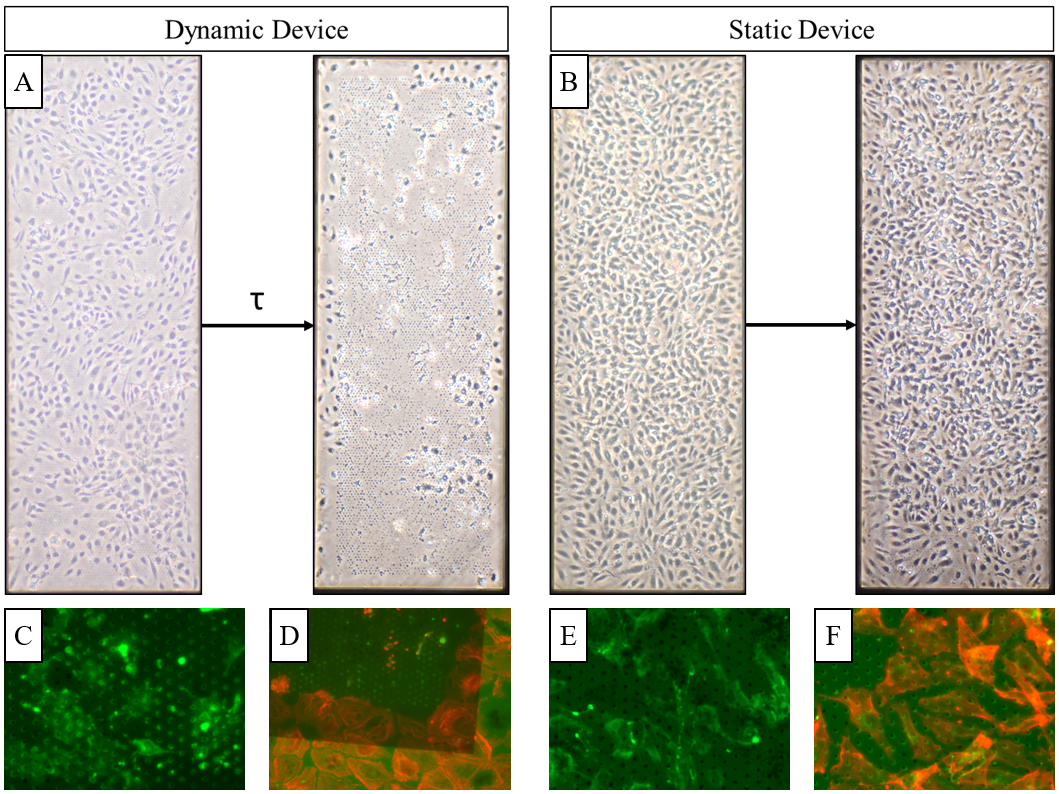
Conclusion
Basement membrane (at least in part) remains intact after shear, pointing to the conclusion that cell release is caused by a variation in cell-basement membrane interactions depending on pore size. This is an interesting conclusion, as it appears that FN completely coats sections of the membrane, occluding the pores in some cases. Nonetheless, this result leads us to the hypothesis that cells favor cell-cell interaction over cell-basement membrane interaction on a larger pore surface. The switch of interactions causes cells to adhere less and shear off. Due to the immediate cell release (within the first hour), it is likely that shear itself does not influence cell interactions to cause release. Further preliminary experiments will be aimed at addressing coatings and integrin interactions based on substrate patterning as well as stiffness.