Monocyte Isolation via CD14+ Selection (Protocol)
Please see the attached .PDF file for a full monocyte isolation protocol. This is for isolating human monocytes from whole blood.
Please see the attached .PDF file for a full monocyte isolation protocol. This is for isolating human monocytes from whole blood.
Introduction A recent collaborative publication from RIT developed a modular µSiM to address the lack of physiological fluid flow in conventional open-well devices (Figure 1). The magnetic latching assembly of this design allows for quick configuration into a fluidic setup. The flow module is a microfabricated PDMS insert that contains a channel over the membrane…
Introduction/Methods As part of our investigation into neutrophil transmigration on tissue chip systems featuring HUVEC monolayers, I have been working on developing code for both cell state analysis and tracking using Wolfram Mathematica (and occasionally Python). This project relies on semantic segmentation via machine learning and microscopy video corrections, both of which have been described…
Introduction Pericytes are mural cells that line the outer surface of microvessels and regulate diverse aspects of vascular development and function. We differentiate brain-pericyte-like cells (BPLCs) from hiPSC clones using the protocol published by Eric Shusta’s lab (Gastfriend et al., 2021) (Figure 1). This protocol describes methods to differentiate hiPSCs to BPLCs via neural crest…
Introduction: Many applications of the µSiM require fluid to be continuously supplied to the microfluidic devices. We use laboratory tubing (typically Cole-Parmer/Tygon Tubing with I.D = 1/16″) that is connected to syringes or peristaltic pumps to do so. However, interfacing the tubing with the current entry and exit ports for the bottom channel is not…
In Part 1 we explained that the composite barrier in our model of the post-capillary NVU is determined by RBBB = RBlB + R2 + RBrB where is R2 is the resistance of the ‘perivascular space’ in our chip. Unlike the other two, the perivascular space is not a regulated cellular barrier that we need…
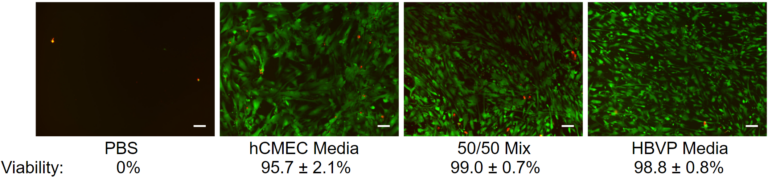
Introduction Mural cells, including smooth muscle cells and pericytes, are important for supporting endothelial cells in the vasculature [1]. They play a role in angiogenesis, and contribute to the development of the vascular basement membrane that provides structure for blood vessels [1,2]. Numerous in vitro models of the blood-brain barrier (BBB) have incorporated pericytes alongside…