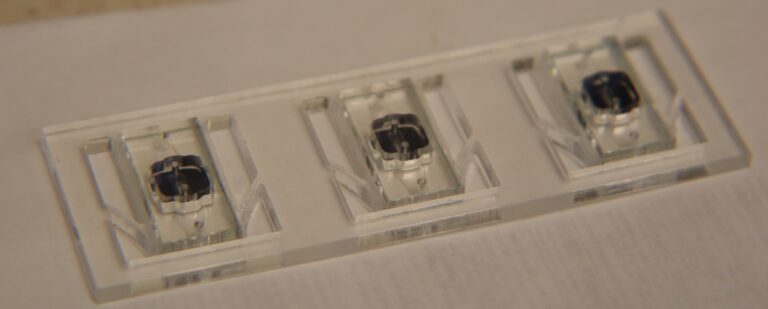
Evidence of functional sodium/hydrogen exchangers in single EVs captured on NPN
Thanks to our collaborators at the University of Chicago we have now used NPN to demonstrate sodium/hydrogen exchange functions at the level of single EVs. This is first-of-a-kind evidence of protein function in individual EVs. It will be officially published in Communcations Biology and will soon be located at this DOI. What follows are key highlights and take-homes from this important new work.
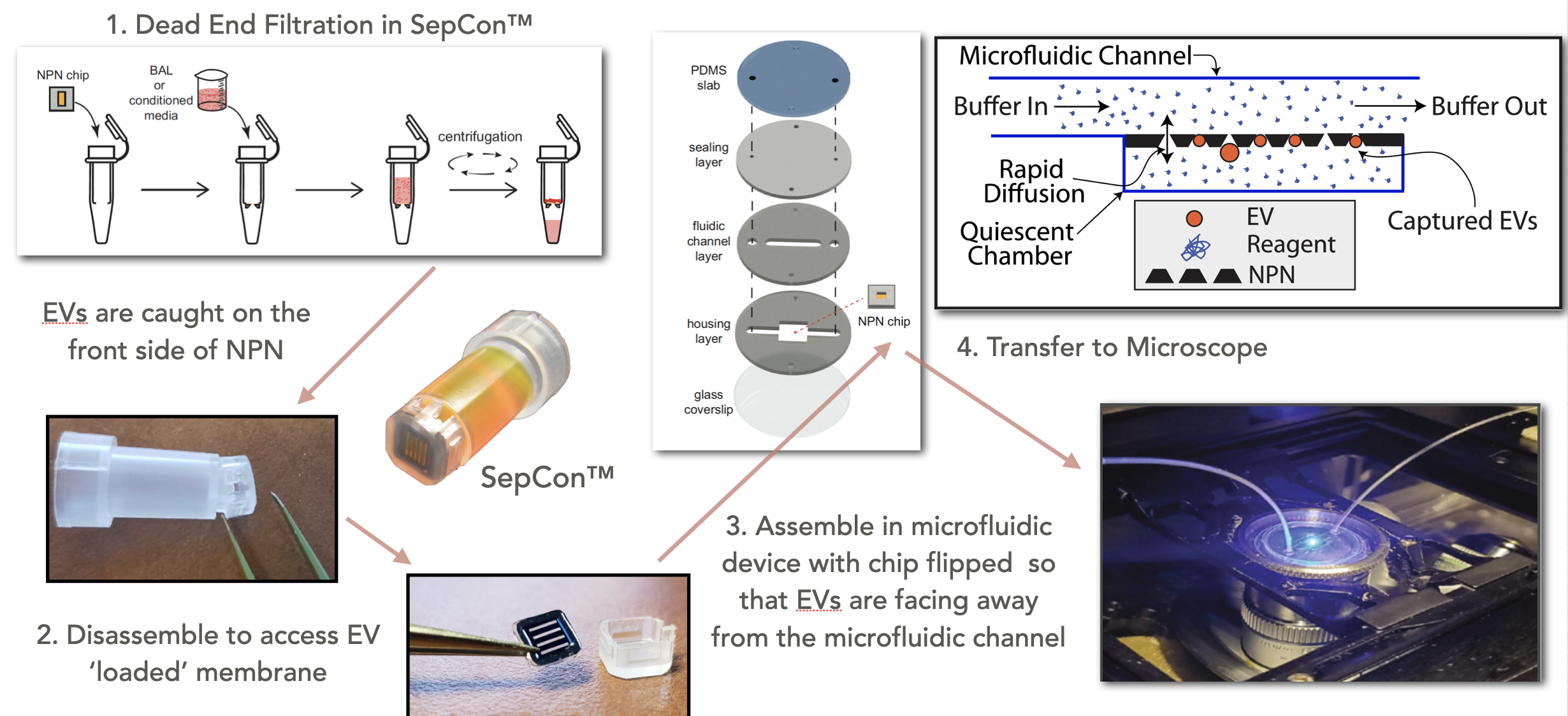
The methodology involves spinning a preparation of EVs through a SepCon™ with an NPN chip. The chip is then removed from the SepCon™ and added to a custom flow cell built following our (until recently) standard methods. The chip is oriented so that the captured EVs are on the backside of the primary flow channel. In this way microfluidics is used to rapidly exchange reagents from the flow channel to an EV chamber without physically disturbing them. This design takes advantage of lessons learned from Henry Chung’s work back in the day (Chung, et al. (2014) Lab on a Chip 14:2456-68): our nanoporous materials do an excellent job of decoupling fluid forces on one side of the membrane from the other side.
To convince ourselves (and the reviewers) that we were able to visualize single EVs in a microscope, we measured the size of Bodipy (a general membrane label) -stained objects by super-resolution microscopy. Because the smallest EVs (exosomes) are 50- 150 nm, size measurements are a challenge for even super-resolution, an average measurement of the smallest objects in the field-of-view came in at roughly the resolution of super-resolution microscopy (150 nm) even with a deconvolution step added in post-processing. To illustrate that this was the limitation of our system, we also imaged 100 nm TetraSpeck™ beads (measured by DLS to be 90 nm and highly monodisperse) and got roughly the same measurement. So the smallest objects in a field of view are roughly the size of small EVs (likely exosomes). Of course with a 150 nm resolution limit, the spots may occasionally be doublets or triplets of exceptionally small EVs. However the evidence that follows also shows that the spots also show individual responses, which helps strengthen our claim of single EV imaging.

The next experiments in the paper demonstrate the use of Acridine Orange as a pH sensitive label of the microenvironment in the EV lumen. AO is membrane permeant dye with a fluorescence that is highly dependent on pH (quenches at lower pH). AO is used routinely in the study of intracellular vesicles which undergo pH changes as they traffic and evolve in the cytoplasm.
The team first showed that Bodipy and AO stains co-localize on an isolated vesicle (satisfying another reviewer concern). They then used the flow cell to challenge the field of EVs to external buffers with different pHs. The fluorescence remained essentially unchanged with these challenges (some fluctuations) demonstrating that the EVs were intact. When the experiment is repeated in the presence of the ‘protonophore’ FCCP (which equilibrates protons across membranes), the external pH becomes the luminal pH and the fluorescence measured responds accordingly.
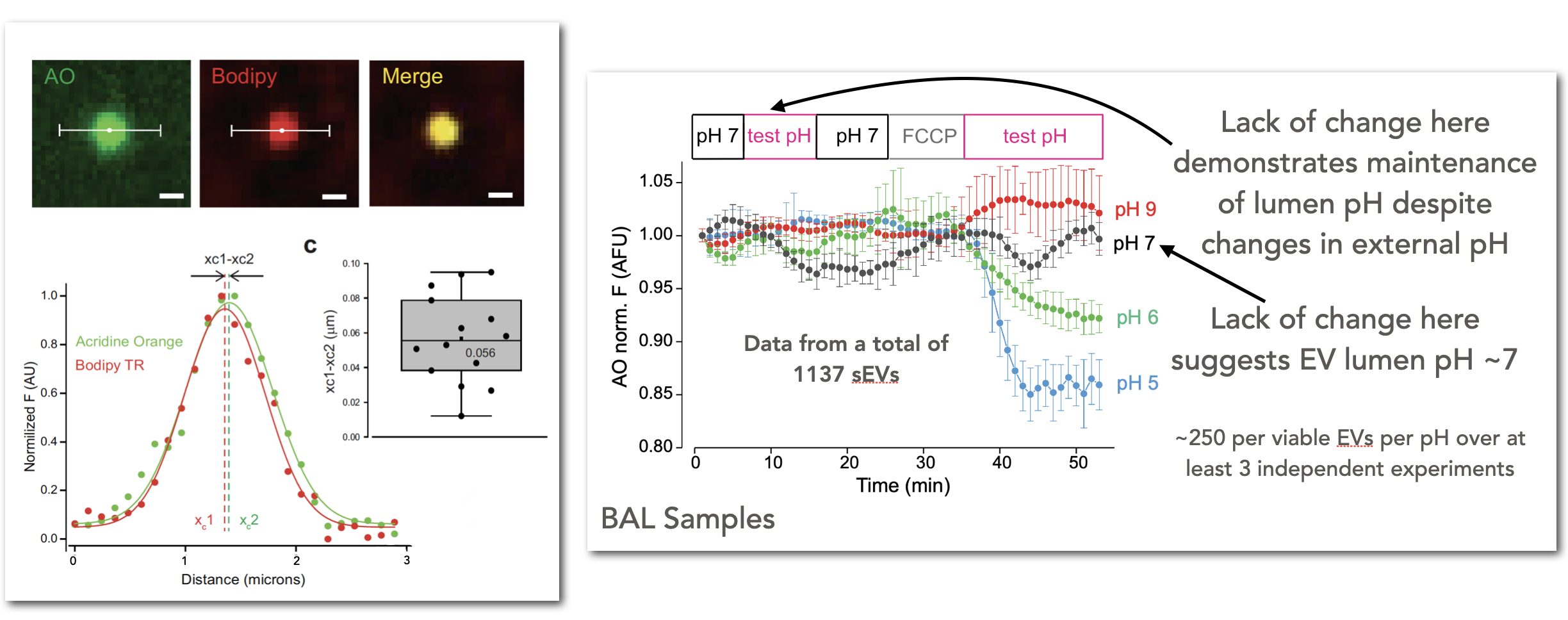
There are a couple of important points about the above experiments you should not miss: 1) the studies were done on a field of EVs subject to serial changes in buffer conditions in situ . So the traces show the history of individual EVs experiencing changing microenvironments in real time (I think this is also a first-of-its-kind experiment). 2) The data represent real-time imaging of 1137 vesicles! Experiments at each pH were done in at least triplicate with about 80 EVs per field-of-view. It is also noteworthy that there is no real change in the fluorescence from the vesicles when allowed to equilibrate with a pH 7 buffer. So EVs are naturally at neutral pH. I’m not sure if anyone knew this before.
Now for the evidence of functional sodium/hydrogen exchangers (NHE) on EVs … First, Western ‘dot’ blots established that the most ubiquitous of the NHEs, NHE1, is present in the main sample of EVs used in this paper which are from bronchial alveolar lavage (BAL). To set things up, the experiments washed in ammonium ions which are known to pass right through membranes and so the lumen of the EVs was quickly acidified. Now with a slightly quenched level of fluorescence as the baseline, washing in Na+ caused a spike in fluorescence as NHE1 exchanged external sodium for internal protons and raised the internal pH. The team proved that this was exchange was mediated by NHE1 by using a NHE1-specific inhibitor called HOE.
Again, the flow cell allowed a whole field of NPN-captured EVs to be assayed during microfludic exchanges of buffers in a serial fashion. This is a simply awesome example of our “Catch and Display” concept.

Interestingly, a large fraction of the EVs were non-responsive to the buffer exchanges. That fact that we even know this demonstrates the power of single EV (i.e. ‘digital’) analysis, as a bulk measurement would simply average the responsive and non-responsive EVs and leave us ignorant to the details. There are two likely reasons for non-responsive EVs: 1) some EVs do not express NHE1 and 2) some EVs have non-functional NHE1, possibly from damage during purification or storage.
The Nelson lab looked at these possibilities as a very useful study that concludes the paper. They first showed that NHE1 was expressed in two cell lines in addition to the BAL samples used for the above studies. The levels of NHE1 was different between the sources however and since a lower level of NHE1 expression appears to correlate with a larger pool of non-responsive EVs, the data is consistent with the idea that some EVs are non-responsive because they are empty of NHE1. The team also examined EV storage conditions and convincingly show that a freeze-thaw cycle results in an increased pool of non-responsive EVs. The control is freshly isolated BAL EVs and each of the tests were for a 24 hour period. So the mistreatment of EVs can lead to non-functional NHE1 is a likely explanation for some of the non-responsive pool. This is a wonderfully practical result. Many more papers could be written examining the impact of purification strategies on EV function and viability. Again the the numbers of single EVs analyzed in these studies is impressive.