Skip to content

Nanomembrane Research Group

  • Home
  • Publications
  • MembranesExpand
    • Common Chip Formats
    • Common Membranes
    • Microslit Membranes
  • DevicesExpand
    • µSiMExpand
      • Geometry
      • µSiM CAD Files
      • AssemblyExpand
        • Protocols.io (µSiM Assembly)
        • Instructions
        • Common Issues and Troubleshooting Tips
      • Cell Culture ProtocolsExpand
        • Top Well: hCMEC/D3
        • Top Well: HUVEC
        • Bottom Channel Culturing
        • Immunocytochemistry Protocol
        • Impact of Chip Orientation on Fluorescence Imaging
        • Permeability: In Situ Method
        • Permeability: Sampling Method
        • Cell Culture Common Issues and Troubleshooting Tips
    • SepCon®Expand
      • Sepcon Assembly
      • Sepcon Video Protocol: Assembly
      • SepCon Gasket Silhouette File
      • SepCon Video Protocol: Wetting the membrane
      • SepCon Video Protocol: Disassembly
    • µSiM-DXExpand
      • µSIM Video Protocol: Capture of Nanoparticles
  • ImpactExpand
    • TraCe-bMPS
    • HCIC
    • LOMP
    • SiMPore
Nanomembrane Research Group
  • Wafer #1540 – 1 Slot NPN
    Wafer QC Pages

    Wafer #1540 – 1 Slot NPN

    ByAhmet Gurcan May 21, 2024May 22, 2024

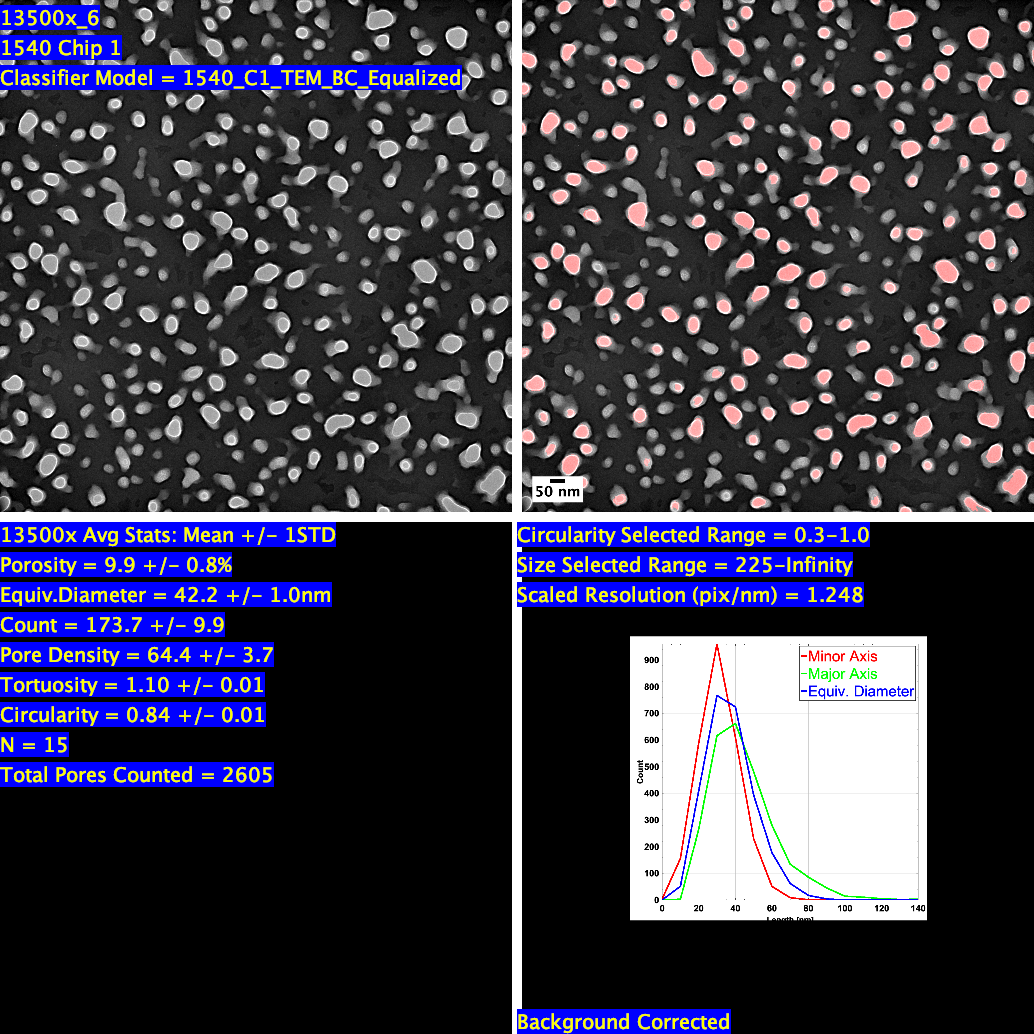
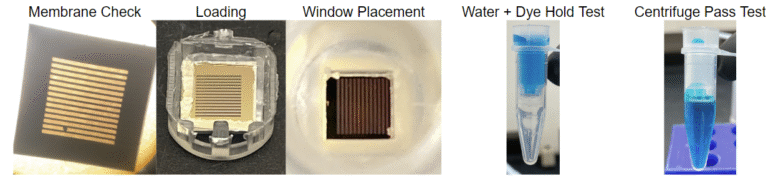
    Manufacturer’s Data Delivery Date: 5/20/2024 (picked up and logged by Ahmet Gurcan) Membrane Type:  NPN 1 Slot SKU: NPSN100-1L Lot Number: 1540 Quantity Received: 225 Manufacturer Test Report: Pore Size: N/A Porosity: N/A Flow Data Avg in SLPM 2psi: N/A 4psi: N/A Burst: N/A Packing slip & invoice: None UR Testing Porosity: 9.9 +/- 0.8%…
    Read More Wafer #1540 – 1 Slot NPNContinue

  • NRG

    Measurement and analysis of pore size variability in microporous membrane chips acquired from Aquamarijn

    ByArvind Srivatsava May 17, 2024

    The purpose of this study was to characterize pore sizes on Aquamarijn (Aquamarijn Membranes B.V., the Netherlands) membrane chips. Membranes provided to us by Aquamarijn have a design specification of 450 nm pore size across 14 windows in the chip. Chips were sputter coated with gold particles at 20 mA for ~60s after which SEM…

    Read More Measurement and analysis of pore size variability in microporous membrane chips acquired from AquamarijnContinue

  • memBrains

    Assessing the Permeability of Two Barriers in the Post-capillary Neurovascular Unit Part 2: Measuring R2

    ByJim May 5, 2024May 6, 2024

    In Part 1 we explained that the composite barrier in our model of the post-capillary NVU is determined by RBBB = RBlB + R2 + RBrB where is R2 is the resistance of the ‘perivascular space’ in our chip. Unlike the other two, the perivascular space is not a regulated cellular barrier that we need…

    Read More Assessing the Permeability of Two Barriers in the Post-capillary Neurovascular Unit Part 2: Measuring R2Continue

  • Compatibility of Aquamarijn Membranes in the SepCon Devices
    NRG

    Compatibility of Aquamarijn Membranes in the SepCon Devices

    ByAhmet Gurcan April 17, 2024April 17, 2024

    The SepCon filtration devices represent an innovative housing solution for Silicon Nitride membranes utilized in the filtration of microparticles and nanoparticles. In assessing compatibility, I conducted a test to evaluate the suitability of Aquamarijn’s microsieve membranes with our existing SepCon devices used in microplastic research. In the initial experiment, a standard SepCon assembly and filtration…

    Read More Compatibility of Aquamarijn Membranes in the SepCon DevicesContinue

  • hToC | Knowledge (Public) | memBrains | NRG | μSiM

    The Journey to a Manufactured Flow Insert + Protocol for Use

    ByIsabelle Linares April 15, 2024February 24, 2025

    Introduction The modular μSiM is based on a 96-well plate format with a 100 μl open well. While these devices have proven extremely useful for various barrier models including the blood-brain barrier1 and the tendon-vascular interface2, there is a need to transform the open well into a fluidic channel. A closed channel device would enable…

    Read More The Journey to a Manufactured Flow Insert + Protocol for UseContinue

  • memBrains | NRG

    Effect of Tau on BMEC Monocultures in μSiMs (Rotation Project – Emily Reitz)

    ByEmily Reitz April 14, 2024April 17, 2024

    Introduction Alzheimer’s disease (AD) is a neurodegenerative disorder that is characterized by accumulation of amyloid beta (Aβ) peptides and neurofibrillary tangles (NFTs) made of aggregates of the protein tau (1,2). It results in the destruction of neurons and their connections due to this accumulation of amyloid beta and tau (3). Tau is a microtubule associated…

    Read More Effect of Tau on BMEC Monocultures in μSiMs (Rotation Project – Emily Reitz)Continue

  • μSlide to hold μSiM devices for enhanced imaging & fluidic applications
    NRG

    μSlide to hold μSiM devices for enhanced imaging & fluidic applications

    ByAhmet Gurcan April 12, 2024April 29, 2024

    Introduction The Slide Body  (Figure 1) has been used for a long time to image μSiM devices. This slide body has the same footprint as a traditional microscope slide but is designed to hold up to 2 μSim devices for imaging. The device has an open center with thin ledges where the edges of the…

    Read More μSlide to hold μSiM devices for enhanced imaging & fluidic applicationsContinue

  • Bacterial Inflammatory Stimulation of the μSiM-BBB Model
    memBrains | NRG | μSiM

    Bacterial Inflammatory Stimulation of the μSiM-BBB Model

    ByLouis Widom April 11, 2024April 12, 2024

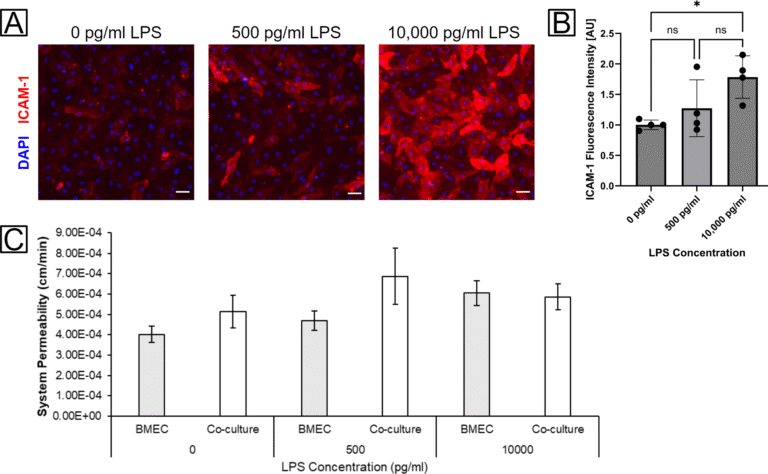
    Introduction Sepsis refers to an uncontrolled systemic inflammatory response which can result from bacterial blood infections. We have long been interested in developing a sepsis model using the μSiM-BBB platform because the neuroinflammation stemming from sepsis can cause severe BBB disruption. For the majority of our stimulation experiments we have relied on cytomix, a cocktail…

    Read More Bacterial Inflammatory Stimulation of the μSiM-BBB ModelContinue

  • Assessing the Permeability of Two Barriers in the Post-capillary Neurovascular Unit Part 1: The Problem Statement
    memBrains | NRG

    Assessing the Permeability of Two Barriers in the Post-capillary Neurovascular Unit Part 1: The Problem Statement

    ByJim April 11, 2024May 10, 2024

    The two barrier anatomy of the post-capillary NVU and why it matters At the post-capilliary venule, the blood-brain barrier (BBB) is actually two barriers in series: 1) one created by the pericyte/BMEC layer at the blood interface and 2) one created by astrocytes and the astrocyte-produced glia limitans at the interface with the brain. We’ll…

    Read More Assessing the Permeability of Two Barriers in the Post-capillary Neurovascular Unit Part 1: The Problem StatementContinue

  • NRG

    History repeats itself: There’s something in the water

    ByMunther Al-Sudais April 10, 2024April 10, 2024

    Dave Fang posted a poster in 2010 about particles found in DI water. I encountered the same issue during the nano-pocket permeability experiment. He said, “I’ve become increasingly suspicious of membrane clogging during the … permeability experiments.” I conducted an experiment with ultrapure water (UPW), typically filling a 1L glass container from a UPW machine….

    Read More History repeats itself: There’s something in the waterContinue

Page navigation

Previous PagePrevious 1 … 9 10 11 12 13 … 231 Next PageNext

© 2026 Nanomembrane Research Group - WordPress Theme by Kadence WP

0
    0
    Your Cart
    Your cart is emptyReturn to Shop
    Continue Shopping
    • Home
    • Publications
    • Membranes
      • Common Chip Formats
      • Common Membranes
      • Microslit Membranes
    • Devices
      • µSiM
        • Geometry
        • µSiM CAD Files
        • Assembly
          • Protocols.io (µSiM Assembly)
          • Instructions
          • Common Issues and Troubleshooting Tips
        • Cell Culture Protocols
          • Top Well: hCMEC/D3
          • Top Well: HUVEC
          • Bottom Channel Culturing
          • Immunocytochemistry Protocol
          • Impact of Chip Orientation on Fluorescence Imaging
          • Permeability: In Situ Method
          • Permeability: Sampling Method
          • Cell Culture Common Issues and Troubleshooting Tips
      • SepCon®
        • Sepcon Assembly
        • Sepcon Video Protocol: Assembly
        • SepCon Gasket Silhouette File
        • SepCon Video Protocol: Wetting the membrane
        • SepCon Video Protocol: Disassembly
      • µSiM-DX
        • µSIM Video Protocol: Capture of Nanoparticles
    • Impact
      • TraCe-bMPS
      • HCIC
      • LOMP
      • SiMPore