Skip to content

Nanomembrane Research Group

  • Home
  • Publications
  • MembranesExpand
    • Common Chip Formats
    • Common Membranes
    • Microslit Membranes
  • DevicesExpand
    • µSiMExpand
      • Geometry
      • µSiM CAD Files
      • AssemblyExpand
        • Protocols.io (µSiM Assembly)
        • Instructions
        • Common Issues and Troubleshooting Tips
      • Cell Culture ProtocolsExpand
        • Top Well: hCMEC/D3
        • Top Well: HUVEC
        • Bottom Channel Culturing
        • Immunocytochemistry Protocol
        • Impact of Chip Orientation on Fluorescence Imaging
        • Permeability: In Situ Method
        • Permeability: Sampling Method
        • Cell Culture Common Issues and Troubleshooting Tips
    • SepCon®Expand
      • Sepcon Assembly
      • Sepcon Video Protocol: Assembly
      • SepCon Gasket Silhouette File
      • SepCon Video Protocol: Wetting the membrane
      • SepCon Video Protocol: Disassembly
    • µSiM-DXExpand
      • µSIM Video Protocol: Capture of Nanoparticles
  • ImpactExpand
    • TraCe-bMPS
    • HCIC
    • LOMP
    • SiMPore
Nanomembrane Research Group
  • NRG

    Towards Surface Enhanced Raman Functionalization of Nanopocket membranes

    ByKevin Petersen March 8, 2024

    Towards Surface Enhanced Raman Functionalization of Nanopocket membranes   Introduction Use of Raman microscopy is used to evaluate the chemical profile of substances.  Surface enhanced Raman spectroscopy (SERS) is a signal-boosting techniques where the weak Raman signal is amplified through plasmon interactions at a metalized (often nanostructured) surface.   SERS for extracellular vesicles (EVs) was recently…
    Read More Towards Surface Enhanced Raman Functionalization of Nanopocket membranesContinue

  • NRG

    Rotation Project – Sergio Garcia

    BySergio Garcia March 6, 2024March 12, 2024

    Introduction  The Ehler-Danlos Syndromes are a group of thirteen heritable connective tissue disorders. These disorders are genetic, and usually involve a mutation in genes that code for components in the collagen matrix (1). Some of the main characteristics in patients with these disorders include tissue fragility, joint hypermobility, and skin hyperextensibility (1). Classical EDS (cEDS),…

    Read More Rotation Project – Sergio GarciaContinue

  • TRACE

    On-line Resolution Calculator Applied to Etaluma Objectives

    ByKevin Webb March 3, 2024

    The following site may be useful to draw to people’s attention when specifying objectives on the Etaluma: https://www.microscope.healthcare.nikon.com/microtools/resolution-calculator/#Focus I have configured a custom resolution calculation using the sensor data supplied by Etaluma, here exemplified at 10x/0.3NA: To take account of the shorter tube lens (which gives ¼ magnification expected cf Nikon 200mm tube) I have…

    Read More On-line Resolution Calculator Applied to Etaluma ObjectivesContinue

  • Wafer QC Pages

    Wafer #1526 – 1 Slot NPN

    ByAhmet Gurcan February 28, 2024March 15, 2024

    Manufacturer’s Data Delivery Date: 2/28/2024 (picked up and logged by Ahmet Gurcan) Membrane Type:  NPN 1 Slot SKU: NPSN100-1L-TE Lot Number: 1526 Quantity Received: 211 Manufacturer Test Report: Pore Size: 49.2nm Porosity: 15.5% Flow Data Avg in SLPM 2psi: 0.130 4psi:  0.248 Burst: 5.510 Packing slip & invoice: None UR Testing Porosity: N/A Pore size:…

    Read More Wafer #1526 – 1 Slot NPNContinue

  • Wafer #1523 – 1 Slot NPN
    Wafer QC Pages

    Wafer #1523 – 1 Slot NPN

    ByAhmet Gurcan February 28, 2024April 19, 2024

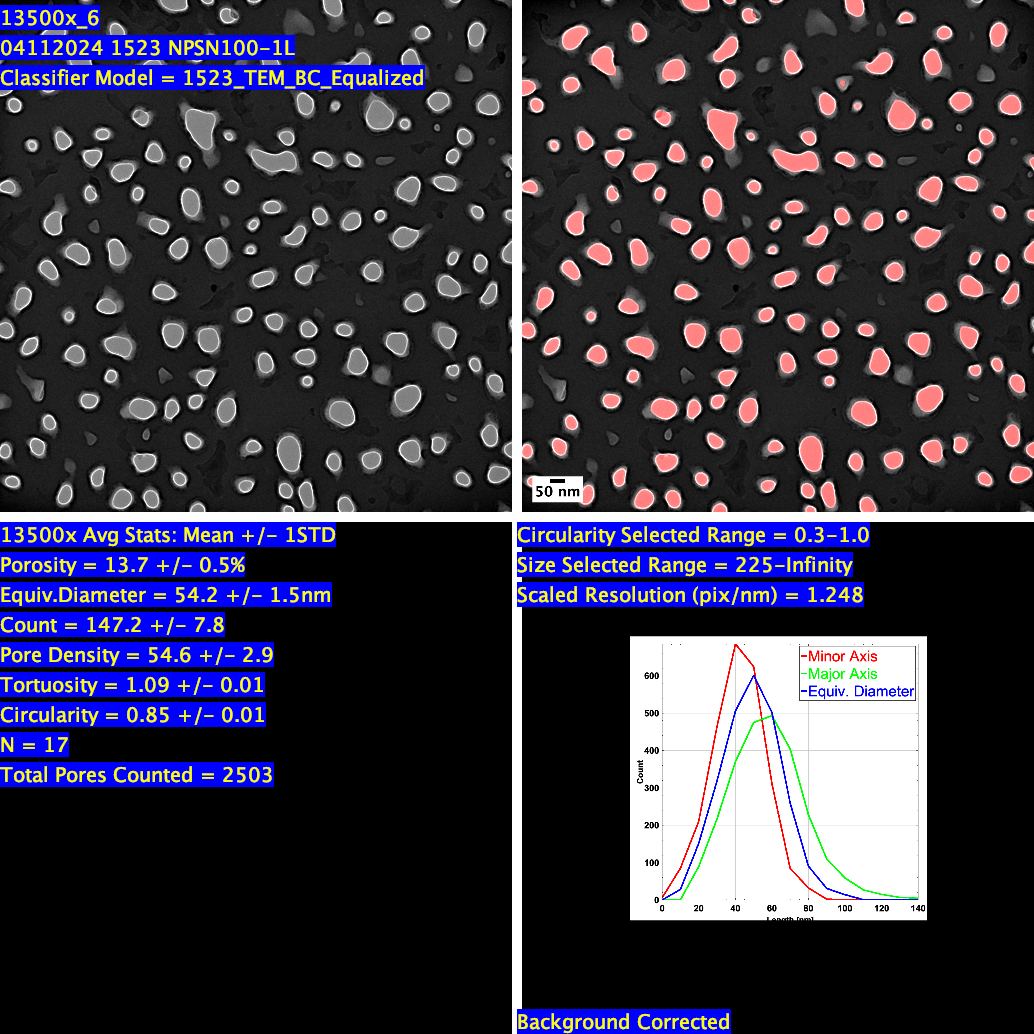
    Manufacturer’s Data Delivery Date: 2/28/2024 (picked up and logged by Ahmet Gurcan) Membrane Type:  NPN 1 Slot SKU: NPSN100-1L-TE Lot Number: 1523 Quantity Received: 237 Manufacturer Test Report: Pore Size: 52.7nm Porosity: 15.0% Flow Data Avg in SLPM 2psi: 0.126 4psi: 0.276 Burst: 6.151 Packing slip & invoice: None UR Testing Porosity: 13.7 +/- 0.5%…

    Read More Wafer #1523 – 1 Slot NPNContinue

  • NRG | μSiM-DX

    EV Enrichment with Izon qEV Column

    BySam Walker February 9, 2024

    Introduction This post will describe the preliminary work I have completed using size exclusion chromatography (SEC) for EV enrichment. We are ultimately interested in interrogating serum EV biomarkers using CAD-LB, however, the presence of protein and lipoprotein contaminants reduces the capacity for EV capture (~104) on NPN membranes and may hinder the analysis of rare…

    Read More EV Enrichment with Izon qEV ColumnContinue

  • NRG | μSiM-DX

    Exploring Urinary EV Detection Using CAD-LB

    ByMoses Arthur February 9, 2024February 28, 2024

    Introduction This post provides an update on a series of experiments conducted with Sam. These experiments were designed to assess the versatility of the CAD-LB platform for detecting EVs in urine samples. Urine is a complex biofluid often used in clinical diagnosis, making it a suitable subject for testing the CAD-LB’s biomarker detection capabilities. After…

    Read More Exploring Urinary EV Detection Using CAD-LBContinue

  • NRG

    The Base of TraCe: Exploring the Fundamentals of the Etaluma Microscope

    ByMichael Klaczko February 9, 2024March 5, 2024

    For year one of the Trace grant, I will be focusing on the development of a standard operating procedure for the uSiM-CA. To begin this process, I am transferring all of my current operating procedures from the Andor dragonfly confocal scope to the new Etaluma microscope. The Etaluma scope will be automated, collecting images of…

    Read More The Base of TraCe: Exploring the Fundamentals of the Etaluma MicroscopeContinue

  • NRG | μSiM

    Modification of Ultrathin Microporous Silicon Nitride Membrane Stiffness for Tissue Barrier Modeling

    ByAtiyeh Hosseinifkhr February 8, 2024March 5, 2024

    Introduction: Developing innovative therapeutics and treatment approaches with improved effectiveness and safety necessitates the use of cell co-culture models and barrier environments that mimic in vivo conditions. These models involve culturing two or more cell types together in vitro, allowing researchers to study cellular interactions, signaling pathways, and responses that closely resemble those seen in…

    Read More Modification of Ultrathin Microporous Silicon Nitride Membrane Stiffness for Tissue Barrier ModelingContinue

  • NRG

    George Wadsworth Training Visit

    ByJim January 14, 2024January 14, 2024

    Slide Deck Video Presentation Jove_Video_Comments_Form (GW)

    Read More George Wadsworth Training VisitContinue

Page navigation

Previous PagePrevious 1 … 11 12 13 14 15 … 231 Next PageNext

© 2026 Nanomembrane Research Group - WordPress Theme by Kadence WP

0
    0
    Your Cart
    Your cart is emptyReturn to Shop
    Continue Shopping
    • Home
    • Publications
    • Membranes
      • Common Chip Formats
      • Common Membranes
      • Microslit Membranes
    • Devices
      • µSiM
        • Geometry
        • µSiM CAD Files
        • Assembly
          • Protocols.io (µSiM Assembly)
          • Instructions
          • Common Issues and Troubleshooting Tips
        • Cell Culture Protocols
          • Top Well: hCMEC/D3
          • Top Well: HUVEC
          • Bottom Channel Culturing
          • Immunocytochemistry Protocol
          • Impact of Chip Orientation on Fluorescence Imaging
          • Permeability: In Situ Method
          • Permeability: Sampling Method
          • Cell Culture Common Issues and Troubleshooting Tips
      • SepCon®
        • Sepcon Assembly
        • Sepcon Video Protocol: Assembly
        • SepCon Gasket Silhouette File
        • SepCon Video Protocol: Wetting the membrane
        • SepCon Video Protocol: Disassembly
      • µSiM-DX
        • µSIM Video Protocol: Capture of Nanoparticles
    • Impact
      • TraCe-bMPS
      • HCIC
      • LOMP
      • SiMPore