Skip to content

Nanomembrane Research Group

  • Home
  • Publications
  • MembranesExpand
    • Common Chip Formats
    • Common Membranes
    • Microslit Membranes
  • DevicesExpand
    • µSiMExpand
      • Geometry
      • µSiM CAD Files
      • AssemblyExpand
        • Protocols.io (µSiM Assembly)
        • Instructions
        • Common Issues and Troubleshooting Tips
      • Cell Culture ProtocolsExpand
        • Top Well: hCMEC/D3
        • Top Well: HUVEC
        • Bottom Channel Culturing
        • Immunocytochemistry Protocol
        • Impact of Chip Orientation on Fluorescence Imaging
        • Permeability: In Situ Method
        • Permeability: Sampling Method
        • Cell Culture Common Issues and Troubleshooting Tips
    • SepCon®Expand
      • Sepcon Assembly
      • Sepcon Video Protocol: Assembly
      • SepCon Gasket Silhouette File
      • SepCon Video Protocol: Wetting the membrane
      • SepCon Video Protocol: Disassembly
    • µSiM-DXExpand
      • µSIM Video Protocol: Capture of Nanoparticles
  • ImpactExpand
    • TraCe-bMPS
    • HCIC
    • LOMP
    • SiMPore
Nanomembrane Research Group
  • NRG

    Plasma Urea Clearance of Liftoff Device

    ByJack Ferruzza October 13, 2022

    Introduction This experiment is a continuation of previous work, cited below. Instead of urea spiked 1x PBS, whole heparinized bovine blood was pushed through the device over a period of four hours to then perform a urea assay on the separated and collected plasma. Please refer to the post below regarding the experimental setup that…
    Read More Plasma Urea Clearance of Liftoff DeviceContinue

  • NRG

    Urea Clearance of Liftoff Device

    ByJack Ferruzza September 29, 2022October 26, 2022

    Introduction These results are thanks to assistance from Sam Walker and his previous posts regarding urea clearance that helped lay the foundation of this experiment. “Single Slot Inverted-Chip and Double Slot: Single-Pass Dialysis Devices” (Walker 2018) https://trace-bmps.org/single-slot-inverted-chip-and-double-slot-single-pass-dialysis-devices/   More information on the Liftoff membranes can be found in the article cited below: “Lift-off of large-scale…

    Read More Urea Clearance of Liftoff DeviceContinue

  • NRG

    Staphing Issues: Standardizing the Staphylococcus aureus µSiM-CA Division Assay

    ByMichael Klaczko September 28, 2022March 5, 2024

    After continually seeing variability in assays using the microfluidic silicon membrane canalicular array (µSiM-CA) and developing a new technique to visualize bacterial division in the µSiM-CA, discussed here, we wanted to improve and stabilize the performance of our assays. Currently, the µSiM-CA is used by our lab, the Gill lab and the Dunman lab to…

    Read More Staphing Issues: Standardizing the Staphylococcus aureus µSiM-CA Division AssayContinue

  • NRG

    A Move in the Light Direction: Visualizing Staphylococcus aureus Division Across Membranes Within µSiM-CA Devices Using Confocal Microscopy

    ByMichael Klaczko September 14, 2022March 5, 2024

    Recently, several studies on Staphylococcus aureus (S. aureus) have been hindered due to poor performance from assays using the µSiM-Canalicular Array (CA). As discussed here, we attempted to improve assay performance by coating our membranes with fibronectin. This did not work well and instead left us in a state of confusion as we did not…

    Read More A Move in the Light Direction: Visualizing Staphylococcus aureus Division Across Membranes Within µSiM-CA Devices Using Confocal MicroscopyContinue

  • NRG

    To Bead or not to Bead: Struggling to Detect tRNA Binding to Silica Particles towards Wastewater Genome Extraction

    ByMichael Klaczko August 18, 2022March 5, 2024

    This post describes my second attempt at developing a protocol for viral genome extraction in large volumes of waste water. Like our first attempt, described here, we looked to improve upon the protocol Direct wastewater RNA extraction via the “Milk of Silica (MoS)” method – A companion method to “Sewage, Salt, Silica and SARS-CoV-2 (4S)”….

    Read More To Bead or not to Bead: Struggling to Detect tRNA Binding to Silica Particles towards Wastewater Genome ExtractionContinue

  • NRG

    Physiological Facade: Fibronectin coating membranes in an attempt to improve the performance of Staphylococcus aureus propagation assays using the µSiM

    ByMichael Klaczko July 11, 2022March 5, 2024

    Parallel with my efforts in the Osteomyelitis project to coat our membranes with polyurethane acrylate, I began working with the Gill lab on improving the performance of our uSiM platform as a propagation assay for Staphylococcus aureus. In the past we have gotten a lot of good data using this assay, but its performance has…

    Read More Physiological Facade: Fibronectin coating membranes in an attempt to improve the performance of Staphylococcus aureus propagation assays using the µSiMContinue

  • memBrains

    High Throughput Multiplexed Digital-Molecular-Counting Blood-Brain-Barrier on a Chip System (dμSIM plate)

    ByHoward Su June 28, 2022June 28, 2022

    Background Tissue-on-a-chip systems have been a promising means of mimicking and understanding the complex and convoluted functions of the in vivo blood-brain barrier (BBB). These semipermeable borders of endothelial cells are highly selective in order to protect the fragile central nervous system (CNS) from bloodborne pathogens or inflammatory signals and are known to have a…

    Read More High Throughput Multiplexed Digital-Molecular-Counting Blood-Brain-Barrier on a Chip System (dμSIM plate)Continue

  • NRG

    Flabbergrassted: Persistent Surface Roughness in Polyurethane Acrylate Etches

    ByMichael Klaczko June 27, 2022March 5, 2024

    Since I discovered a dilution of polyurethane acrylate (PUA) which coats well (described here), I have restarted my efforts towards etching the PUA. Described below are my most recent attempts towards creating a PUA coating with a smooth surface with a 1 um in thickness. Unfortunately, it has proven harder to maintain a smooth surface…

    Read More Flabbergrassted: Persistent Surface Roughness in Polyurethane Acrylate EtchesContinue

  • Fibronectin and Friends: Confirming the Presence of Multiple Vascular Basement Membrane Components in the μSiM-hNVU
    memBrains | NRG | μSiM

    Fibronectin and Friends: Confirming the Presence of Multiple Vascular Basement Membrane Components in the μSiM-hNVU

    ByLouis Widom June 24, 2022March 5, 2024

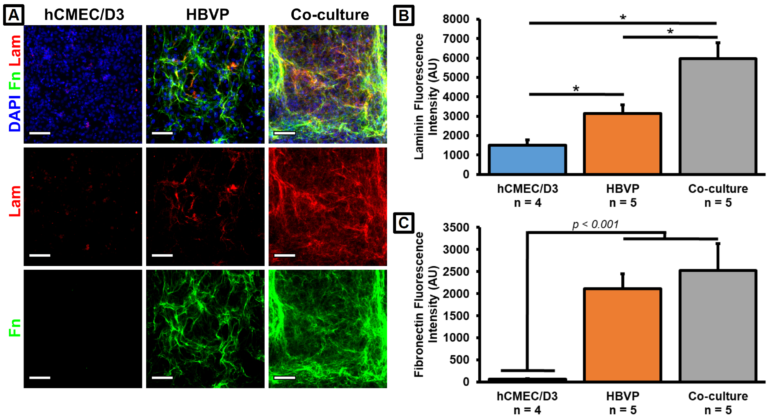
    Introduction The blood-brain barrier (BBB) plays an important role in maintaining brain chemistry by restricting the permeability of small molecules and cells. Inflammatory diseases may disrupt the BBB and promote the development of neurological disorders [1]. One potential mechanism of BBB disruption is the degradation of the extracellular matrix proteins that make up the vascular…

    Read More Fibronectin and Friends: Confirming the Presence of Multiple Vascular Basement Membrane Components in the μSiM-hNVUContinue

  • NRG

    Does the Shoe Fit? Re-evaluating and Re-discovering an Amenable PUA Solution

    ByMichael Klaczko June 9, 2022March 5, 2024

    Since we last discovered our polyurethane acrylate (PUA) has a shelf life (described here) and received a new solution of PUA, we have been trying to replicate the results that we had before. Unfortunately, we have realized that this is much easier said than done. What we have found is the specific dilution of PUA…

    Read More Does the Shoe Fit? Re-evaluating and Re-discovering an Amenable PUA SolutionContinue

Page navigation

Previous PagePrevious 1 … 16 17 18 19 20 … 231 Next PageNext

© 2026 Nanomembrane Research Group - WordPress Theme by Kadence WP

0
    0
    Your Cart
    Your cart is emptyReturn to Shop
    Continue Shopping
    • Home
    • Publications
    • Membranes
      • Common Chip Formats
      • Common Membranes
      • Microslit Membranes
    • Devices
      • µSiM
        • Geometry
        • µSiM CAD Files
        • Assembly
          • Protocols.io (µSiM Assembly)
          • Instructions
          • Common Issues and Troubleshooting Tips
        • Cell Culture Protocols
          • Top Well: hCMEC/D3
          • Top Well: HUVEC
          • Bottom Channel Culturing
          • Immunocytochemistry Protocol
          • Impact of Chip Orientation on Fluorescence Imaging
          • Permeability: In Situ Method
          • Permeability: Sampling Method
          • Cell Culture Common Issues and Troubleshooting Tips
      • SepCon®
        • Sepcon Assembly
        • Sepcon Video Protocol: Assembly
        • SepCon Gasket Silhouette File
        • SepCon Video Protocol: Wetting the membrane
        • SepCon Video Protocol: Disassembly
      • µSiM-DX
        • µSIM Video Protocol: Capture of Nanoparticles
    • Impact
      • TraCe-bMPS
      • HCIC
      • LOMP
      • SiMPore