Skip to content

Nanomembrane Research Group

  • Home
  • Publications
  • MembranesExpand
    • Common Chip Formats
    • Common Membranes
    • Microslit Membranes
  • DevicesExpand
    • µSiMExpand
      • Geometry
      • µSiM CAD Files
      • AssemblyExpand
        • Protocols.io (µSiM Assembly)
        • Instructions
        • Common Issues and Troubleshooting Tips
      • Cell Culture ProtocolsExpand
        • Top Well: hCMEC/D3
        • Top Well: HUVEC
        • Bottom Channel Culturing
        • Immunocytochemistry Protocol
        • Impact of Chip Orientation on Fluorescence Imaging
        • Permeability: In Situ Method
        • Permeability: Sampling Method
        • Cell Culture Common Issues and Troubleshooting Tips
    • SepCon®Expand
      • Sepcon Assembly
      • Sepcon Video Protocol: Assembly
      • SepCon Gasket Silhouette File
      • SepCon Video Protocol: Wetting the membrane
      • SepCon Video Protocol: Disassembly
    • µSiM-DXExpand
      • µSIM Video Protocol: Capture of Nanoparticles
  • ImpactExpand
    • TraCe-bMPS
    • HCIC
    • LOMP
    • SiMPore
Nanomembrane Research Group
  • NRG

    Optimizing IMR90-4 Coculture BBB Model

    ByMolly McCloskey June 9, 2022June 9, 2022

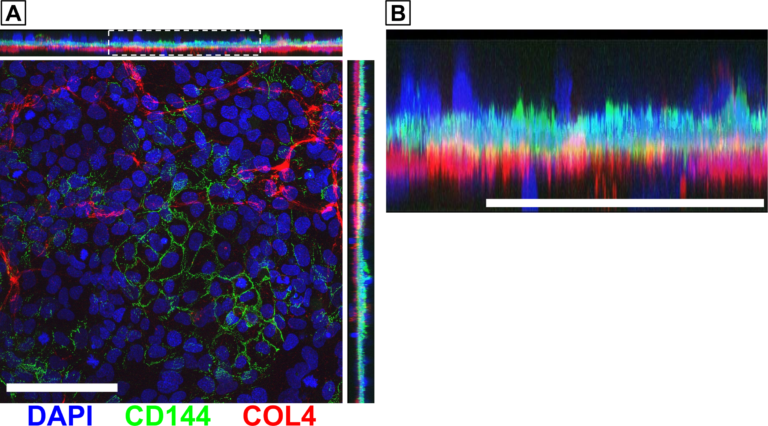
    Introduction While we have optimized coculture models for commercial brain endothelial cells and pericytes, we needed to do the same for iPSC-derived cocultures. In this post, I show the optimization process using IMR90-4-derived EECM-BMEC-like cells [1] and brain pericyte-like cells (BPLC) [2]. Methods The top well chip surface was coated with collagen iv (Sigma C5533), bovine fibronectin…
    Read More Optimizing IMR90-4 Coculture BBB ModelContinue

  • memBrains | NRG

    Optimizing Cytomix Stimulation on Mono- and Coculture BBB Models

    ByMolly McCloskey June 9, 2022March 5, 2024

    Introduction The µSiM BBB model is being developed at UR with the goal to understand the impact of sepsis on the brain. Here, we use an EECM-BMEC-like cell (iSPC-derived brain endothelial cells) [1] monoculture model and an EECM-BMEC-like cell and brain pericyte-like cell (BPLC; iSPC-derived brain pericytes) [2] coculture model to optimize the concentration of…

    Read More Optimizing Cytomix Stimulation on Mono- and Coculture BBB ModelsContinue

  • Merging Man with Machine: A Computer Vision Aided Leukocyte Transmigration Assay
    hToC | memBrains | NRG

    Merging Man with Machine: A Computer Vision Aided Leukocyte Transmigration Assay

    ByDan Ahmad April 25, 2022March 5, 2024

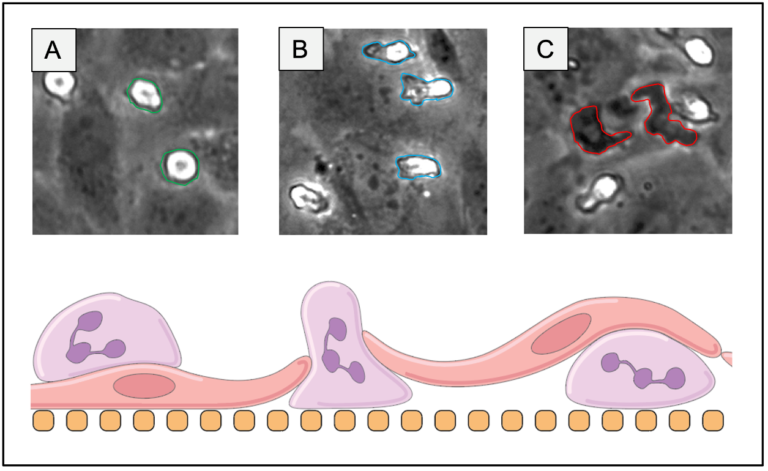
    Introduction High throughput imaging techniques in conjunction with in vitro micro-physiological systems (MPS) allow for comprehensive exploration of physiologically relevant phenomena in a living 3D mimetic of a tissue microenvironment. Prior work in this lab has readily demonstrated that vascular tissue mimetics (the µSiM) facilitate real time phase-microscopy visualization of immune cell trafficking in response…

    Read More Merging Man with Machine: A Computer Vision Aided Leukocyte Transmigration AssayContinue

  • Updates on Modeling the Vascular Basement Membrane in the μSiM-hNVU
    memBrains | NRG | μSiM

    Updates on Modeling the Vascular Basement Membrane in the μSiM-hNVU

    ByLouis Widom April 25, 2022

    Introduction The blood-brain barrier (BBB) plays an important role in maintaining brain chemistry by restricting the permeability of small molecules and cells. Inflammatory diseases may disrupt the BBB and promote the development of neurological disorders [1]. One potential mechanism of BBB disruption is the degradation of the extracellular matrix proteins that make up the endothelial…

    Read More Updates on Modeling the Vascular Basement Membrane in the μSiM-hNVUContinue

  • memBrains

    Effects of TNF-alpha on iPSC-EC glycocalyx (EGL)

    ByRichard Waugh April 25, 2022April 25, 2022

    One of the validations of the in vitro human Blood Brain Barrier system is to ensure that the endothelial cells derived from iPSC’s and cultured in our system exhibit behaviors that are consistent with endothelial cell behavior in situ.  The particular aspect of BBB endothelial function addressed in this post is the expression and properties…

    Read More Effects of TNF-alpha on iPSC-EC glycocalyx (EGL)Continue

  • NRG

    Fabrication the Nano-pocket membrane (update)

    ByMunther Al-Sudais April 19, 2022April 19, 2022

    The fabrication of nano pocket membrane to capture and release the EV faced challenges during the etching step. There was a suggestion after the last NRG post to use RIE-2000 located in the UR. This post shows the update on the methodology of creating the nano pocket membranes and the preliminary results after using the…

    Read More Fabrication the Nano-pocket membrane (update)Continue

  • NRG

    Crazy Colorful Counting Conundrum: From Counts to Colocalization

    ByAlex Evans April 19, 2022

    Summary We look at nanoparticle counting and colocalization after an ALine device membrane capture and compare IMARIS and ImageJ methods with an example. Procedures for particle counting and colocalization for IMARIS are discussed and a walkthrough is provided An example of the observed difference between ImageJ and IMARIS on the observed counts showing a near…

    Read More Crazy Colorful Counting Conundrum: From Counts to ColocalizationContinue

  • NRG

    The Enemy Within: Optimizing an OLCN PUA Coated Microporous Membrane Mimetic and Exposing an Unlikely Saboteur

    ByMichael Klaczko April 13, 2022March 5, 2024

    The battle for soft membrane coatings wages on as we continue to optimize polyurethane acrylate (PUA) coatings for our osteomyelitis project, whose background is described here and here and initial progress is described here. Since our last update, we have honed in on our most promising recipe and tried to fine tune its settings in…

    Read More The Enemy Within: Optimizing an OLCN PUA Coated Microporous Membrane Mimetic and Exposing an Unlikely SaboteurContinue

  • NRG

    Aliens, Voodoo, or Magic? How does DNA Extraction via Silica Adsorption Actually Work?

    ByMichael Klaczko April 4, 2022March 5, 2024

    The first DNA extraction was done over 150 years ago in 18691. Since then, the process has been refined and expanded to include multiple physical and or chemical methods. For the waste water epidemiology project (described here), we will be focusing on DNA extraction via silica adsorption without the use of chaotropic agents. The mechanism…

    Read More Aliens, Voodoo, or Magic? How does DNA Extraction via Silica Adsorption Actually Work?Continue

  • memBrains | NRG | μSiM

    Daily In-Situ Permeability using mouse CMECs

    ByFeyone La March 29, 2022March 29, 2022

    Introduction In the Glading Lab we study Cerebral Cavernous Malformations (CCMs). In CCMs, brain capillaries develop enlarged lumens and a disrupted blood-brain barrier. The presence of a mutation in KRIT1 causes loss of KRIT1 protein function in the endothelial cells. KRIT 1 plays a role in the integrity of endothelial junctions, therefore the lack of…

    Read More Daily In-Situ Permeability using mouse CMECsContinue

Page navigation

Previous PagePrevious 1 … 17 18 19 20 21 … 231 Next PageNext

© 2026 Nanomembrane Research Group - WordPress Theme by Kadence WP

0
    0
    Your Cart
    Your cart is emptyReturn to Shop
    Continue Shopping
    • Home
    • Publications
    • Membranes
      • Common Chip Formats
      • Common Membranes
      • Microslit Membranes
    • Devices
      • µSiM
        • Geometry
        • µSiM CAD Files
        • Assembly
          • Protocols.io (µSiM Assembly)
          • Instructions
          • Common Issues and Troubleshooting Tips
        • Cell Culture Protocols
          • Top Well: hCMEC/D3
          • Top Well: HUVEC
          • Bottom Channel Culturing
          • Immunocytochemistry Protocol
          • Impact of Chip Orientation on Fluorescence Imaging
          • Permeability: In Situ Method
          • Permeability: Sampling Method
          • Cell Culture Common Issues and Troubleshooting Tips
      • SepCon®
        • Sepcon Assembly
        • Sepcon Video Protocol: Assembly
        • SepCon Gasket Silhouette File
        • SepCon Video Protocol: Wetting the membrane
        • SepCon Video Protocol: Disassembly
      • µSiM-DX
        • µSIM Video Protocol: Capture of Nanoparticles
    • Impact
      • TraCe-bMPS
      • HCIC
      • LOMP
      • SiMPore