Hydraulic permeability of carbonized membranes
A simple hydraulic permeability study was performed to determine whether carbonization would negatively impact water transport through the membranes. 5 slit square SepCons from SC 471 were carbonized and put in the ultra-centrifuge with a 500 uL starting volume. The samples were spun for 10 minutes at 3000 RPM (equiv to 4.95 PSI starting).
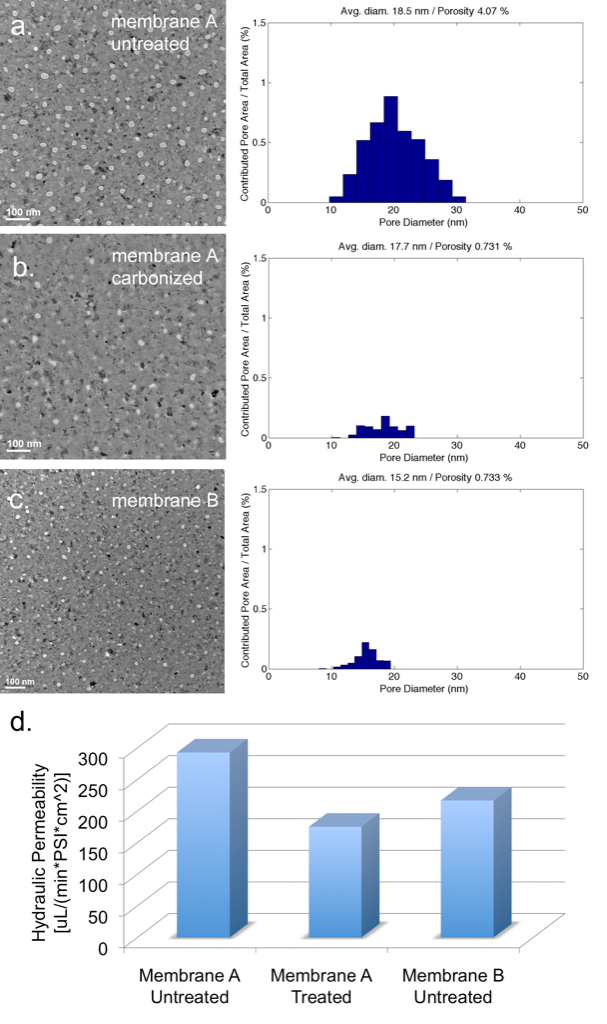
SC 471 (membrane ‘A’) untreated had a hydraulic permeability of 591 µL/(min-PSI-cm2), while a carbonized SC 471 yielded a permeability of 289 µL/(min-PSI-cm2). SC 476 (membrane ‘B’) had a similar pore distribution as the carbonized SC 471 and had a permeability of 357 µL/(min-PSI-cm2). No enhancement was seen in the carbonized sample, which is not entirely surprising considering that in a 15 nm thick material the advantages offered by an atomically “smooth” wall are minimal. My guess is that the membrane thickness is the dominant player in transport rate, as the carbonized membrane is also > 10 nm thicker than the untreated sample since the carbon forms on the top/bottom of the membrane as well as the pore walls.
One problem with these numbers is that if we compare the untreated membrane A and membrane B, a drop in porosity by a factor of 6 only drops the permeability numbers by a factor of 2. We need to figure out if this is due to something in our experiment.
Let me know if anyone wants to try separations with carbonized membranes. Maybe we’ll find something interesting with the different surface charge…
Thanks Nakul for running the permeability measurements.
Lets be sure to compare these flow rates against theory before Tuesday’s meeting. A post showing the expected flow rate for each membrane would be helpful.
Jess has run some preliminary calculations and it seems that the theoretical permeability is 1.5 higher than the measured. I’ll have to check in with her to see why the theory is so much higher than the experimental…
Dave – how many more pinhole free samples do you have? Do you want me to check out the TEER and maybe the permeability of fluorescein for another set of comparisons?