Membrane with Ar sputter after a-Si dep
Inspired by some recent literature that I have been reading, I decided to add an argon bombardment step after the amorphous silicon deposition step by applying a 50 W substrate bias. The idea is that point defects on the surface of the a-Si will become seeds for crystallization and thus lower the crystallization temperature and maybe yield more porous membranes.
From the one wafer that I processed, it seems that the Ar bombarded film is quite similar in terms of morphology with a baseline membrane (1000 C 20/15/20 stack).
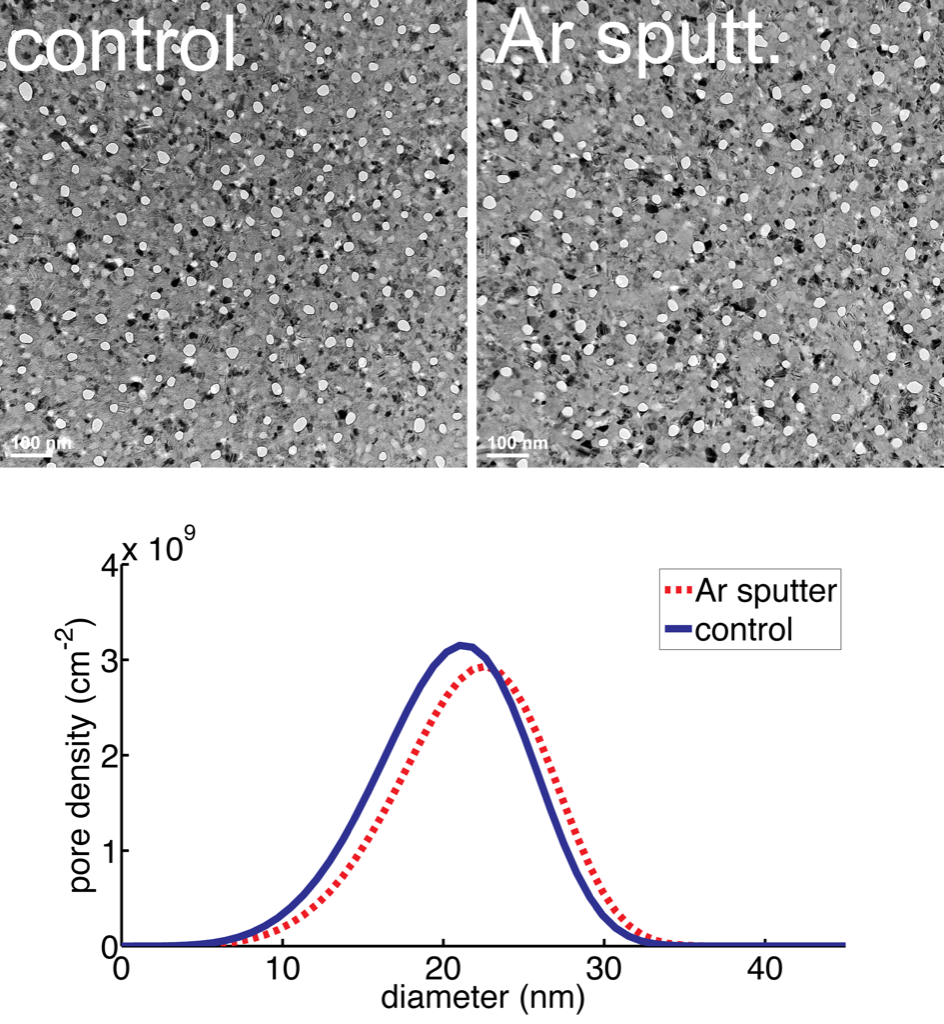
It would seem that a 1000 C anneal does not show a difference in porosity/size, but I may try this again at a lower temperature anneal. I wonder if the Ar sputter would help form pores at say 800 C.
Update
I annealed a wafer with the Ar sputter process at 900 C and found that the porosity was significantly increased.
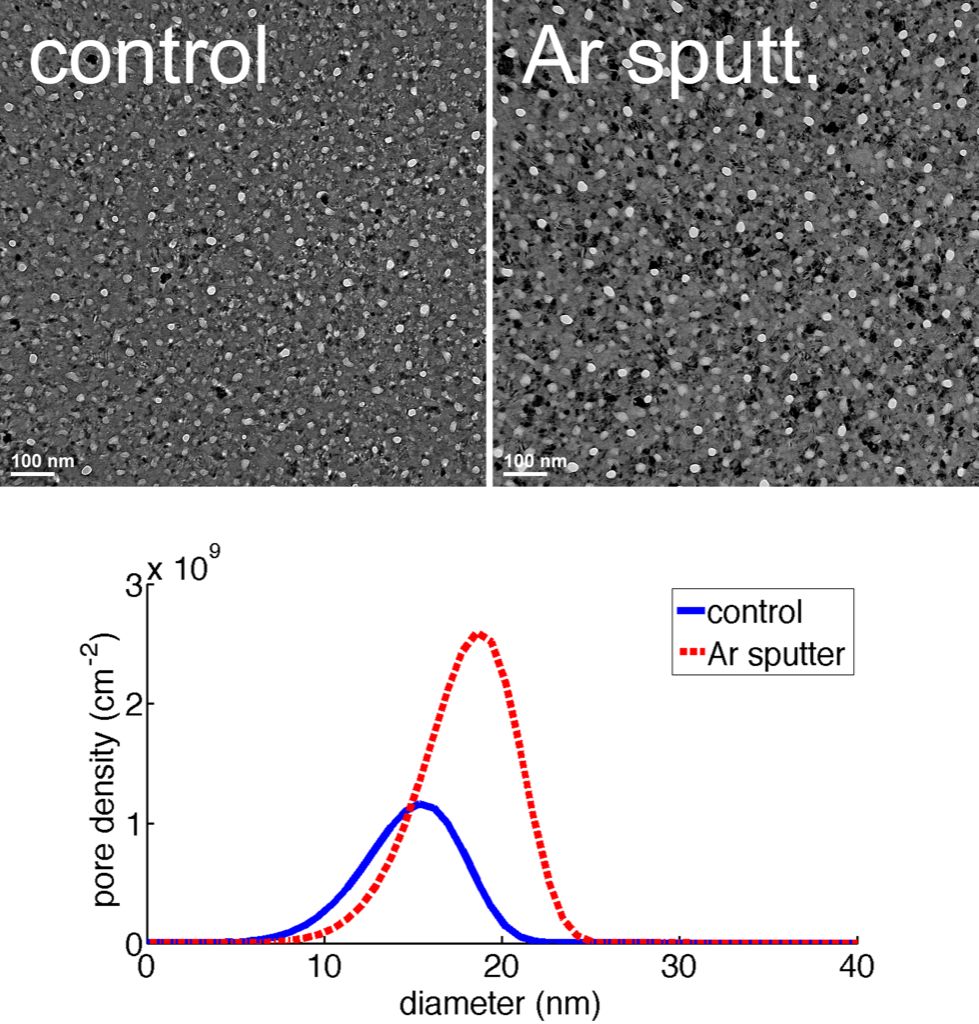
My interpretation of this result is that the crystallization/pore formation dynamics are altered with the Ar treatment. My guess is that the bombardment lowers the activation energy of crystallization (documented in lit). and therefore pore formation, which in turn increases the porosity at a given anneal temperature. This effect is exaggerated at lower annealing temperatures.
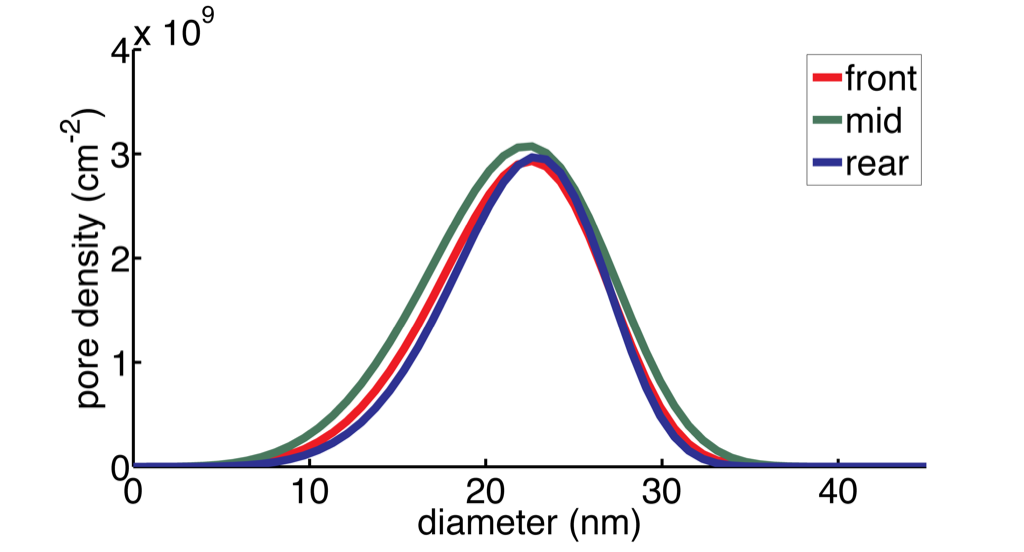
My other observation was that the uniformity across this wafer was pretty good. We recently tuned the lamps again and it seems to be helping, at least on a 4-inch wafer.

Lastly, the pinhole density on this wafer was extremely low. I looked at all the chips and only counted a total of 3 pinholes. Might the Ar bombardment do something to the Si/SiO2 interface that would help mitigate pinholes?
Accidental discoveries are golden (and the origin for the entire NRG). So let’s hope there is some magic cure for pinholes here.
this is very interesting- with both practical and theoretical implication.
Very interesting indeed. You may be smoothing out the interface with the extra bombardment and are likely embedding some extra Ar at the surface, which will obviously affect the strain. Do you know if any thickness was lost in the Si? How long was the bias run and what voltage did it generate?