BBB TEER with Mitomycin C
In my last post, I presented the results of my BBB TEER experiments. For the BBB co-culture, there was a spike in TEER. I hypothesized that this was caused by media acidification by rapidly proliferating glial cells, which in turn negatively affected barrier function of endothelial cells. When I presented this data to Angela Glading, she suggested that I try this experiment with Mitomycin C. Mitomycin C is a DNA cross-linker than can be used to inhibit cell proliferation – it’s commonly used to create feeder layers of cells for co-cultures. (this stuff is nasty – is anyone wants to use it – read the MSDS first). I tried this drug with the following protocol – I treated NG10815 cells in T-25 flasks with 10ug/mL mitomycin C for 2 hours and then split them onto the apical side of transwells (with or without bEnd3 on the basolateral side) at 50000 cells/cm2. I then repeated TEER measurements as before.
The top graph shows results from a NG10815 mono-culture. On PET, untreated NG10815 cells slowly proliferated and the TEER correspondingly increased (green triangles). Mitomycin C treatment knocked down proliferation enough to cause no TEER increase (blue diamonds). The effect of mitomycin C was more dramatic with pnc-Si. Untreated NG10815 on pnc-Si proliferated over the 2-week experiment and the TEER steadily increased (purple x’s). Mitomycin C treatment significantly inhibited NG10815 proliferation and the increase in TEER (red squares). For this experiment, I hypothesized that mitomycin C treatment would significantly alter NG10815 TEER on pnc-Si since glial clumping was more pronounced on pnc-Si (because of the wells) than on PET. These results support this hypothesis.
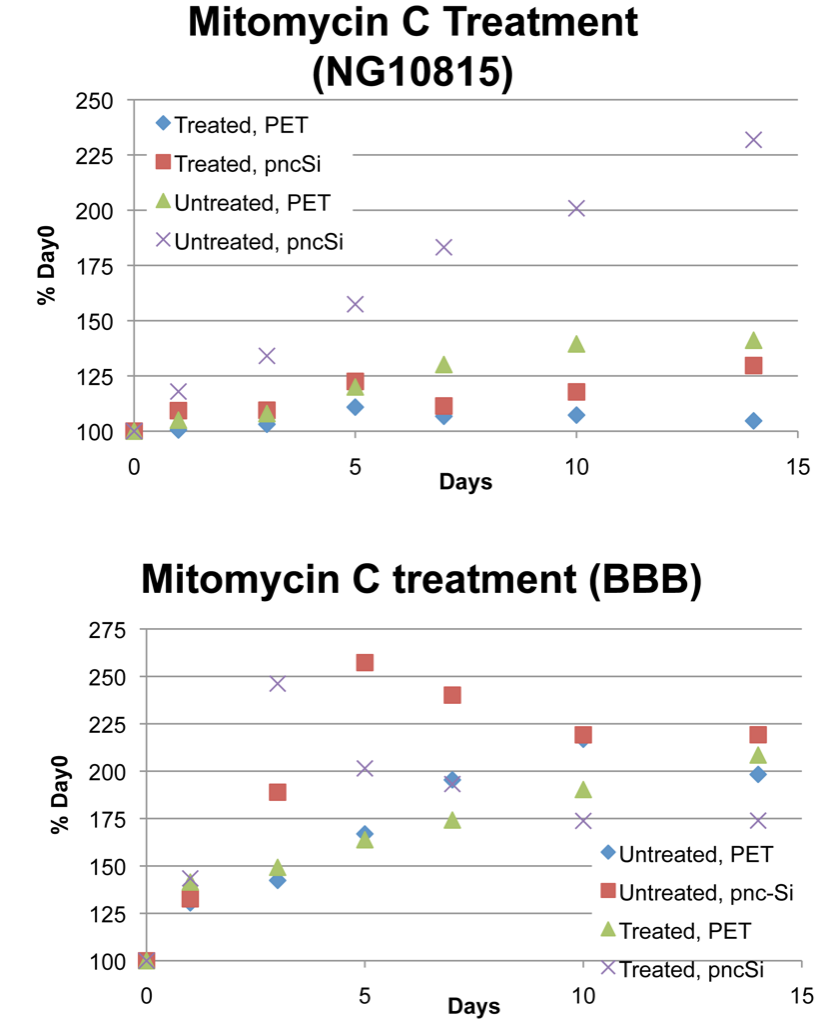
The bottom graph shows results of mitomycin C treatment with BBB co-cultures. Mitomycin C treatment (green triangles) of the BBB on PET slightly decreased the TEER compared to untreated controls (blue diamonds). Since the effects of glial proliferation are less pronounced on PET, the BBB TEER was only slightly altered. On pnc-Si, the TEER trend for treated and untreated samples was the same – a rapid increase to a transient spike. However, mitomycin C treatment (purple x’s) shifted the TEER spike to an earlier time point compared to untreated samples (red squares). Since mitomycin C slowed proliferation of glia monocultures (top graph) and media acidification, I expected the BBB TEER to spike to a later time point with mitomycin C. So, this result is confusing. The TEER of mitomycin C-treated BBB samples on pnc-Si is dominated by the bEnd3 monolayer since NG10815 TEER is significantly decreased. Even though NG10815 growth is inhibited, the bEnd3 cells only showed enhanced barrier function for a couple of days. There is something about this co-culture that the bEnd3 cells can’t tolerate after a few days (i.e., NG10815 media components, NG10815 secreted proteins).
To show the inhibition of NG10815 proliferation by mitomycin C, I imaged (20X Nikon) PET and pnc-Si transwells after 3 and 10 days of culture:
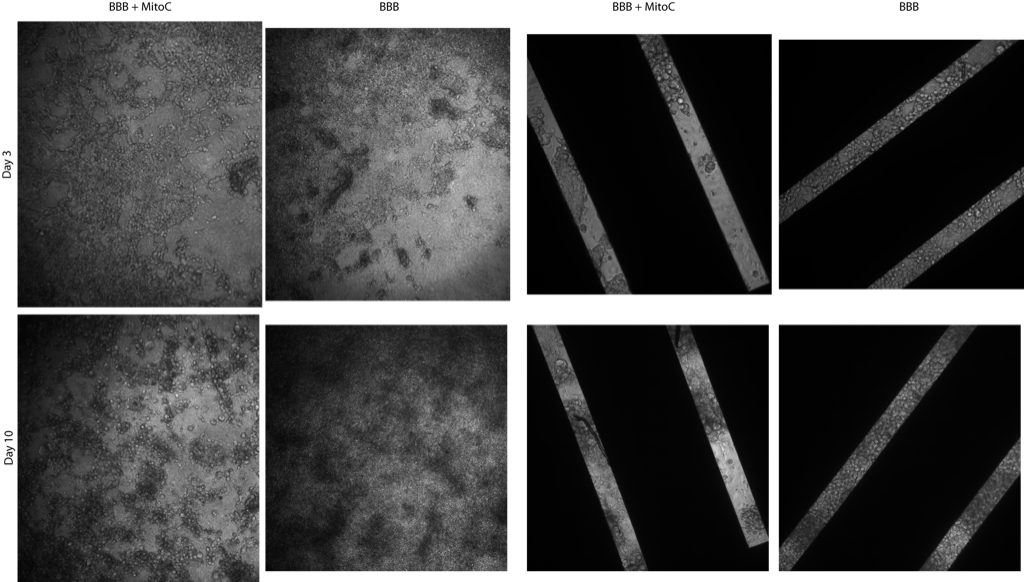
The left 2 columns are PET transwells, and the right 2 columns are pnc-Si transwells. Samples were either normal BBB co-cultures (‘BBB’) or BBB co-cultures (‘BBB+MitoC’) in which the NG10815 cells were treated with mitomycin C. On PET, NG10815 cell density did not increase significantly from Day3 to Day10 with mitomycin C treatment, but it did for the untreated BBB sample. On pnc-Si, NG10815 cell density increased only slightly with mitomycin C treatment but glial cells completely covered pnc-Si wells in the untreated sample. Therefore, NG10815 proliferation is significantly, but not completely, inhibited by 10 ug/mL mitomycin C.
Its possible that mitoC itself is negatively impacting the health of the bEnd monolayer. We don’t have that control.
I treated the glial cells in a T-25 with mitomycin C, disposed of the mitoC media and then split those cells from the flasks to the transwells. I think that very little mitomycin C would make it through these wash steps to affect the bEnd3.
Got it. Well I’m out of ideas then.