Gold filtration with alumina coated pnc-Si
With some of the recent high porosity membranes being produced, I wanted to demonstrate that we can use ALD to create a movable cut-off without sacrificing too much in permeability. I took sc713 and coated it with 5 nm and 10 nm of Al2O3 i.e. I shrank the pore diameter by 5 and 10 nm. An oxygen plasma treatment was performed before experiments to ensure wetting of the pores. Here is a TEM micrograph and histogram of the membrane I used:
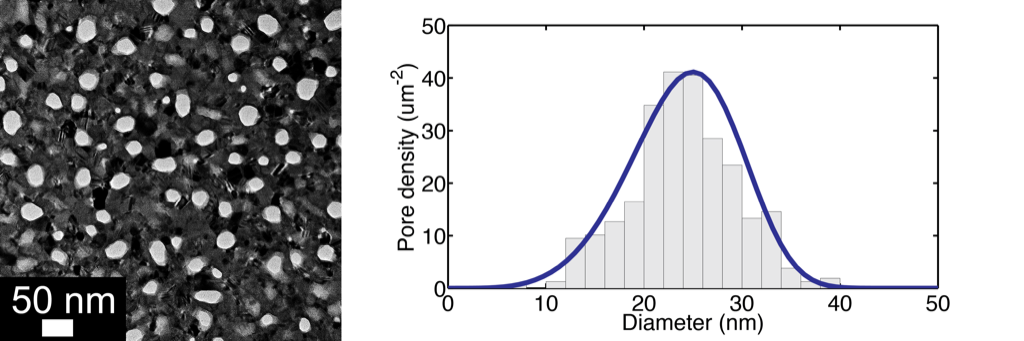
The average diameter was 24 nm and the porosity 12%. After ALD I expect the histogram to shift by 5 and 10 nm .
Before running the gold through, I measured the hydraulic permeability of the membranes and compared it to theoretical predictions. This is a rough estimate as I did not measure the exact dimensions of the active area. Units are mL/min-cm2-bar
| actual | theory | |
| untreated | 52.9 | 52.8 |
| 5 nm Al2O3 | 23.2 | 22 |
| 10 nm Al2O3 | 3.9 | 7.8 |
The untreated and 5 nm coated membrane seem to follow theory, while the 10 nm coated sample falls a bit short. This could just be large experimental error since the lower porosity samples needed to be run longer so things like evaporation have a larger effect. A more detailed study on the permeability of lower porosity membranes will need to be performed.
Here is the raw absorbance data taken on the Tecan.

The data has been adjusted using a “blank” of water. The top plot shows 15 nm Au passing through the untreated membrane. The middle plot shows filtration through a membrane coated with 5 nm of alumina. 15 nm Au is held back while 10 nm Au can pass through. The bottom plot shows a membrane coated with 10 nm of alumina and shows that 15 and 10 nm Au is retained but passes 5 nm Au.
The sieving coefficients are:
untreated: 0.82 (15 nm Au)
5 nm alumina: 0.14 (15 nm Au) / 0.51 (10 nm Au)
10 nm alumina: 0.03 n.d. (15 nm Au) / 0.05 n.d. (10 nm Au) / 0.64 (5 nm Au)
The cutoff for the alumina coated membranes is not particularly sharp, so in my next experiment I will try to coat with 2 nm and 7 nm. Charge interactions may also affect the filtration performance as Al2O3 has a different zeta potential than SiO2.
I also tried to do a “quick” verification of the Au nanoparticle size on the SEM. After two hours I found one particle! The 15 nm stock measures ~ 14.6 nm from this n=1. Next time I won’t dilute as much…

I snapped a couple of nice SEMs of the pnc-Si along the way, too.
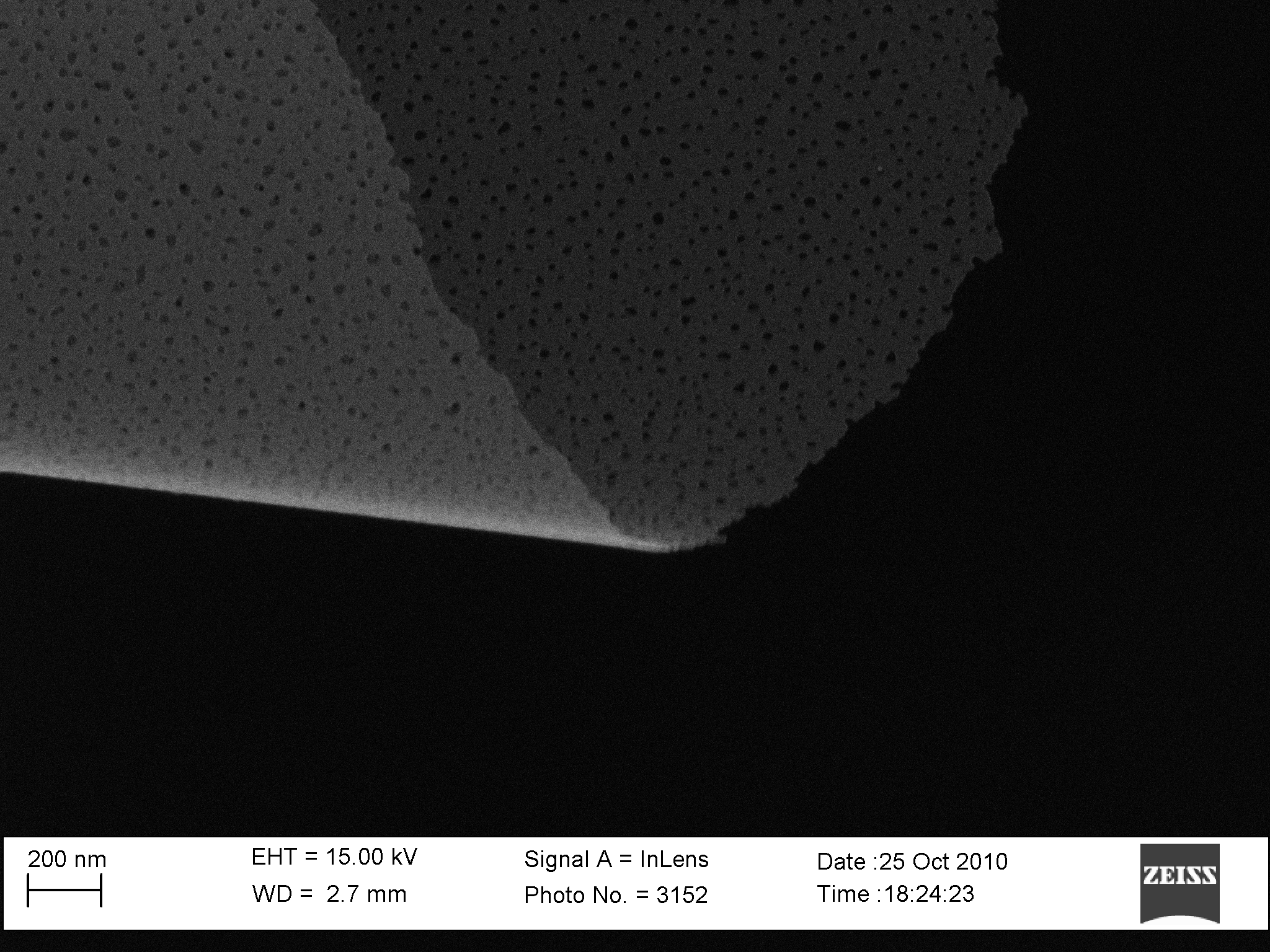
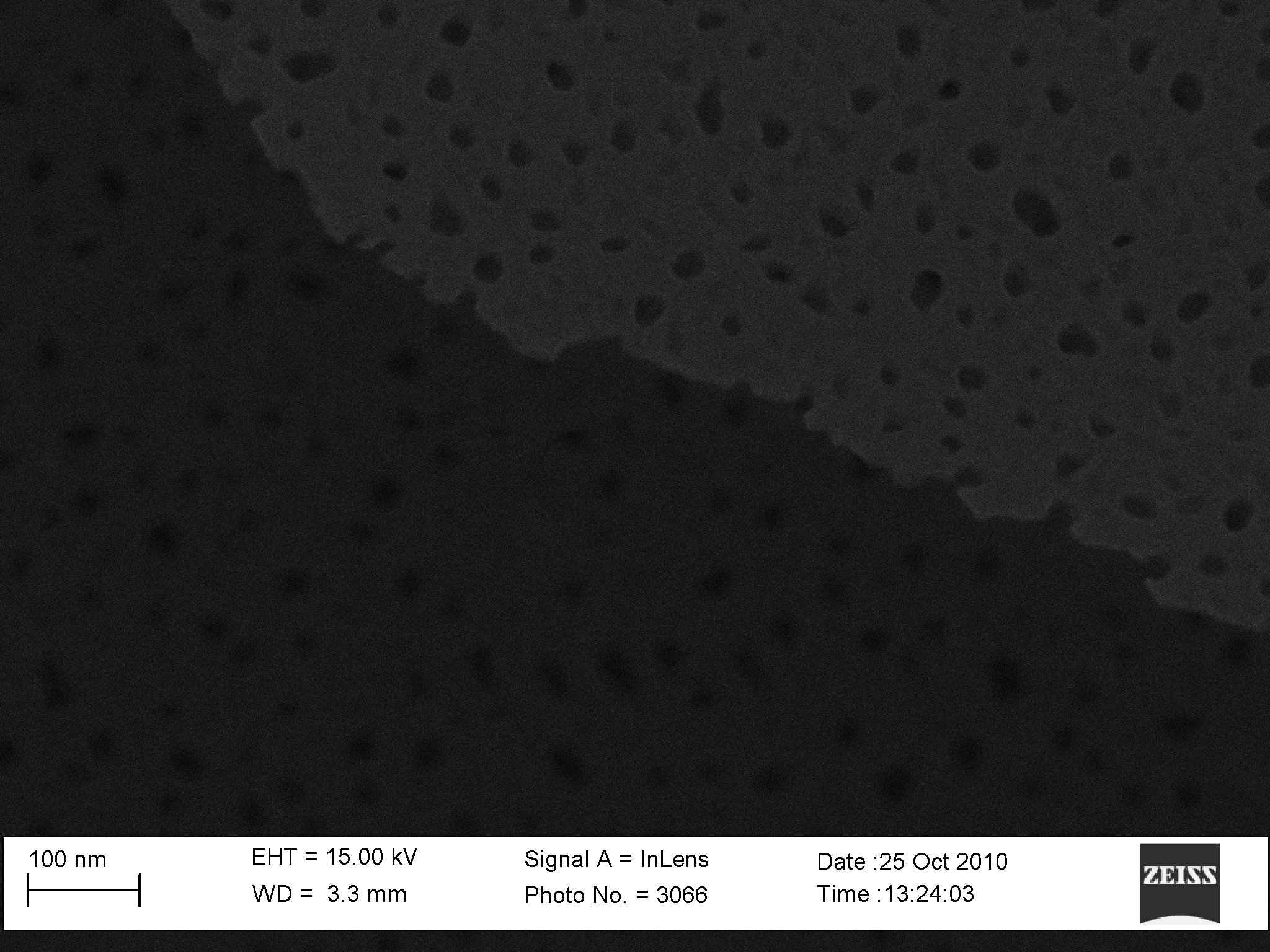
This data looks very nice and seems consistent with our earlier work.
How much did the flow rate drop with the thickening of the alumina? It seems like the porosity probably dropped considerably. How does it compare to native small-pore flow rates?