SiMPore's Collaboration with Vaccinex
Vaccinex has developed an antibody, VX15/2503, for Semaphorin 4D, a molecule implicated in axonal guidance mediation and blood brain barrier (BBB) disruption. The role of SiMPore in its partnership with Vaccinex is to produce a workable model of the BBB, with the ability to introduce flow conditions and measure an electric gradient across the membrane. Before I get into the specifics of the project, I think it’s appropriate to briefly review both the BBB and how antigens and antibodies work.
Blood Brain Barrier
The blood brain barrier can essentially be thought of as a membrane that filters molecules in the blood prior to entering the brain; this ensures that the brain is exposed to the least amount of toxins. Endothelial cells in the capillaries form tight junctions, which act as selectors for what can pass into the brain. Small, hydrophobic molecules generally pass through (CO2, O2, amino acids, glucose), while hydrophilic or larger molecules (drugs) do not. These endothelial cells are surrounded by the end feet of astrocytes, a type of glial cell, which support the neurons in the brain. The astrocytes will uptake molecules that pass through the tight junctions and use them to “feed” the neurons. Disruption of the BBB is mediated partly by inflammation, causing endothelial cells to swell, increasing the width of the tight junctions, and thus increasing the permeability of solutes across the barrier.

Image from: http://www.jaymun.com/research/blood-brain-barrier.shtml
Antigens and Antibodies
Antigens are substances which elicit an immune response in the body, while antibodies are produced to target the specific antigen that initiated the immune response. When an antibody binds to an antigen, it prevents the antigen from functioning via four mechanims: (1) agglutination – antibodies clump antigens together; (2) precipitation –antigen-antibody complex becomes insoluble; (3) neutralization –antibody covers the active sites on the antigen; and (4) lysis – antibody attacks and destroys the antigen.
Source: Temenoff, JS, & Mikos, AB. (2009). Biomaterials: The intersection of biology and materials science. Prentice Hall.

Image from: http://www.whfoods.com/genpage.php?pfriendly=1&tname=faq&dbid=30
The Specifics
Sema4D has two endothelial cell receptors, CD72 and Plexin B1. CD72 is a low affinity (300 nM) receptor and Plexin B1 is a high affinity (1 nM) receptor, with high localization at cell-cell junctions. Important to the focus on the BBB, Semaphorin 4D (Sema4D) has been previously shown in in vitro systems to decrease the effectiveness of the BBB. When expressed in HEK293 cells containing Plexin B1, it has induced cytoskeletal collapse, presumably negatively affecting the tight junctions in the endothelial cells. In addition, Sema4D is highly expressed in tumor cells; since tumor cells require a large supply of blood to proliferate, it could be assumed that this is another avenue of Sema4D function. VX15/2503 targets and binds to Sema4D, preventing Sema4D from binding to Plexin B1. As a result, cytoskeletal collapse is mitigated and the tight junctions function as expected. While these results can be seen in vitro, static conditions reduce Sema4D activity, and thus flow conditions are needed.
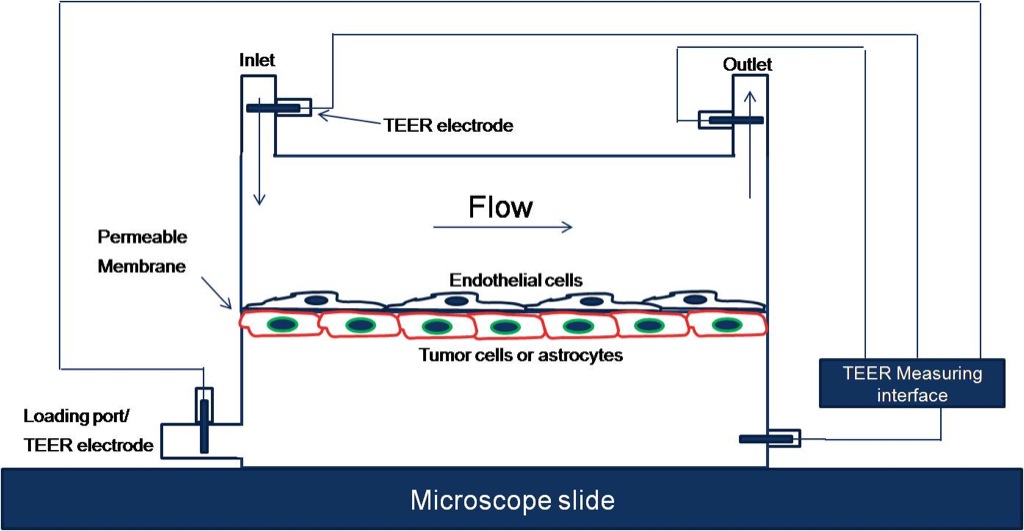
The role of SiMPore is to produce a microporous membrane (approximately 1 um pores) that would allow endothelial cells to be cultured on one side and astrocyte cells to be cultured on the other side, mimicking the blood brain barrier. The larger pore size would also permit exposure of Sema4D and VX15 to both cell types. Smaller pore sizes (< 50 nm) could be developed to study individual cell types and larger pore sizes (> 3 um) could be used to monitor cell migration. Laminar flow conditions would be introduced to the apical well via an external pump, with a flow rate of 10 dynes/cm2, and electrodes would be attached to the apical and basal wells to measure the increase in TEER (transepithelial electric resistance), indicating confluence of the cells. Below is a mock-up by Vaccinex of the proposed device.
My goals for the rotation project, assuming approximately four weeks are left, are to co-culture HUVECs and astrocyte cells on the CytoVu and assess their viability using a live/dead assay, in both in vitro and in vivo conditions.