HUVEC spreading on pncSi and glass
Following time lapse movies show the spreading of HUVECs on pncSi and glass ( @ 37C, in L15 media supplemented with 10% FBS) over a time period of ~4 hrs.
Following time lapse movies show the spreading of HUVECs on pncSi and glass ( @ 37C, in L15 media supplemented with 10% FBS) over a time period of ~4 hrs.
I have been using ITO electrodes deposited on PTFE sheets for my TEER measurements. A 100 nm thin ITO is deposited on ~300 micron PTFE sheets, and have a sheet resistivity of 60 ohms/sq. This sheet is commercially available from Sigma; so the electrode properties are consistent within the experiments. Although ITO has a huge…
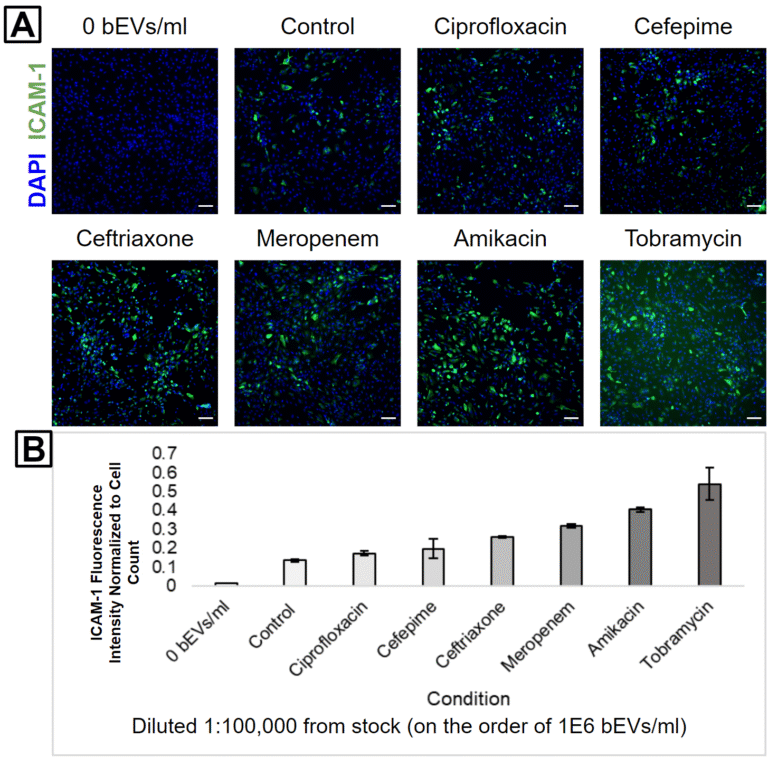
Introduction In prior work by Panteha Torabian and the Michel Lab (RIT’s College of Science), we have seen that treatment of E. coli with different antibiotics can result in changes in the production of bacterial extracellular vesicles (bEVs). In the context of sepsis, this is important because clinicians tend to treat patients with a broad…
The thickness of bottom oxide in the ‘sandwich structure’ is also a key factor to affect the pore morphology. In last few weeks I deposited five wafers with different bottom oxide thicknesses and they were 05/15/20, 10/15/20, 20/15/20, 40/15/20 and 100/15/20. Then I annealed them at 1000C for 1 minute with a 100C/s ramp rate….
UPDATE: Some data presented here is out of date. For up-to-date data, see my next post here. — Lately I’ve been performing comparison experiments between our NPN membranes (wafer 1132, 3 slot SEPCON, 40-48nm pores and 13-20% porosity) and commercial cellulose triacetate filtration membranes, with respect to the degree to which they hinder the diffusion…
The Bernhard group wants to use our membranes to separate pieces of DNA. During their experiments they noticed that some of their samples caused discoloration over the summer. Since then, I’ve been helping a new student to the project, Paul Black. He first started by testing pH, and found that higher pH leads to fast…
I went over to RIT to work with JP on measuring the deflection of NPN and pnc-Si membranes as a function of pressure. JP and Dave Fang did this work years ago, and we want to pick it up again to correlate with Sarah’s burst pressure data. We used the Veeco Wyko (white light interferometer)…
Comments are closed.
Looks great.
So we have fibroblasts on glass and HUVEC on pnc-Si. I guess we have a couple more to go?
Make sure you can submit your to the publisher at the same play rate and same duration to make the point that pncSi = glass when it comes to cell spreading.
Yes, I am left with HUVEC on glass and fibroblast on pncSi. I tried fibroblast on pncSi, but it doesn’t look great as the seeding density was high.
I got that point and will make sure the movies are ready for submission.