High salt concentrations (~50mM) shouldn't be used to tune effective pore sizes for gold colloid separations
What we’d like to have accompany the Sepcon filters is a general way to tune the pore sizes for any given separation. If, for instance, someone wanted to have a filter cutoff of 12nm, we could create a custom wafer with a mean pore size of roughly 17nm. But it would be much easier (and much cheaper) to instead use the existing 15nm sepcons and add some small amount of salt, so that the electrostatic repulsion around the lip of the pores is shielded and the effective pore size increases.
In this batch of experiments, we examined how 0mM, 50mM and 100mM NaCl concentrations affected the ability of 10nm gold colloids to pass through the 20nm cutoff pnc-si sepcon filters.
First, we looked how the membranes behaved over the course of a sequence of separations. We charted both the concentration of gold in the filtrate and the volume of water passed in three 20nm cutoff membranes.We do see clumping in the DLS scans of the three solutions: 0mM 10nm gold has its size graph peak at 8.95nm, 50mM peaks at 21.8nm, and 100mM peaks at 590nm. It seems that 0mM gold passes through without clogging at all, while at 50mM the clumps are nearly the size of the pore and get stuck more easily, whereas in 100mM the clumps are so big that it takes several passes for them to stick securely in a pore.
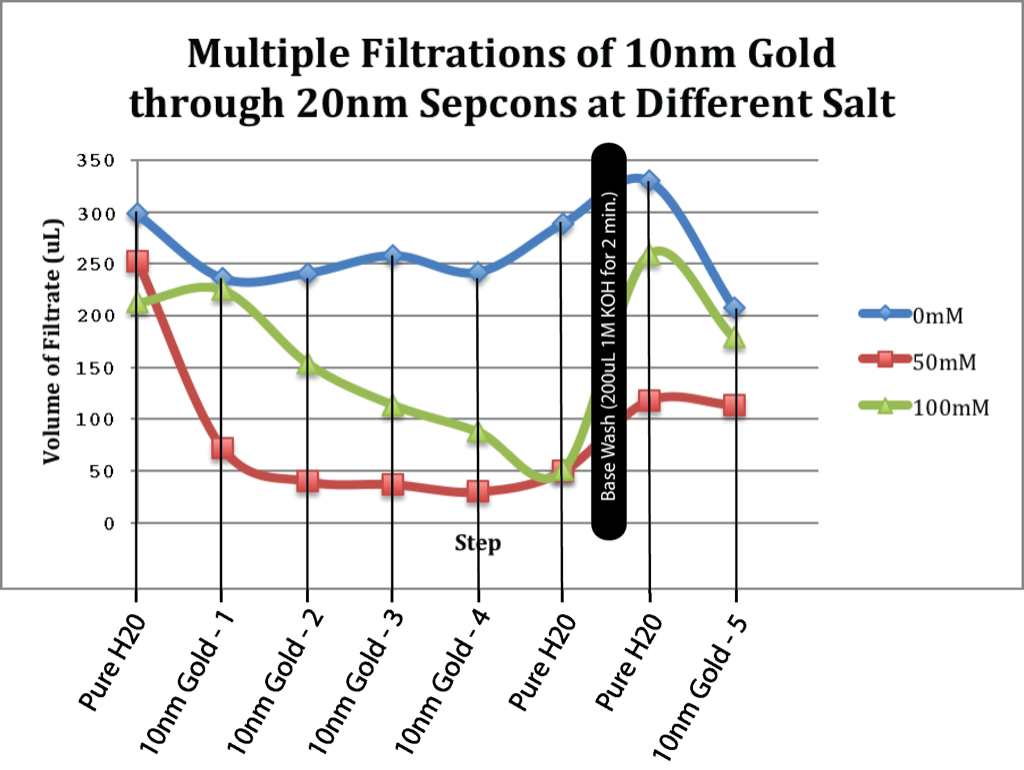
We measured the concentration of the 10nm gold in the filtrate relative to the feed for both 0mM and 50mM at each of the five gold separations:
| Percentages: | ||
| separation # | 0mM | 50mM |
| 1 | 42% | 0% |
| 2 | 39% | -0.01% |
| 3 | 52% | 0.01% |
| 4 | 45% | -0.11% |
| 5 | 74% | 0.15% |
So none of the gold suspended in the 50mM salt is passing through the filter, and when there is no salt the concentration passed stays in the ~45% range. Note that separation 5 has a higher gold concentration in both salts – although the 50mM result may just be noise, there could also be something interesting going on with the breakdown of the membrane due to the base wash, which occurs between separations 4 and 5 and should etch the membrane somewhat.
The take home message from all of this is that if salt is going to be used to tune pore sizes, concentrations smaller than 50mM are best so that clumping does not occur. Also, it is interesting that clogging happens much faster with particles close to the size of the holes as opposed to particles much larger than the pores.